

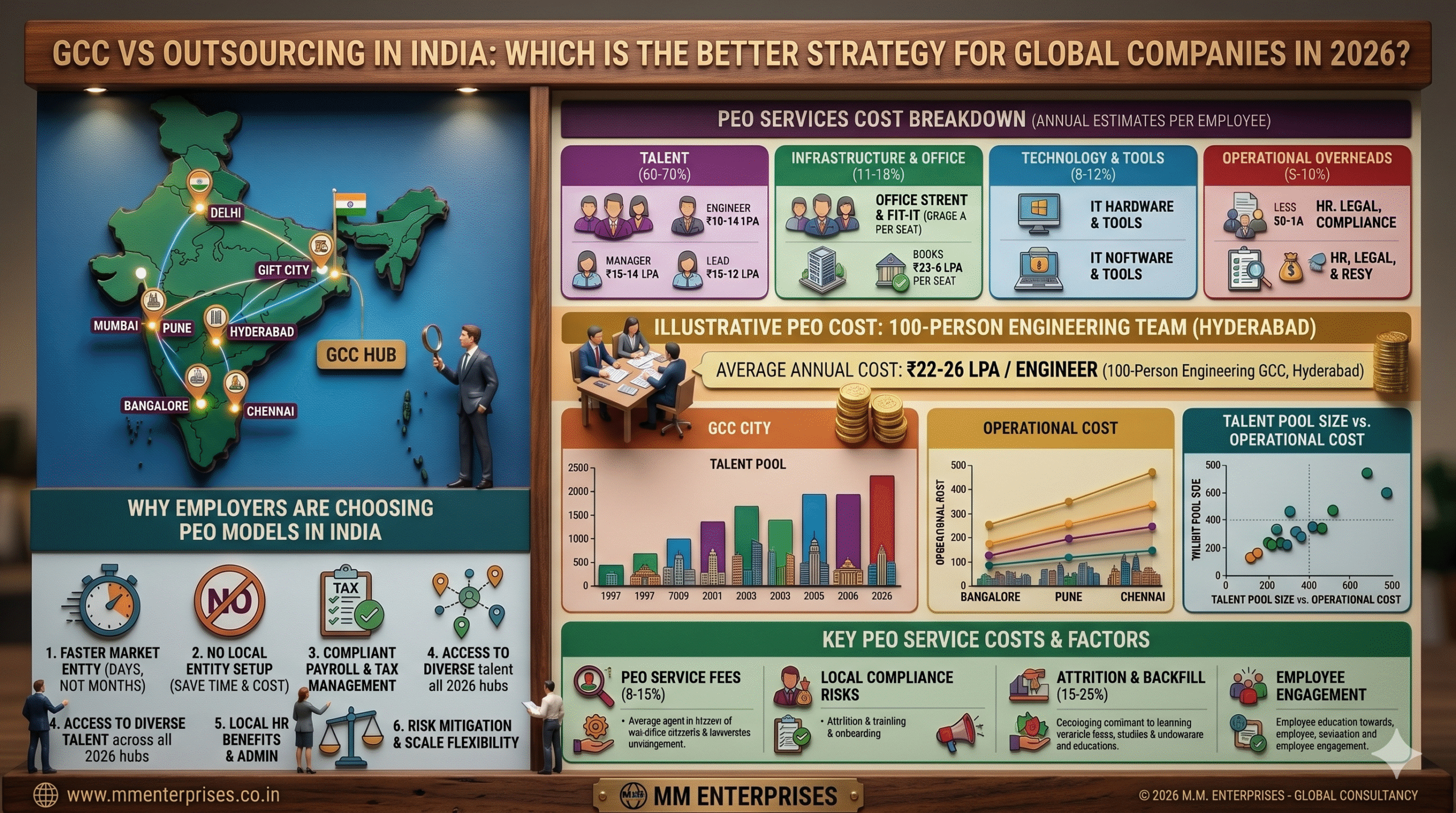
GCC vs Outsourcing in India: Which Is the Better Strategy for Global Companies in 2026?
India Is the Global Hub for Talent, Innovation, and Business Expansion
As global companies look to accelerate growth, reduce operational costs, access specialized talent, and scale faster, India continues to emerge as one of the world’s most attractive destinations.
From technology and engineering to finance, analytics, customer support, and artificial intelligence, organizations across the United States, United Kingdom, Europe, Singapore, Australia, and the Middle East are increasingly building teams in India.
However, one strategic question continues to dominate boardroom discussions:
Should we build a Global Capability Center (GCC) in India, or should we outsource to a third-party service provider?
Both models offer distinct advantages.
Both can help organizations access India’s exceptional talent pool.
But the right choice depends on your business objectives, growth plans, budget, control requirements, and long-term strategy.
This guide explores the differences between GCCs and outsourcing, helping global business leaders make informed workforce and expansion decisions in 2026.
Understanding the GCC Model
A Global Capability Center (GCC) is a dedicated center established by a multinational company to perform business-critical functions from India.
Unlike outsourcing, a GCC is owned and controlled by the parent organization.
Employees work exclusively for the company.
Processes, technology, culture, and intellectual property remain under direct organizational control.
Today’s GCCs support:
- Software Engineering
- Product Development
- Artificial Intelligence
- Data Analytics
- Cloud Operations
- Cybersecurity
- Finance & Accounting
- Shared Services
- Procurement
- HR Operations
- Customer Experience
Modern GCCs are no longer back-office operations.
Many now drive innovation and strategic decision-making.
Understanding the Outsourcing Model
Outsourcing involves partnering with an external service provider that delivers specific business functions on behalf of the client.
The provider manages:
- Recruitment
- Infrastructure
- Operations
- Workforce Management
- Administrative Functions
Organizations typically outsource:
- Software Development
- Customer Support
- IT Services
- Business Process Operations
- Finance Processes
- Technical Support
- Back-Office Functions
The service provider is responsible for staffing, delivery, and management.
The client receives services without directly employing the workforce.
Why India Remains the Preferred Destination for Both GCCs and Outsourcing
Before comparing Global Capability Centers (GCCs) and outsourcing, it’s essential to understand why India continues to be the first choice for multinational corporations expanding their global workforce. Over the past two decades, India has evolved from being a cost-saving destination into a strategic hub for innovation, digital transformation, research and development, engineering, and business operations.
Today, thousands of global organizations—including Fortune 500 companies, technology giants, financial institutions, healthcare providers, manufacturing leaders, and high-growth startups—depend on India to build and manage critical business functions. Whether establishing a dedicated Global Capability Center (GCC) or partnering with an outsourcing provider, organizations consistently choose India because of its unique combination of talent, scalability, infrastructure, and business-friendly ecosystem.
Exceptional Talent Availability
India possesses one of the world’s largest and most diverse professional talent pools. Every year, millions of graduates enter the workforce, including engineers, software developers, finance professionals, data analysts, business managers, legal experts, healthcare specialists, and digital marketing professionals.
Organizations can recruit talent across virtually every business function, including:
- Software Engineering
- Artificial Intelligence (AI)
- Machine Learning
- Data Science
- Cybersecurity
- Cloud Computing
- DevOps
- Product Development
- Finance & Accounting
- Human Resources
- Customer Support
- Supply Chain Management
- Legal and Compliance
- Research & Development
- Engineering Design
- Digital Marketing
- Sales Operations
India is also home to a rapidly growing ecosystem of professionals with expertise in emerging technologies such as Generative AI, blockchain, robotic process automation (RPA), Internet of Things (IoT), quantum computing research, and advanced analytics.
This broad availability of skilled professionals enables companies to build both highly specialized teams and large-scale operational workforces with relative ease.
Cost Efficiency Without Compromising Quality
One of India’s biggest advantages is its ability to deliver exceptional value. While labor costs remain significantly lower than those in North America, Western Europe, Australia, and many parts of East Asia, the quality of talent has steadily improved.
Organizations benefit from:
- Lower recruitment costs
- Competitive employee salaries
- Reduced operational expenses
- Affordable office infrastructure
- Lower technology support costs
- Cost-effective administrative services
Rather than simply reducing expenses, companies can redirect savings toward innovation, product development, expansion into new markets, employee training, and digital transformation initiatives.
This balance between affordability and quality continues to make India one of the most attractive global business destinations.
Unmatched Scalability
Business needs change rapidly, especially in industries driven by technology and digital transformation. India provides companies with the flexibility to scale operations up or down depending on market demand.
Whether an organization needs:
- 10 software engineers,
- 100 finance professionals,
- 500 customer support executives,
- or an entire engineering center,
India offers recruitment capacity that few countries can match.
Large metropolitan cities and emerging technology hubs provide access to deep talent pools, enabling businesses to expand operations much faster than in many developed markets where skilled professionals are often in short supply.
This scalability is particularly valuable for:
- Fast-growing startups
- Multinational corporations
- Global Capability Centers
- Business Process Outsourcing (BPO)
- IT Services
- Product Development Companies
- Engineering Organizations
Thriving Innovation Ecosystem
India is no longer viewed solely as a back-office destination. It has become one of the world’s leading centers for innovation, digital engineering, and technology development.
Many multinational companies now use their Indian operations to lead:
- Artificial Intelligence development
- Product engineering
- Software architecture
- Cloud transformation
- Cybersecurity initiatives
- Digital product innovation
- Research & Development
- Automation programs
- Advanced analytics
India also boasts one of the world’s largest startup ecosystems, fostering collaboration between enterprises, universities, incubators, venture capital firms, and technology innovators.
This environment encourages continuous learning, experimentation, and rapid adoption of new technologies, making India an ideal location for organizations seeking long-term innovation capabilities.
Mature Business Infrastructure
India has invested significantly in modern business infrastructure over the last decade, making it easier for international companies to establish and manage operations.
Organizations benefit from:
- Grade A commercial office spaces
- World-class technology parks
- High-speed internet connectivity
- Reliable telecommunications infrastructure
- International airports with strong global connectivity
- Expanding metro rail networks
- Modern residential developments for professionals
- Robust banking and financial systems
Major business cities such as Bengaluru, Hyderabad, Pune, Chennai, Gurugram, Noida, Mumbai, and Ahmedabad offer well-developed ecosystems designed to support multinational business operations.
These cities provide everything required for building large, high-performing teams.
Strong English Proficiency
English serves as the primary language of business across much of India’s corporate sector. This significantly reduces communication barriers between global headquarters and Indian teams.
Professionals routinely collaborate with stakeholders across:
- United States
- United Kingdom
- Canada
- Australia
- Europe
- Middle East
- Asia-Pacific
High levels of English proficiency improve project management, customer service, software development, documentation, reporting, and cross-border collaboration.
Government Support for Global Business
India’s regulatory environment has become increasingly favorable for foreign investment and international business expansion. Government initiatives have encouraged multinational companies to establish operations by simplifying business processes, improving digital governance, strengthening intellectual property protections, and supporting technology-driven industries.
Programs focused on digital infrastructure, manufacturing, innovation, and skill development continue to enhance India’s attractiveness as a global investment destination.
Time Zone Advantage
India’s time zone enables businesses to operate around the clock by complementing teams in North America, Europe, the Middle East, and Asia-Pacific.
This allows organizations to:
- Provide 24/7 customer support
- Accelerate software development cycles
- Reduce project turnaround times
- Improve global service delivery
- Enable continuous business operations
The ability to maintain “follow-the-sun” operations is particularly valuable for multinational enterprises managing distributed global teams.
Extensive Experience Serving Global Enterprises
India has decades of experience supporting multinational corporations across industries such as:
- Information Technology
- Banking and Financial Services
- Healthcare
- Pharmaceuticals
- Manufacturing
- Automotive
- Retail
- E-commerce
- Telecommunications
- Energy
- Logistics
- Professional Services
This maturity means companies entering India benefit from experienced service providers, established recruitment networks, skilled managers, proven operational processes, and a workforce familiar with international quality standards and global business practices.
GCC vs Outsourcing: The Core Difference
At a fundamental level:
GCC
You build and manage your own team.
Outsourcing
A third-party provider builds and manages the team for you.
This distinction influences everything from cost and control to scalability and innovation.
Comparison #1: Control
Control is often the biggest factor influencing expansion decisions.
GCC Advantage
With a GCC, the organization maintains direct control over:
- Hiring decisions
- Employee development
- Work processes
- Technology systems
- Performance management
- Organizational culture
The workforce becomes a direct extension of the company.
This enables stronger alignment with long-term business goals.
For organizations handling sensitive intellectual property or strategic projects, control can be critical.
Outsourcing Advantage
Outsourcing reduces management responsibility.
The provider oversees:
- Staffing
- Workforce administration
- Operational management
This allows leadership teams to focus on core business objectives.
However, companies typically have less day-to-day influence over operations.
Winner: GCC
When control is a priority.
Comparison #2: Cost
Cost remains one of the most important factors for global employers.
GCC Costs
Building a GCC requires investment in:
- Entity setup
- Recruitment
- Office infrastructure
- Payroll
- Compliance
- Technology systems
- Employee benefits
Initial investments can be significant.
However, long-term operating costs often become more efficient as the center scales.
Outsourcing Costs
Outsourcing requires minimal upfront investment.
Companies typically pay:
- Service fees
- Project fees
- Resource-based pricing
There is no need to establish infrastructure or hire administrative teams.
This creates faster cost predictability.
However, over time, provider margins can increase total costs compared to a mature GCC operation.
Winner:
Short-Term: Outsourcing
Long-Term: GCC
Comparison #3: Speed to Launch
Organizations entering India often need rapid workforce deployment.
GCC
Building a GCC typically involves:
- Business planning
- Legal setup
- Infrastructure development
- Recruitment
Timelines can range from several months to over a year.
Outsourcing
A service provider already has:
- Infrastructure
- Recruitment capabilities
- Management systems
- Operational processes
As a result, outsourcing can begin almost immediately.
Winner: Outsourcing
For rapid market entry.
Comparison #4: Talent Acquisition
Talent is the foundation of every successful expansion strategy.
GCC
Companies directly recruit employees.
Benefits include:
- Employer brand development
- Direct employee engagement
- Long-term retention strategies
The organization owns the entire talent experience.
Outsourcing
The provider handles recruitment and staffing.
This reduces internal effort but limits direct influence over talent acquisition decisions.
Winner: GCC
For strategic workforce building.
Comparison #5: Scalability
Growth often determines the success of global expansion initiatives.
GCC
Scaling a GCC requires:
- Additional recruitment
- Expanded office capacity
- Increased management oversight
Growth can be highly successful but requires planning.
Outsourcing
Providers often have ready access to large talent pools and infrastructure.
This enables faster scaling during periods of rapid growth.
Winner: Outsourcing
For immediate scalability.
Comparison #6: Intellectual Property Protection
For technology companies, intellectual property protection is often a major concern.
GCC
Employees work directly for the organization.
Processes remain internal.
Technology environments remain company-controlled.
This provides stronger oversight.
Outsourcing
Although reputable providers maintain strong security standards, work occurs within an external environment.
Some organizations perceive this as additional risk.
Winner: GCC
For IP-sensitive operations.
Comparison #7: Innovation Capability
The role of India has evolved dramatically.
Companies increasingly use India for innovation rather than just execution.
GCC
Modern GCCs drive:
- AI Development
- Product Engineering
- R&D Initiatives
- Data Science Programs
- Digital Transformation
Many global innovation teams now operate from India.
Outsourcing
Outsourcing providers can deliver innovation services.
However, innovation often becomes more powerful when integrated directly into the company’s culture and objectives.
Winner: GCC
For long-term innovation leadership.
GCC vs Outsourcing: Cost Example
Let’s consider a technology company planning to build a 50-person engineering team.
GCC Model
Estimated Annual Cost:
₹12 crore – ₹25 crore
Includes:
- Salaries
- Benefits
- Infrastructure
- Compliance
- Technology
Outsourcing Model
Estimated Annual Cost:
Provider-dependent pricing
Includes:
- Talent
- Management
- Infrastructure
- Operational support
Lower initial investment.
Potentially higher cumulative cost over several years.
When GCC Is the Better Choice
A GCC is often the preferred option when:
✓ India is a long-term strategic market
✓ Intellectual property protection is critical
✓ Product development is a core function
✓ Innovation is a business priority
✓ Workforce scale will exceed 50–100 employees
✓ Leadership wants direct control
Organizations building long-term global operations frequently choose the GCC model.
When Outsourcing Is the Better Choice
Outsourcing is often ideal when:
✓ Speed is essential
✓ Hiring demand is uncertain
✓ The company wants minimal operational complexity
✓ Market entry risk must be reduced
✓ Specialized projects require immediate support
✓ Internal management resources are limited
For first-time expansion initiatives, outsourcing can be a highly effective starting point.
The Emerging Third Option: GCC + Recruitment Partner
Increasingly, organizations combine GCC ownership with specialist recruitment support.
This hybrid approach allows companies to:
- Maintain operational control
- Accelerate hiring
- Access local talent expertise
- Reduce recruitment bottlenecks
Many successful multinational companies use recruitment partners to build and scale GCC teams in India.
This model delivers the advantages of GCC ownership while reducing hiring challenges.
Common Mistakes Companies Make
Choosing GCC Too Early
Some companies establish GCCs before validating market demand.
Outsourcing Strategic Functions
Core innovation activities may suffer when outsourced entirely.
Underestimating Talent Competition
India offers exceptional talent, but competition remains intense.
Ignoring Long-Term Costs
Short-term savings should not drive strategic decisions.
Lack of Workforce Planning
Successful expansion requires clear talent acquisition strategies.
Future Trends Shaping GCCs and Outsourcing
Several trends are influencing workforce decisions in 2026.
Artificial Intelligence
AI talent demand continues to rise.
Global Capability Centers
GCC expansion remains strong.
Hybrid Workforce Models
Companies increasingly combine in-house and outsourced teams.
Digital Transformation
Organizations continue investing heavily in India-based technology capabilities.
Specialized Talent Acquisition
Access to niche skills is becoming a competitive advantage.
Which Model Is Right for Your Business?
There is no one-size-fits-all answer when choosing between a Global Capability Center (GCC) and outsourcing. Both models have proven successful for global organizations, but the right decision depends on your company’s growth stage, strategic objectives, operational requirements, and long-term vision.
Rather than asking which model is “better,” businesses should ask which model best aligns with their current priorities and future expansion plans. A thoughtful evaluation of several key factors can help determine the most suitable approach.
1. Business Goals
Your organization’s core objectives should be the primary driver of your decision.
If your focus is on building proprietary capabilities, developing intellectual property, strengthening innovation, and creating a long-term competitive advantage, establishing a GCC may be the ideal choice. A GCC enables companies to develop dedicated teams that work exclusively on business-critical functions while maintaining full alignment with the organization’s culture, processes, and strategic direction.
On the other hand, if your goal is to quickly access skilled talent, improve operational efficiency, reduce costs, or outsource non-core functions, partnering with an outsourcing provider may offer a faster and more practical solution.
Clearly defining what success looks like for your business is the first step toward selecting the right operating model.
2. Expansion Plans
Your long-term plans for growth play a significant role in determining the most appropriate model.
Organizations planning substantial expansion in India—such as building large engineering teams, establishing research and development centers, or creating regional headquarters—often benefit from investing in a GCC. Although establishing a GCC requires more time and resources initially, it creates a scalable foundation for long-term growth and greater operational control.
Conversely, businesses entering India for the first time or testing a new market may prefer outsourcing. This approach allows companies to establish operations quickly without committing significant capital or managing the complexities of setting up and operating a local entity.
As the business grows and gains confidence in the market, it can reassess whether transitioning to a GCC aligns better with its evolving strategy.
3. Hiring Volumes
The size of your workforce also influences the decision.
If your organization expects to hire a small or medium-sized team for specific projects or functions, outsourcing can be highly efficient. Recruitment, onboarding, payroll, compliance, and day-to-day workforce management are typically handled by the service provider, reducing administrative effort and accelerating hiring.
However, companies planning to build large, permanent teams—potentially hundreds or even thousands of employees—may find greater value in establishing a GCC. A dedicated center provides stronger workforce integration, standardized processes, and long-term talent development opportunities.
The larger and more strategic your workforce becomes, the more attractive a GCC may be.
4. Budget and Investment Capacity
Financial considerations extend beyond salary costs.
Setting up a GCC requires significant upfront investment, including legal entity formation, office infrastructure, technology systems, recruitment, compliance, leadership hiring, and operational management. While these investments can deliver substantial long-term value, they may not be suitable for every organization, especially startups or companies with limited expansion budgets.
Outsourcing generally requires a much lower initial investment. Service providers already have the infrastructure, operational expertise, and support functions in place, enabling businesses to launch operations more quickly while avoiding many fixed costs.
Companies should evaluate both short-term affordability and long-term return on investment when comparing the two models.
5. Risk Tolerance
Every international expansion involves some level of operational, legal, and financial risk.
Organizations comfortable managing regulatory compliance, employment laws, tax obligations, and workforce administration may be well-positioned to establish and operate a GCC.
Businesses seeking to minimize these responsibilities often prefer outsourcing. Experienced service providers manage many of the administrative and compliance-related complexities, allowing organizations to focus on their core business while reducing operational risk.
For companies entering unfamiliar markets, outsourcing can serve as a lower-risk entry strategy.
6. Strategic Priorities
Different organizations prioritize different outcomes.
If maintaining complete ownership of talent, intellectual property, technology, and organizational culture is essential, a GCC offers greater control over every aspect of the workforce. This is particularly valuable for businesses where innovation, product development, research, or customer experience directly contribute to competitive advantage.
If flexibility, speed, cost optimization, and operational simplicity are the primary priorities, outsourcing may provide greater value. Organizations can rapidly adjust team sizes, respond to changing market conditions, and access specialized expertise without managing the operational complexities internally.
Ultimately, the best model is the one that supports your organization’s broader strategic vision rather than simply addressing immediate operational needs.
When a GCC Is the Better Choice
A Global Capability Center is generally the right option when your organization wants to:
- Build a long-term presence in India.
- Develop proprietary products, platforms, or technologies.
- Maintain complete control over employees, processes, and intellectual property.
- Create a strong organizational culture and leadership pipeline.
- Invest in innovation, research, and digital transformation.
- Scale a large workforce over several years.
- Establish India as a strategic global operations hub.
Although the initial investment is higher, a well-managed GCC can become a significant driver of innovation, operational excellence, and sustainable business growth.
When Outsourcing Is the Better Choice
Outsourcing is often the preferred solution when your organization needs to:
- Enter the Indian market quickly.
- Hire skilled professionals without establishing a local entity.
- Reduce administrative and compliance burdens.
- Lower upfront investment and operational costs.
- Scale teams up or down based on changing business requirements.
- Access specialized expertise for specific projects or business functions.
- Focus internal resources on strategic initiatives rather than workforce management.
For many businesses, outsourcing provides the speed and flexibility needed to remain competitive in rapidly evolving markets.
A Hybrid Approach: The Best of Both Worlds
For many organizations, the decision is not strictly between a GCC and outsourcing. Increasingly, companies adopt a hybrid approach that combines the strengths of both models.
For example, a business may establish a GCC to oversee core functions such as product engineering, research and development, data science, and strategic operations, while outsourcing non-core activities like customer support, payroll administration, finance processing, IT helpdesk services, or recruitment.
This blended model enables organizations to retain control over mission-critical capabilities while benefiting from the efficiency, scalability, and cost advantages of outsourcing.
The Evolutionary Path: From Outsourcing to GCC
Many successful multinational companies do not begin with a fully established Global Capability Center. Instead, they follow a phased approach that minimizes risk while supporting long-term growth.
A typical progression looks like this:
- Market Entry: Begin by outsourcing specific functions to quickly establish a presence in India with minimal investment.
- Business Validation: Evaluate talent availability, operational performance, and market opportunities while refining expansion plans.
- Team Expansion: Gradually increase headcount as business needs evolve and confidence in the market grows.
- Capability Building: Identify strategic functions that would benefit from greater control, dedicated leadership, and deeper integration.
- GCC Establishment: Transition selected operations into a Global Capability Center, creating a long-term, fully integrated extension of the global organization.
This phased strategy allows businesses to reduce initial risk, gain valuable market insights, and build a strong operational foundation before making larger investments.
Final Thoughts
India remains one of the world’s most attractive destinations for global workforce expansion.
Both GCCs and outsourcing offer compelling advantages.
The decision should not be based solely on cost.
Instead, organizations should evaluate control, scalability, innovation requirements, hiring needs, and long-term business strategy.
The companies that align their workforce model with their growth objectives will be best positioned to compete in the years ahead.
Thinking About Building a GCC or Expanding Operations in India?
MM Enterprises helps global companies evaluate talent availability, recruitment strategies, workforce planning, and GCC expansion opportunities across India.
Explore more:
- MM Enterprises
- Contact Us
Target Keywords: GCC vs Outsourcing India, Global Capability Center India, GCC Setup India, Outsourcing Services India, Offshore Team India, Build GCC in India, GCC Recruitment India, Global Expansion India, India Talent Strategy, GCC Hiring 2026.