

Why Global Construction Companies Are Hiring Quantity Surveyors & MEP Heads Through EOR Solutions in 2026
The global construction industry is entering a new era of transformation.
From smart cities and mega infrastructure projects to renewable energy facilities and industrial automation-driven developments, construction companies worldwide are scaling operations at unprecedented speed in 2026.
But alongside this growth, one major challenge continues to slow down project execution across global markets:
The shortage of experienced construction leadership talent.
Today, EPC companies, infrastructure firms, real estate developers, and global engineering organizations are aggressively hiring:
- Quantity Surveyors
- MEP Heads
- Construction Engineers
- Project Control Specialists
- Smart Infrastructure Experts
At the same time, businesses are also rethinking how they hire internationally.
Traditional hiring models are becoming increasingly difficult due to:
- Compliance complexity
- International payroll challenges
- Multi-country workforce regulations
- Delayed onboarding
- Project-based workforce demands
This is why Employer of Record (EOR) solutions are rapidly becoming one of the most preferred workforce expansion strategies for construction companies worldwide.
For founders, CFOs, CHROs, EPC leaders, and infrastructure decision-makers, the question in 2026 is no longer:
“Where can we find construction talent?”
The real question is:
“How can we scale specialized construction teams globally without operational complexity?”
That is where workforce partners like MM Enterprises are helping organizations simplify global construction hiring through recruitment and Employer of Record (EOR) solutions.
Global Construction Workforce Shortages Are Increasing
The infrastructure sector is growing faster than the global workforce supply.
Governments and private organizations are investing heavily in:
- Smart infrastructure
- Green energy projects
- Urban transportation
- Industrial facilities
- Commercial real estate
- Data center construction
- Smart manufacturing plants
This expansion is creating enormous demand for highly specialized construction professionals.
However, many companies are struggling to hire experienced talent quickly enough to support project timelines.
Construction workforce shortages are especially visible in:
- Quantity surveying
- MEP leadership
- Project controls
- Commercial construction management
- Infrastructure coordination
As a result, international recruitment has become essential for global construction firms.
Smart Infrastructure Growth Is Reshaping Hiring Strategies
Construction projects today are very different from traditional infrastructure developments.
Modern projects now involve:
- Smart building systems
- AI-supported infrastructure
- Sustainable construction technologies
- Intelligent energy systems
- Industrial automation integration
- Connected building ecosystems
This transformation requires professionals who understand both:
- Traditional construction operations
- Advanced infrastructure technologies
The demand for multidisciplinary construction leadership is rising rapidly.
Why Quantity Surveyors Are in High Demand in 2026
Quantity Surveyors have become some of the most important professionals in modern infrastructure projects.
In today’s competitive construction environment, profitability depends heavily on:
- Cost accuracy
- Commercial planning
- Budget control
- Contract management
- Financial risk reduction
Quantity Surveyors help organizations maintain operational and financial efficiency across complex projects.
Cost Optimization Is Now a Boardroom Priority
For CFOs and infrastructure leaders, cost control has become more critical than ever.
Rising material prices, global supply chain instability, and large-scale project investments have increased financial pressure across the construction sector.
Quantity Surveyors help companies:
- Forecast project costs
- Improve budgeting accuracy
- Reduce commercial risks
- Optimize procurement spending
- Improve contract efficiency
This directly impacts infrastructure profitability.
As global projects become larger and more complex, experienced Quantity Surveyors are becoming increasingly difficult to hire.
Project Budgeting & Commercial Management
Modern infrastructure projects involve multiple stakeholders, vendors, contractors, and suppliers.
Quantity Surveyors play a vital role in:
- Tender management
- Contract administration
- Cost estimation
- Vendor negotiations
- Financial planning
Their expertise helps construction companies avoid:
- Budget overruns
- Commercial disputes
- Delayed payments
- Procurement inefficiencies
This is why global construction companies are aggressively scaling Quantity Surveyor recruitment in 2026.
Infrastructure Profitability Depends on Commercial Efficiency
In large infrastructure environments, even small budgeting errors can result in major financial losses.
Quantity Surveyors help companies maintain:
- Financial visibility
- Cost discipline
- Commercial accountability
- Project profitability
This has elevated Quantity Surveyors from operational support roles to strategic business-critical positions.
Why MEP Heads Are Critical in Modern Infrastructure Projects
MEP (Mechanical, Electrical, and Plumbing) systems are now central to smart infrastructure development.
Modern buildings and industrial facilities depend heavily on advanced MEP integration for:
- Energy efficiency
- Smart automation
- Sustainability
- Intelligent facility management
- Operational performance
As infrastructure becomes more technology-driven, MEP Heads are becoming indispensable project leaders.
Smart Buildings Are Driving MEP Hiring
The rise of smart buildings has transformed MEP operations completely.
Modern buildings now include:
- Automated HVAC systems
- Intelligent lighting
- IoT-connected infrastructure
- Smart energy monitoring
- AI-driven facility controls
MEP Heads must now manage highly sophisticated technical environments.
This has significantly increased demand for experienced MEP leadership professionals.
HVAC Systems & Sustainable Infrastructure
Sustainability goals are reshaping global construction standards.
Governments and developers are investing heavily in:
- Green buildings
- Energy-efficient facilities
- Smart climate systems
- Sustainable urban infrastructure
HVAC optimization has become a major priority in these projects.
MEP Heads help organizations improve:
- Energy efficiency
- System integration
- Building performance
- Environmental compliance
This makes them essential for sustainable infrastructure development.
Industrial Automation Integration
Industrial construction is also becoming increasingly automated.
Factories, warehouses, logistics centers, and manufacturing facilities now rely heavily on:
- Smart electrical systems
- Automated controls
- Robotics infrastructure
- Intelligent utilities management
MEP Heads capable of managing automation-integrated environments are becoming highly valuable globally.
Why EOR Is Transforming Construction Hiring in 2026
International hiring has traditionally been slow and operationally complex.
Construction companies often face challenges involving:
- International compliance
- Multi-country payroll
- Employment laws
- Workforce documentation
- Project-based hiring structures
Employer of Record (EOR) solutions are helping organizations solve these challenges efficiently.
Faster Workforce Onboarding
Construction projects operate on strict timelines.
Hiring delays can impact:
- Project execution
- Infrastructure delivery
- Operational profitability
- Client commitments
EOR solutions help companies onboard professionals faster by managing:
- Employment contracts
- Payroll setup
- HR administration
- Compliance documentation
- Workforce onboarding
This improves hiring speed significantly.
International Compliance Management
Global infrastructure firms often hire across multiple countries and regions.
Managing workforce compliance internally can become highly complex.
EOR providers simplify:
- Employment compliance
- Labor law management
- Tax administration
- Payroll regulations
- Workforce documentation
This reduces operational risk for construction companies.
Multi-Country Payroll Support
Large infrastructure firms frequently manage geographically distributed project teams.
EOR providers help organizations handle:
- Multi-country payroll
- Cross-border workforce payments
- Statutory contributions
- Contractor management
- Workforce scalability
This creates smoother international workforce operations.
Project-Based Workforce Scaling
Construction hiring is often project-driven.
Companies need the flexibility to:
- Scale teams quickly
- Expand workforce capacity temporarily
- Support multiple infrastructure projects simultaneously
EOR models provide this flexibility without requiring immediate legal entity setup in every market.
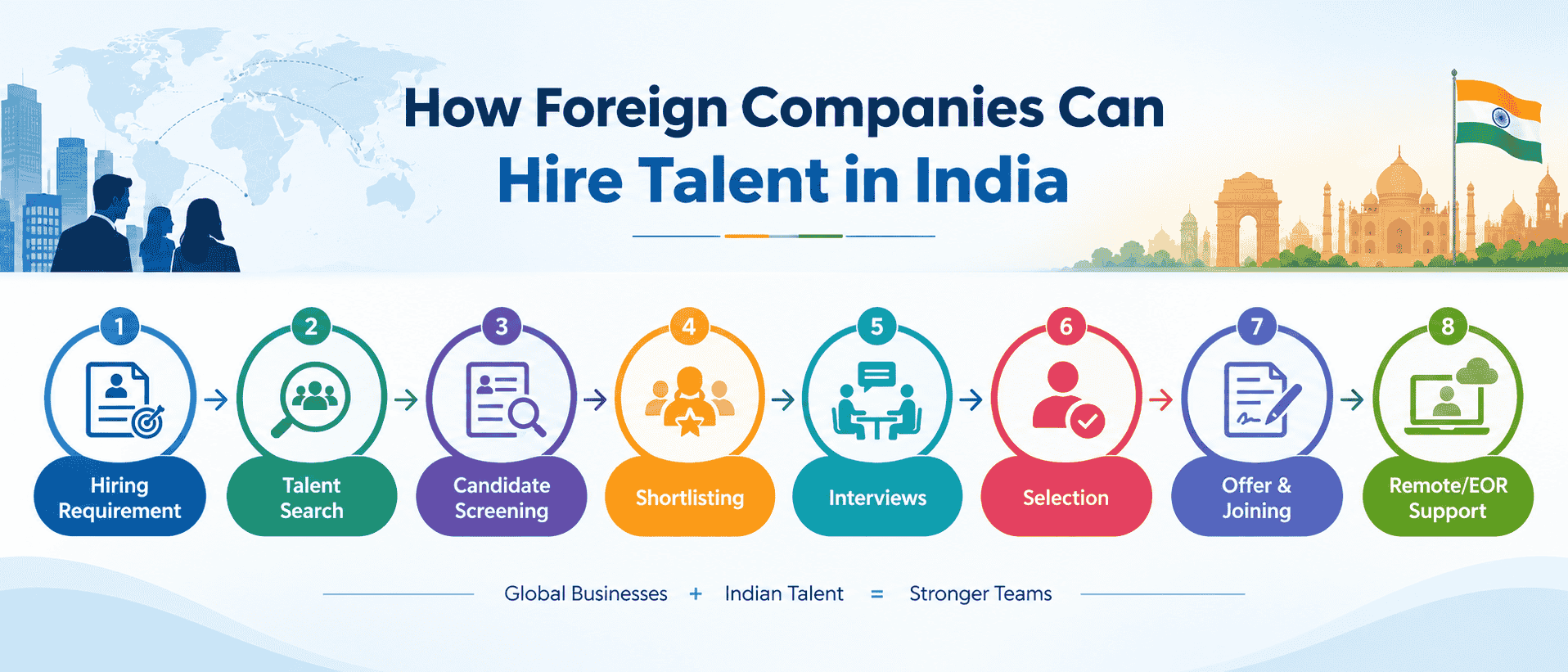
Why Construction Companies Are Expanding Recruitment in India
India has become one of the world’s leading construction and engineering talent hubs.
Global companies are increasingly hiring from India because of:
- Large technical workforce availability
- Engineering expertise
- Cost optimization
- Infrastructure experience
- Workforce scalability
This is increasing demand for:
- Construction Recruitment India
- Engineering Workforce Solutions
- Construction EOR Services
GCC & Infrastructure Expansion Trends
Global Capability Centers (GCCs) and engineering support hubs are expanding rapidly across India.
Many organizations are building:
- Engineering support teams
- Construction management centers
- Commercial project coordination units
- Design & MEP support divisions
India’s infrastructure workforce ecosystem continues to strengthen in 2026.
How MM Enterprises Supports Global Construction Hiring
MM Enterprises helps global organizations scale construction and engineering teams efficiently through:
- Quantity Surveyor recruitment
- MEP Head hiring
- Construction workforce solutions
- Employer of Record (EOR) services
- Payroll & compliance management
- International workforce support
We help infrastructure companies reduce operational complexity while scaling specialized teams faster.
Business Opportunities in 2026: Why Global Construction Workforce Expansion Is Accelerating
The global construction industry is entering a powerful new growth cycle in 2026.
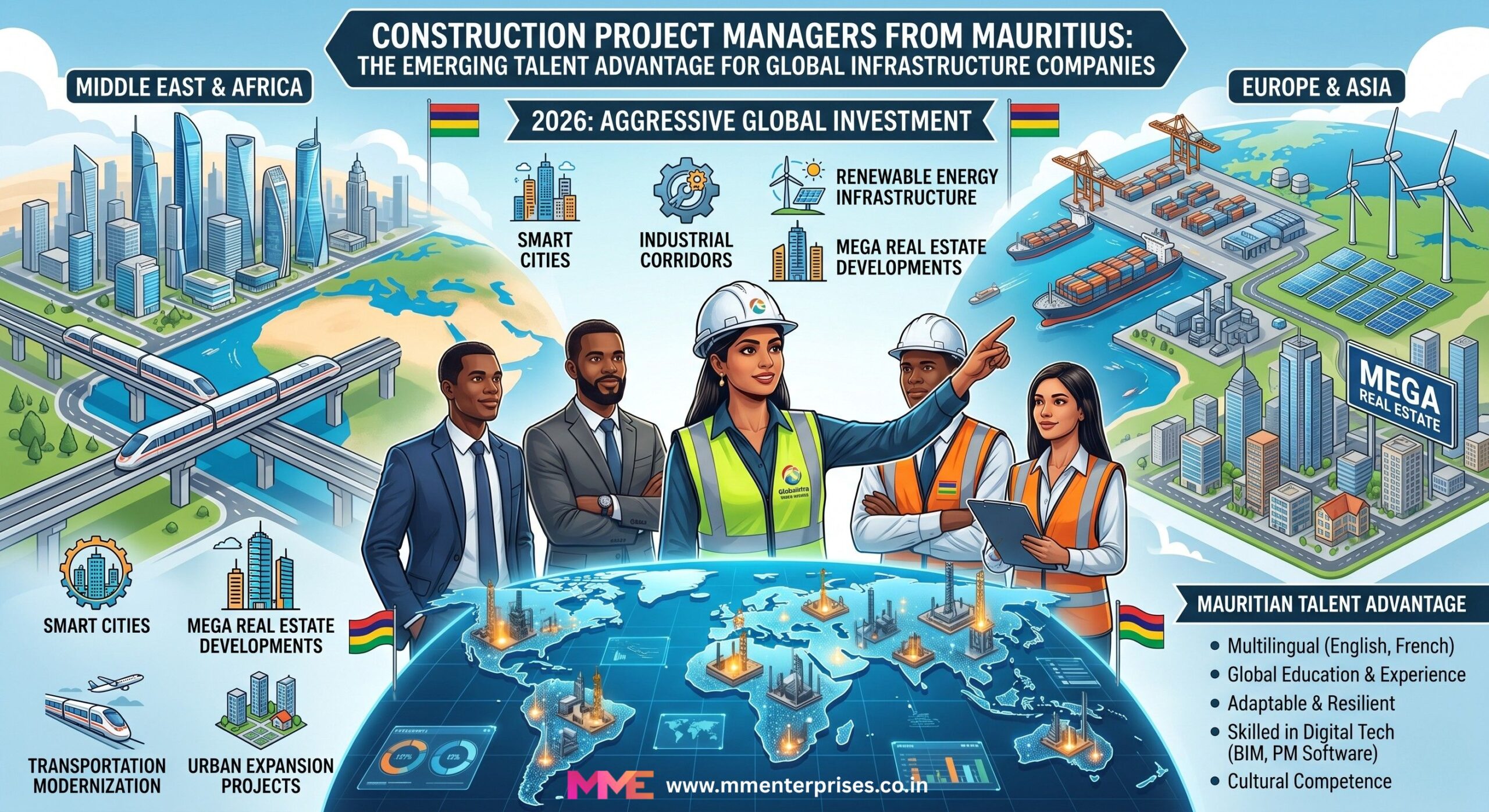
Governments, infrastructure investors, real estate developers, EPC companies, and technology firms are investing aggressively in next-generation infrastructure ecosystems designed to support:
- Urban modernization
- Digital transformation
- Renewable energy expansion
- AI-powered industries
- Smart manufacturing
- Sustainable economic growth
As these investments grow, one major reality is becoming increasingly clear:
Infrastructure growth is no longer only about construction — it is about building intelligent, scalable, and technology-driven environments.
This transformation is creating enormous business opportunities for:
- Construction companies
- Engineering consultancies
- Workforce solution providers
- EPC firms
- Employer of Record (EOR) partners
- Recruitment agencies
- Infrastructure investors
At the center of this opportunity is the rising global demand for specialized construction leadership professionals such as:
- Quantity Surveyors
- MEP Heads
- Construction Project Managers
- Infrastructure Planning Experts
- Smart Building Engineers
- Commercial Construction Specialists
Organizations that build scalable workforce strategies today will gain major competitive advantages throughout the next decade.
Smart City Development Is Reshaping Global Infrastructure Investment
One of the biggest infrastructure trends in 2026 is the global expansion of smart city development projects.
Governments worldwide are investing heavily in intelligent urban ecosystems capable of supporting:
- Population growth
- Sustainable transportation
- Energy optimization
- Digital governance
- Climate resilience
- AI-driven urban management
Unlike traditional urban development projects, smart cities rely heavily on advanced engineering integration.
These projects require seamless coordination between:
- Civil engineering
- Mechanical systems
- Electrical infrastructure
- Smart utilities
- Data connectivity
- Intelligent transportation systems
This is creating major demand for experienced infrastructure leadership professionals.
Smart Transportation Projects Are Expanding Rapidly
Transportation modernization has become a top priority globally.
Countries are investing in:
- Smart highways
- Metro rail systems
- Electric mobility infrastructure
- AI-driven traffic management
- Intelligent logistics corridors
- Smart airports and ports
These projects involve highly complex engineering coordination requiring experienced:
- Construction Project Managers
- MEP Heads
- Infrastructure Consultants
- Quantity Surveyors
- Commercial Managers
For global EPC companies, this creates enormous workforce expansion opportunities.
Sustainable Urban Planning Is Driving Infrastructure Recruitment
Sustainability is no longer optional in modern construction.
Urban infrastructure projects now focus heavily on:
- Green buildings
- Energy efficiency
- Water conservation
- Smart energy systems
- Sustainable HVAC solutions
- Carbon reduction targets
This transformation is increasing demand for professionals who understand both:
- Traditional infrastructure execution
- Sustainable engineering systems
MEP Heads and smart infrastructure specialists are becoming especially valuable in these projects.
Intelligent Infrastructure Systems Require Specialized Talent
Smart cities rely heavily on intelligent infrastructure technologies such as:
- IoT-enabled utilities
- AI-driven monitoring systems
- Smart lighting networks
- Intelligent water systems
- Automated building management platforms
As infrastructure becomes increasingly technology-driven, companies need multidisciplinary professionals capable of managing:
- Construction execution
- Smart systems integration
- Operational scalability
- Energy optimization
This is significantly reshaping construction recruitment globally.
Renewable Energy Infrastructure Is Creating Massive Workforce Demand
The renewable energy sector is expected to remain one of the fastest-growing infrastructure industries throughout 2026.
Governments and private investors are aggressively expanding:
- Solar energy projects
- Wind farms
- Battery storage infrastructure
- Green hydrogen facilities
- Smart power grids
- Sustainable industrial plants
These projects require highly specialized construction and engineering expertise.
Commercial Planning Is Critical for Renewable Projects
Renewable energy projects involve large-scale capital investments.
Infrastructure companies must carefully manage:
- Budget forecasting
- Procurement planning
- Contract administration
- Vendor coordination
- Commercial risk management
This is increasing global demand for experienced Quantity Surveyors and commercial construction specialists.
Companies capable of controlling project costs efficiently will gain stronger profitability in the renewable infrastructure sector.
MEP Integration Is Becoming More Complex
Renewable infrastructure projects rely heavily on advanced MEP systems.
Modern facilities require:
- Intelligent HVAC systems
- Smart electrical integration
- Energy optimization systems
- Automated utilities management
- Sustainable facility operations
MEP Heads now play a critical role in ensuring these systems operate efficiently across complex infrastructure environments.
This expertise is becoming increasingly difficult to hire globally.
Infrastructure Coordination Is Essential for Project Success
Renewable projects often involve:
- International contractors
- Multi-country engineering teams
- Advanced compliance requirements
- Cross-border project coordination
Construction leadership professionals capable of managing these complexities are becoming highly valuable in global hiring markets.
Smart Facility Development Is Accelerating
Modern renewable facilities are no longer traditional industrial plants.
Today’s projects are increasingly powered by:
- AI monitoring systems
- Automation platforms
- Predictive maintenance technologies
- Smart operational analytics
This creates strong demand for engineering leaders capable of integrating:
- Construction expertise
- Smart technologies
- Sustainable engineering principles
Organizations investing early in this talent will strengthen long-term operational efficiency.
Data Center Construction Is Becoming One of the Fastest-Growing Infrastructure Sectors
The rapid growth of Artificial Intelligence, cloud computing, and digital transformation is creating an unprecedented global data center construction boom.
Technology companies, cloud providers, AI firms, and enterprise organizations are investing billions into:
- Hyperscale data centers
- AI computing facilities
- Edge infrastructure
- Smart digital campuses
- High-density computing environments
This sector is expected to grow aggressively throughout 2026 and beyond.
AI Growth Is Fueling Infrastructure Expansion
Artificial Intelligence applications require massive computing power.
As AI adoption increases globally, organizations need:
- Advanced server infrastructure
- High-performance cooling systems
- Intelligent power management
- Smart facility monitoring
This is dramatically increasing demand for highly specialized infrastructure construction talent.
Smart Facilities Require Advanced MEP Leadership
Modern data centers depend heavily on complex MEP systems.
These facilities require:
- Precision cooling systems
- High-capacity electrical infrastructure
- Backup power systems
- Smart energy management
- Intelligent automation controls
MEP Heads capable of managing these environments are becoming some of the most sought-after professionals in the infrastructure sector.
Industrial Infrastructure Expansion Is Accelerating
Beyond data centers, industrial infrastructure growth is also accelerating globally due to:
- Smart manufacturing
- Semiconductor expansion
- EV production facilities
- Automation-driven logistics hubs
These projects require highly coordinated engineering execution and commercial management expertise.
Quantity Surveyors and construction leadership professionals play a vital role in:
- Cost optimization
- Vendor management
- Infrastructure scalability
- Operational efficiency
Why Workforce Expansion Strategies Matter in 2026
As infrastructure projects become larger and more technology-driven, workforce scalability has become a strategic business priority.
Companies must now build workforce models capable of supporting:
- Faster onboarding
- Cross-border hiring
- Compliance management
- Specialized engineering recruitment
- Multi-project workforce scaling
Traditional hiring approaches are often too slow for modern infrastructure growth.
This is why Employer of Record (EOR) models and workforce expansion partnerships are becoming increasingly important.
The Business Opportunity for Recruitment & EOR Firms
The infrastructure boom is creating enormous opportunities for:
- Recruitment consultancies
- Workforce solution providers
- Construction staffing firms
- Employer of Record (EOR) companies
Organizations that can provide:
- Specialized engineering talent
- Faster onboarding
- Compliance-driven hiring
- International workforce scalability
will become essential partners for global construction companies.
This is where experienced workforce partners like MM Enterprises are helping businesses scale infrastructure teams more efficiently through recruitment and EOR solutions.
Frequently Asked Questions (FAQs)
Q1. Why are Quantity Surveyors in high demand globally?
Quantity Surveyors help organizations improve:
- Cost optimization
- Budget planning
- Contract management
- Infrastructure profitability
Q2. Why are MEP Heads critical for modern infrastructure projects?
MEP Heads manage:
- HVAC systems
- Smart building infrastructure
- Electrical integration
- Sustainable engineering systems
Q3. Why is EOR becoming popular in construction hiring?
EOR solutions simplify:
- International compliance
- Payroll management
- Faster onboarding
- Workforce scalability
- Project-based hiring
Q4. Why are global construction companies hiring in India?
India offers:
- Large engineering talent pools
- Cost-efficient workforce expansion
- Technical expertise
- Infrastructure experience
Q5. Why partner with MM Enterprises?
MM Enterprises supports:
- Construction recruitment
- EOR services
- Workforce compliance
- Payroll administration
- International workforce scaling
Final Thoughts
The future of construction hiring is becoming increasingly global, technology-driven, and compliance-focused.
As infrastructure projects become more sophisticated, companies need workforce strategies capable of supporting:
- Smart infrastructure
- Sustainable construction
- International project expansion
- Flexible workforce scaling
Quantity Surveyors and MEP Heads are becoming mission-critical roles in this transformation.
Organizations that invest early in scalable workforce models and EOR-supported hiring strategies will gain significant competitive advantages in 2026 and beyond.
And with experienced workforce partners like MM Enterprises, global construction companies can scale specialized engineering teams faster, compliantly, and more efficiently across international markets.