


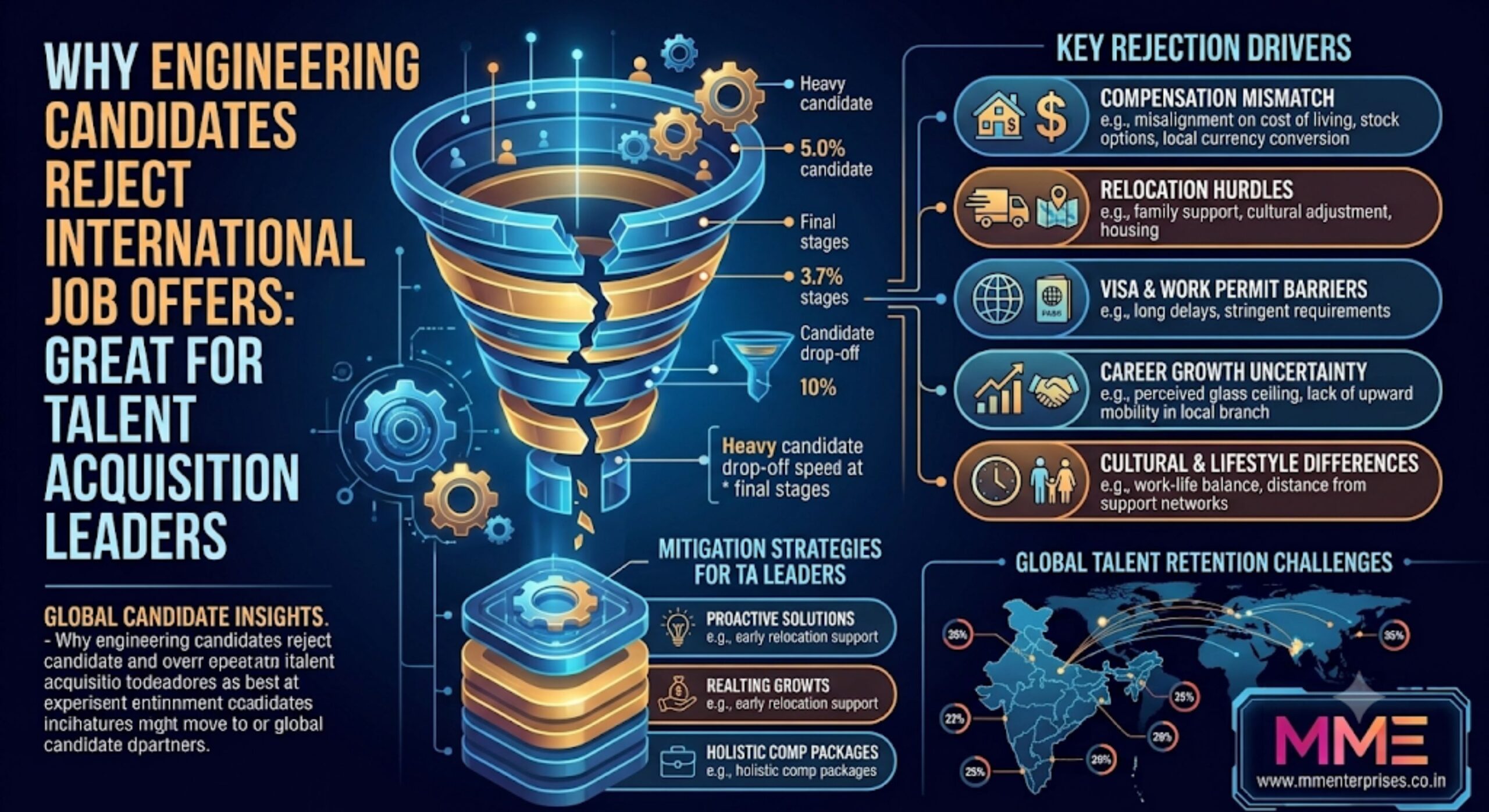
Why Engineering Candidates Reject International Job Offers: Great for Talent Acquisition leaders.
Executive Summary
For multinational companies, attracting engineering talent is no longer the primary challenge—securing accepted offers is. Across industries including automotive, semiconductor, renewable energy, aerospace, industrial automation, construction, and AI engineering, employers are discovering that a technically successful recruitment process can still fail at the final stage. Engineering candidates increasingly evaluate international opportunities through a broader lens that includes career progression, project complexity, leadership quality, relocation support, work flexibility, employer reputation, family considerations, and long-term stability.
For CHROs, CTOs, GCC leaders, Procurement Heads, CFOs, and founders, this trend has direct financial implications. Every rejected offer extends vacancy periods, delays project delivery, increases contractor spending, places additional pressure on existing teams, and can postpone market expansion initiatives. Measuring recruitment success solely by time-to-hire or cost-per-hire no longer reflects business reality. A stronger indicator is Offer Acceptance Rate (OAR)—a metric that links recruitment performance directly to operational outcomes and investment returns.
Engineering recruitment has also become increasingly competitive because global employers now compete simultaneously across multiple regions. Candidates often receive offers from multinational corporations, fast-growing startups, Global Capability Centers (GCCs), and remote-first employers at the same time. Companies that rely on traditional recruitment processes frequently lose highly qualified candidates before onboarding begins.
This report examines why engineering professionals reject international job offers and provides a benchmark-driven framework that executive teams can use to improve hiring outcomes. Rather than focusing on generic recruitment advice, it analyzes the commercial impact of offer rejections, compares international hiring practices, and highlights measurable strategies that improve acceptance rates.
Key areas covered include:
- Executive benchmarks for engineering offer acceptance
- Major reasons candidates decline international opportunities
- Financial impact of offer rejections on engineering projects
- KPIs that should appear in board-level hiring dashboards
- Best practices used by high-performing multinational employers
- Strategies to improve engineering offer acceptance while reducing recruitment costs
Organizations that consistently achieve high offer acceptance rates treat recruitment as a strategic business function rather than an administrative HR activity. They combine competitive compensation with transparent communication, structured hiring processes, strong employer branding, and market intelligence to reduce hiring risk.
For international companies planning engineering recruitment in India, partnering with an experienced recruitment specialist such as MM Enterprises provides access to real-time talent insights, faster candidate engagement, and proven hiring strategies that improve offer acceptance while supporting long-term workforce growth.
Why Offer Acceptance Matters More Than Hiring Speed
For years, recruitment teams were evaluated primarily on time-to-hire. While reducing hiring cycles remains important, today’s engineering recruitment landscape demands a broader performance metric. A position filled quickly delivers little value if the selected candidate ultimately declines the offer, forcing the recruitment process to restart.
Engineering projects operate on strict timelines involving product launches, plant commissioning, infrastructure delivery, and research milestones. Every rejected offer can delay these objectives, increasing operational costs and affecting business performance far beyond the HR function.
Consider two recruitment scenarios:
| Metric | Company A | Company B |
| Time-to-Hire | 18 Days | 32 Days |
| Offer Acceptance Rate | 48% | 91% |
| Hiring Restarts | Frequent | Rare |
| Project Delays | High | Low |
| Recruitment Cost | Higher | Lower |
Although Company A recruits faster, its low acceptance rate creates repeated recruitment cycles, longer vacancy periods, and higher overall hiring costs. Company B takes slightly longer to finalize offers but secures significantly more accepted offers, resulting in better workforce stability and stronger business outcomes.
Leading organizations increasingly monitor metrics such as:
- Offer Acceptance Rate (OAR)
- Candidate Withdrawal Rate
- Counteroffer Acceptance Rate
- Time-to-Accept
- Hiring Manager Satisfaction
- Cost per Accepted Offer
- Vacancy Cost per Engineering Role
These indicators provide a more accurate view of recruitment effectiveness than hiring speed alone.
Offer acceptance also reflects the strength of an organization’s employer value proposition. Candidates who understand the role, career path, project scope, compensation structure, relocation benefits, and organizational culture are more likely to commit confidently.
For executive leadership, improving offer acceptance delivers measurable business value:
- Reduced recruitment expenditure
- Faster project execution
- Lower productivity loss from vacant roles
- Improved workforce planning accuracy
- Stronger employer reputation within engineering talent markets
In a global engineering talent market where skilled professionals often receive multiple offers simultaneously, the organizations that consistently secure accepted offers gain a significant competitive advantage.
Engineering Offer Rejection Benchmark (2026–2027)
Engineering recruitment is becoming increasingly data-driven, making Offer Acceptance Rate (OAR) one of the most valuable executive hiring KPIs. While acceptance rates vary by industry, seniority, and geography, organizations should establish internal benchmarks to identify risks before they affect business operations.
Engineering Offer Acceptance Benchmark
| Performance Level | Offer Acceptance Rate | Business Impact |
| Excellent | Above 90% | Strong employer brand and efficient hiring process |
| Good | 80–90% | Competitive recruitment performance |
| Average | 70–79% | Improvement opportunities exist |
| Below Average | 60–69% | Increased hiring costs and delays |
| High Risk | Below 60% | Significant recruitment and project delivery risk |
Companies consistently operating below a 70% acceptance rate often experience recurring vacancies, increased agency costs, extended project timelines, and reduced hiring manager productivity.
Common Engineering Offer Rejection Drivers
| Factor | Estimated Influence |
| Better competing offer | High |
| Limited career growth visibility | High |
| Compensation misalignment | High |
| Slow interview process | Medium-High |
| Weak relocation support | Medium |
| Employer reputation concerns | Medium |
| Project uncertainty | Medium |
| Work-life balance expectations | Medium |
| Counteroffer from current employer | Medium-High |
International employers are also competing with rapidly expanding GCCs and technology-driven engineering firms in India that offer competitive compensation, advanced projects, hybrid work options, and faster decision-making.
Executive Hiring Dashboard
Organizations should monitor:
- Offer Acceptance Rate
- Average Days to Accept
- Counteroffer Frequency
- Candidate Drop-off Rate
- Hiring Manager Productivity Loss
- Vacancy Duration
- Cost per Accepted Offer
- Project Delay Cost
- Engineering Team Capacity Gap
- Recruitment ROI
Rather than reviewing these metrics independently, leadership teams should analyze them together to understand the overall health of the engineering hiring pipeline.
Top 15 Reasons Engineers Reject International Job Offers
Engineering professionals rarely reject international job offers for a single reason. Instead, they evaluate the complete employment proposition, comparing compensation, career opportunities, technical challenges, organizational culture, and long-term stability. For global employers hiring in India, understanding these decision drivers is essential to improving offer acceptance rates and reducing recruitment costs.
1. Compensation Does Not Match Market Expectations
Salary remains one of the most visible reasons for offer rejection, but it is rarely about base pay alone. Engineers compare total compensation, including annual bonuses, equity, performance incentives, relocation support, insurance, retirement benefits, education assistance, and tax implications.
Organizations relying on outdated salary benchmarks often lose candidates to competitors that regularly adjust compensation according to market demand.
2. Limited Career Growth Opportunities
Senior engineers increasingly prioritize long-term career progression over short-term financial gains. Candidates want to understand:
- Promotion timelines
- Leadership opportunities
- Technical specialization paths
- Global mobility programs
- Research and innovation exposure
If these aspects remain unclear during recruitment, candidates frequently choose employers offering greater career visibility.
3. Slow Hiring Decisions
Highly skilled engineering professionals often receive multiple offers simultaneously.
When interview feedback, approvals, or offer releases take several weeks, candidates may already have accepted another opportunity.
Leading multinational companies aim to reduce unnecessary interview rounds and accelerate executive approvals.
4. Poor Employer Brand
Candidates research organizations extensively before accepting offers.
They evaluate:
- Leadership credibility
- Technology investments
- Employee reviews
- Financial stability
- Engineering achievements
- Innovation capability
Weak employer branding reduces confidence, particularly among experienced engineering professionals.
5. Unclear Project Scope
Engineers prefer solving meaningful technical challenges.
Generic job descriptions with limited information about products, technologies, clients, or engineering objectives often create uncertainty.
Candidates are more likely to accept offers when hiring managers clearly explain:
- Product roadmap
- Technical architecture
- Engineering responsibilities
- Innovation goals
- Team structure
6. Relocation Concerns
International assignments involve more than changing workplaces.
Candidates evaluate:
- Family relocation
- Housing assistance
- Visa processing
- Children’s education
- Healthcare
- Local cost of living
Insufficient relocation support remains a major reason international offers are declined.
7. Better Competing Offers
Engineering talent markets have become increasingly competitive.
Candidates commonly receive simultaneous offers from:
- Global Capability Centers (GCCs)
- Technology companies
- Manufacturing leaders
- Semiconductor firms
- AI startups
- International engineering consultancies
Companies unable to differentiate their employee value proposition often lose candidates despite competitive salaries.
8. Counteroffers from Current Employers
Many organizations actively retain high-performing engineers through counteroffers.
These frequently include:
- Immediate salary revisions
- Promotions
- Flexible working arrangements
- Leadership responsibilities
- Retention bonuses
Employers should anticipate counteroffers and proactively reinforce their long-term value proposition during recruitment.
9. Lack of Flexible Working Options
Although many engineering roles require onsite collaboration, professionals increasingly value flexibility where practical.
Hybrid work policies, flexible schedules, and modern collaboration tools influence candidate decisions, especially for software, electronics, AI, and design engineering roles.
10. Technology Stack Is Outdated
Experienced engineers seek opportunities to work with advanced technologies.
Candidates may reject offers involving outdated systems with limited innovation potential.
Organizations investing in AI, digital engineering, robotics, automation, Industry 4.0, and cloud engineering typically achieve stronger offer acceptance rates.
11. Weak Communication During Recruitment
Recruitment itself shapes the candidate experience.
Common issues include:
- Long response times
- Limited interview feedback
- Confusing communication
- Delayed documentation
- Multiple scheduling changes
Professional, transparent communication significantly improves employer perception.
12. Concerns About Business Stability
Engineers increasingly evaluate commercial risk before accepting offers.
Candidates review:
- Revenue growth
- Funding
- Client portfolio
- Expansion plans
- Financial performance
- Layoff history
Companies demonstrating long-term stability generate greater confidence.
13. Cultural Misalignment
International candidates seek organizations where they can succeed professionally and personally.
Important considerations include:
- Leadership style
- Diversity
- Inclusion
- Decision-making culture
- Collaboration
- Learning environment
Culture has become a significant differentiator among multinational employers.
14. Complex Interview Process
Engineering candidates appreciate rigorous technical assessments—but not unnecessary complexity.
Processes involving:
- Six or more interview rounds
- Repeated technical assessments
- Multiple executive approvals
often increase candidate fatigue and withdrawal rates.
High-performing employers balance thorough evaluation with efficient decision-making.
15. Lack of Long-Term Vision
Today’s engineering professionals want to contribute to organizations with ambitious growth strategies.
Candidates increasingly ask:
- What products are being developed?
- Where is the business expanding?
- How much investment is planned?
- Will engineering become a strategic function?
Companies communicating a compelling long-term vision consistently outperform competitors in attracting engineering talent.
Executive Insight
While compensation remains important, international engineering recruitment is increasingly influenced by career growth, project quality, organizational reputation, leadership transparency, and candidate experience. Companies focusing solely on salary negotiations often overlook the broader factors that determine offer acceptance.
Recruitment partners such as MM Enterprises help multinational employers address these challenges through market intelligence, salary benchmarking, candidate engagement strategies, and structured hiring processes that improve engineering offer acceptance rates while reducing recruitment risk.
Country-by-Country Comparison
Engineering candidates evaluate international opportunities differently depending on destination markets. Understanding these regional priorities helps multinational employers tailor their recruitment strategy and improve offer acceptance.
| Country | Primary Candidate Priorities | Common Offer Rejection Drivers |
| United States | Career growth, innovation, equity, leadership opportunities | Better competing offers, visa uncertainty, counteroffers |
| Germany | Long-term stability, engineering excellence, work-life balance | Language requirements, relocation concerns, slower hiring |
| Japan | Technology leadership, structured career paths, employer reputation | Cultural adaptation, language barriers, relocation challenges |
| UAE | Tax-efficient income, infrastructure projects, international exposure | Housing costs, family relocation, contract clarity |
| Singapore | Regional leadership roles, innovation, career mobility | High living expenses, competing multinational offers |
| United Kingdom | Flexible work, professional development, global projects | Immigration changes, salary expectations, economic uncertainty |
Strategic Observations
United States
Candidates expect rapid recruitment, competitive total rewards, and opportunities to work on cutting-edge technologies. Delays beyond three to four weeks can significantly reduce offer acceptance.
Germany
German engineering employers attract candidates through technical excellence and employment stability. However, relocation support and language expectations remain important decision factors.
Japan
Japan continues to attract engineers interested in advanced manufacturing, robotics, and precision engineering. Organizations offering cultural integration support achieve better hiring outcomes.
United Arab Emirates
Large infrastructure and energy investments continue to create demand for engineering professionals. Housing, family benefits, and transparent employment contracts strongly influence offer acceptance.
Singapore
Singapore attracts highly skilled engineers through regional leadership opportunities and innovation ecosystems. Competition among multinational employers makes employer branding increasingly important.
United Kingdom
Engineering candidates evaluate flexibility, career progression, and project quality alongside compensation. Clear communication regarding immigration processes and long-term employment stability improves candidate confidence.
Executive Recommendation
Rather than applying a single global recruitment model, multinational companies should adapt their employer value proposition to regional candidate expectations. Local market intelligence, salary benchmarking, and culturally aligned recruitment strategies significantly improve international offer acceptance.
For organizations recruiting engineering professionals from India for global assignments, MM Enterprises provides localized hiring expertise that helps align employer offerings with candidate expectations across multiple international markets.
The Hidden Cost of Offer Rejections (ROI & CFO Calculator)
Offer rejections represent more than recruitment setbacks—they are measurable business costs that affect profitability, operational efficiency, and strategic execution.
When an engineering offer is declined, organizations typically incur:
- Additional sourcing expenses
- Repeated interview costs
- Hiring manager time
- Project delays
- Contractor dependency
- Overtime costs
- Reduced engineering productivity
- Revenue delays
- Increased recruitment agency expenditure
Executive ROI Framework
A practical approach for finance and HR leaders is to estimate the Cost per Rejected Offer using the following components:
Cost per Rejected Offer = Recruitment Cost + Vacancy Cost + Hiring Manager Time + Project Delay Cost + Replacement Recruitment Cost
For example, if a senior automation engineer rejects an offer after six weeks of recruitment, the organization may experience:
| Cost Component | Estimated Impact |
| Recruitment activities | $3,000 |
| Hiring manager interview time | $2,000 |
| Vacancy productivity loss | $12,000 |
| Project delivery delay | $18,000 |
| Additional recruitment cycle | $5,000 |
| Estimated Total Cost | $40,000 |
Although actual figures vary by industry and role, this framework helps CFOs and executive leadership quantify the financial consequences of low offer acceptance rates.
Board-Level Metrics to Track
Executive teams should regularly monitor:
- Offer Acceptance Rate
- Cost per Accepted Offer
- Vacancy Cost per Engineering Role
- Candidate Withdrawal Rate
- Counteroffer Success Rate
- Time-to-Accept
- Revenue Delayed by Vacancies
- Recruitment ROI
Board-Level Offer Acceptance Dashboard
Engineering recruitment performance should be measured with the same discipline applied to finance, operations, and sales. A board-level offer acceptance dashboard enables executives to identify recruitment risks early and understand how hiring outcomes influence project delivery, workforce planning, and business growth.
Rather than focusing only on the number of positions filled, leadership teams should review metrics that reflect the quality and efficiency of the hiring process.
Executive Recruitment Dashboard
| KPI | Target | Executive Insight |
| Offer Acceptance Rate | Above 90% | Indicates competitiveness of the employer value proposition |
| Time to Offer | Less than 20 days | Reduces risk of losing candidates to competitors |
| Candidate Withdrawal Rate | Below 5% | Measures recruitment experience and engagement |
| Counteroffer Loss Rate | Below 10% | Assesses candidate commitment before offer acceptance |
| Average Vacancy Duration | Below 30 days | Helps minimize productivity loss |
| Cost per Accepted Offer | Tracked monthly | Measures recruitment efficiency rather than recruitment activity |
| Hiring Manager Satisfaction | Above 90% | Reflects recruitment quality and communication |
| Critical Engineering Roles Filled on Time | Above 95% | Supports project delivery and operational continuity |
Beyond operational metrics, executive leadership should monitor the financial consequences of recruitment performance. Engineering vacancies often affect product development, manufacturing schedules, customer commitments, and capital investment projects.
Quarterly reviews should answer questions such as:
- Which engineering functions experience the highest offer rejection rates?
- Are compensation packages aligned with current market expectations?
- Which countries or business units experience the longest hiring cycles?
- How many projects were delayed because of unfilled engineering positions?
- What is the return on investment from recruitment initiatives?
When recruitment data is presented alongside business performance indicators, hiring becomes a strategic management discussion rather than an isolated HR activity. Organizations that adopt board-level recruitment dashboards are better positioned to anticipate talent shortages, allocate hiring budgets effectively, and improve workforce planning.
How Global Companies Improve Acceptance Rates (Case Studies & Framework)
Leading multinational organizations recognize that increasing offer acceptance is not achieved through higher salaries alone. Successful employers combine market intelligence, efficient recruitment processes, transparent communication, and a compelling employee value proposition to create a hiring experience that builds candidate confidence from the first interaction to onboarding.
Case Study 1: Global Automotive Manufacturer
Challenge
A multinational automotive company recruiting design and manufacturing engineers from India experienced an offer acceptance rate of approximately 64%. Many candidates accepted competing offers before final approval due to a lengthy interview process involving multiple technical and management rounds.
Solution
The company redesigned its recruitment workflow by:
- Reducing interview rounds from six to three.
- Setting a target of releasing offers within five business days after the final interview.
- Providing candidates with detailed information about upcoming vehicle platforms, R&D investments, and career progression opportunities.
- Maintaining regular communication throughout the recruitment process.
Outcome
Within six months, the organization significantly improved offer acceptance, reduced recruitment cycle time, and accelerated staffing for critical manufacturing projects.
Case Study 2: Global Capability Center (GCC)
Challenge
A technology GCC struggled to recruit AI and software engineering professionals despite offering competitive salaries. Exit interviews revealed that candidates lacked visibility into leadership opportunities and long-term career growth.
Solution
The organization introduced:
- Career progression roadmaps.
- Technical leadership programs.
- Internal innovation initiatives.
- Early engagement sessions with engineering leaders.
- Structured onboarding previews before offer acceptance.
Outcome
Candidates gained greater confidence in long-term career prospects, resulting in improved acceptance rates and stronger employee retention during the first year.
Case Study 3: Industrial Engineering Company
Challenge
An engineering firm hiring specialists for international projects faced frequent offer rejections because relocation support was communicated only after candidates accepted offers.
Solution
The recruitment team incorporated relocation planning into the interview process by providing:
- Visa timelines.
- Housing assistance information.
- Family relocation guidance.
- Cost-of-living comparisons.
- Destination country orientation.
Outcome
Candidate confidence increased substantially, leading to fewer offer declines and smoother international mobilization.
The Engineering Offer Acceptance Framework
Organizations achieving consistently high acceptance rates typically follow a structured framework:
1. Market Intelligence
Use current salary benchmarks, hiring trends, and talent availability data to create competitive offers that reflect regional market conditions.
2. Faster Decision-Making
Reduce unnecessary interview stages, automate approvals where possible, and maintain predictable recruitment timelines.
3. Transparent Communication
Clearly explain role expectations, technical projects, reporting structures, career opportunities, and organizational goals throughout the recruitment journey.
4. Strong Employer Branding
Highlight engineering innovation, global projects, employee success stories, learning opportunities, and organizational stability through consistent employer branding.
5. Candidate Experience
Treat candidates as future business partners by providing timely feedback, responsive communication, and a professional interview experience.
6. Executive Involvement
For senior engineering and leadership roles, engagement from business leaders reinforces organizational commitment and helps candidates understand the strategic importance of the position.
Organizations implementing these practices consistently report higher offer acceptance, reduced hiring costs, improved workforce planning, and faster execution of engineering projects.
Why Companies Partner with MM Enterprises
Hiring engineering professionals in today’s global market requires more than access to resumes. It requires market intelligence, industry expertise, and recruitment strategies that align with business objectives. MM Enterprises has built its reputation by helping multinational companies recruit engineering talent across sectors such as automotive, manufacturing, construction, infrastructure, oil and gas, renewable energy, semiconductor, electronics, aerospace, robotics, and emerging technologies.
Our recruitment approach begins with understanding your workforce strategy rather than simply filling vacancies. We analyze role requirements, benchmark compensation against current market conditions, identify potential hiring risks, and develop sourcing strategies designed to improve offer acceptance while reducing recruitment timelines.
Through extensive engineering talent networks, structured candidate assessments, and continuous engagement throughout the hiring process, we help organizations secure professionals who possess both the technical expertise and long-term commitment required for critical business initiatives.
Whether you are establishing a Global Capability Center (GCC), expanding engineering operations, launching a new manufacturing facility, or scaling project teams across India, MM Enterprises provides recruitment solutions tailored to your business goals.
By combining recruitment expertise with market intelligence, salary benchmarking, and a strong understanding of international hiring requirements, MM Enterprises enables organizations to build high-performing engineering teams while improving hiring efficiency, reducing offer rejection rates, and delivering measurable return on recruitment investment.