

IT Manager Jobs in Zambia: More Than a Vacancy—A Strategic Business Investment
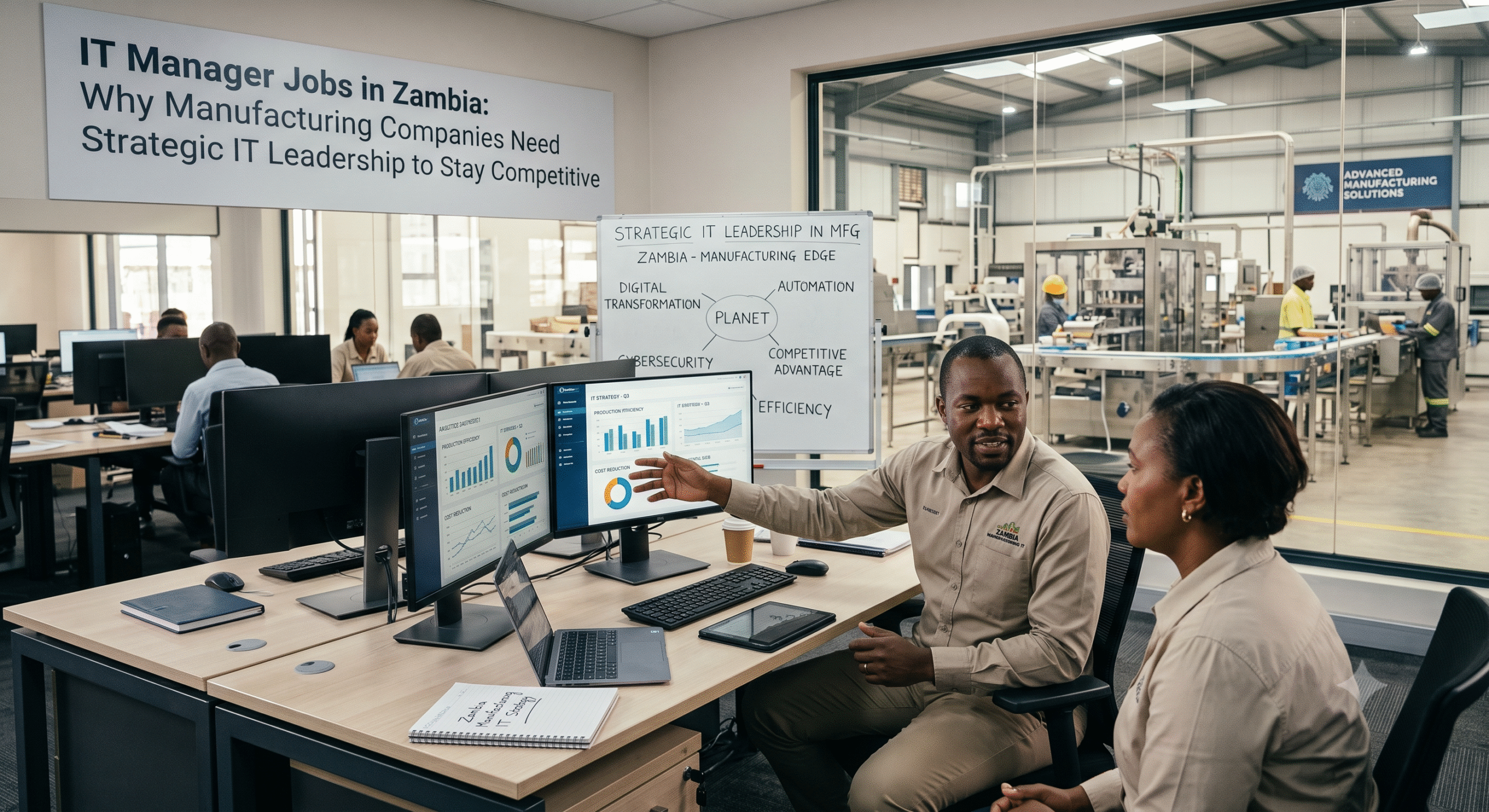
The manufacturing industry is undergoing one of the biggest technological transformations in its history. From Industry 4.0 and smart factories to cloud computing, ERP systems, cybersecurity, predictive maintenance, and industrial automation, information technology has become the backbone of modern manufacturing operations.
For manufacturing companies operating in Zambia, hiring an experienced IT Manager is no longer simply about maintaining computers or supporting office users. Today’s IT leaders are responsible for enabling operational efficiency, protecting digital assets, integrating production systems, improving supply chain visibility, and driving long-term business growth.
As Zambia continues to attract investment in manufacturing, mining, packaging, food processing, pharmaceuticals, and industrial production, the demand for skilled technology leaders is increasing rapidly. Companies are competing for professionals who understand both enterprise technology and manufacturing operations.
For business leaders, the conversation is no longer about filling an IT vacancy. It is about securing leadership capable of supporting digital transformation while reducing operational risk.
Zambia’s Manufacturing Sector Is Entering a New Digital Era
Manufacturing businesses across Africa are investing heavily in digital infrastructure to improve productivity and remain globally competitive. Zambia is no exception.
Companies are modernizing operations through:
- Enterprise Resource Planning (ERP)
- Manufacturing Execution Systems (MES)
- Warehouse Management Systems
- Industrial IoT
- Cloud Infrastructure
- Data Analytics
- Cybersecurity
- Production Automation
- Supply Chain Visibility
- AI-powered Reporting
Each investment increases operational complexity.
Without experienced IT leadership, businesses often experience:
- Production downtime
- Cybersecurity vulnerabilities
- Poor ERP implementation
- Delayed decision-making
- Supply chain disruptions
- Compliance challenges
- Rising technology costs
An experienced IT Manager ensures these technology investments deliver measurable business value rather than becoming expensive operational burdens.
Why IT Leadership Has Become Essential for Manufacturing Companies
Traditionally, manufacturing organizations viewed IT as a support function.
That perception has changed dramatically.
Today’s IT Manager works alongside executive leadership, plant managers, finance teams, operations directors, procurement departments, and production supervisors.
Rather than fixing technical issues, they help organizations answer critical business questions:
- How can production become more efficient?
- Which systems should be automated?
- How can downtime be reduced?
- How can manufacturing data improve forecasting?
- How can cybersecurity protect intellectual property?
- Which technologies generate the highest return on investment?
Technology decisions now influence every department inside a manufacturing company.
As a result, IT leadership has become a strategic business function rather than a back-office operation.
The Growing Demand for IT Managers in Zambia
Several factors are driving demand for experienced IT professionals across Zambia’s manufacturing sector.
Industrial Expansion
New manufacturing investments require scalable technology infrastructure capable of supporting future growth.
Digital Transformation Projects
Organizations are replacing legacy software with integrated enterprise platforms.
Cybersecurity Risks
Manufacturing companies are increasingly targeted by ransomware, phishing attacks, and industrial cyber threats.
Automation Initiatives
Factories are adopting connected production systems that require continuous monitoring and maintenance.
Global Compliance
International manufacturers must comply with increasingly complex data protection, quality, and operational standards.
Each of these developments increases the need for experienced IT leadership capable of managing both business priorities and technology infrastructure.
The Flexible Packaging Industry Is Becoming More Technology-Driven
Flexible packaging manufacturers have evolved significantly over the past decade.
Modern facilities now depend on integrated technologies that support:
- Production planning
- Inventory control
- Procurement
- Quality management
- Customer order tracking
- Warehouse automation
- Machine monitoring
- Predictive maintenance
- Financial reporting
- Vendor management
Instead of operating as separate departments, manufacturing organizations increasingly rely on connected digital ecosystems.
An IT Manager ensures these systems communicate effectively, remain secure, and support uninterrupted production.
Without effective IT governance, even small technology failures can create significant operational disruptions across the entire manufacturing process.
The Cost of Hiring the Wrong IT Leader
Recruitment mistakes become particularly expensive when hiring senior technology professionals.
An unsuitable IT Manager may contribute to:
- Failed ERP implementations
- High cybersecurity exposure
- Technology budget overruns
- Poor vendor management
- Low employee adoption of digital systems
- Frequent production interruptions
- Inadequate disaster recovery planning
- Weak IT governance
Beyond direct financial losses, these issues can damage customer relationships, reduce operational efficiency, and delay strategic growth initiatives.
For manufacturing companies, hiring decisions should therefore focus on long-term business capability rather than simply filling an immediate vacancy.
What Manufacturing Companies Should Look for Beyond Technical Skills
Many organizations prioritize certifications and software expertise when recruiting senior IT professionals.
While technical knowledge remains important, successful manufacturing IT leaders also demonstrate strong business capabilities.
These include:
Strategic Planning
The ability to align technology investments with business objectives.
Manufacturing Knowledge
Understanding production environments, supply chains, quality systems, and operational workflows.
Leadership
Managing internal IT teams, external vendors, consultants, and cross-functional stakeholders.
Risk Management
Identifying operational risks before they become costly business problems.
Project Delivery
Leading ERP implementations, infrastructure upgrades, cloud migrations, and cybersecurity initiatives.
Communication
Translating complex technical concepts into practical business decisions for executive leadership.
These capabilities distinguish strategic technology leaders from traditional IT administrators.
Why Executive Recruitment Is Different from Traditional Hiring
Senior technology recruitment requires more than advertising vacancies.
Experienced IT Managers are often passive candidates who are already employed and not actively searching for opportunities.
Successful executive hiring therefore depends on:
- Industry-specific talent mapping
- Confidential executive search
- Leadership assessment
- Technical evaluation
- Cultural alignment
- Manufacturing experience
- Long-term retention strategy
Organizations that invest in structured recruitment processes are significantly more likely to secure leaders capable of supporting business transformation rather than simply managing daily operations.
The Biggest Challenges Manufacturing Companies Face When Hiring IT Managers
As manufacturing operations become increasingly digital, finding the right IT Manager has become one of the most difficult executive hiring decisions. While there may be a large number of technology professionals in the market, only a small percentage possess the combination of technical expertise, leadership ability, and manufacturing knowledge required to lead digital transformation successfully.
Many organizations encounter challenges such as:
1. Limited Industry Experience
An IT professional with experience in banking, retail, or telecommunications may not fully understand the operational demands of a manufacturing environment. Manufacturing companies require leaders who are familiar with production planning, industrial automation, ERP systems, plant networks, quality control systems, and supply chain operations.
2. Growing Cybersecurity Risks
Manufacturing has become a frequent target for cyberattacks. A single ransomware incident can disrupt production, delay customer deliveries, and result in significant financial losses. Companies increasingly seek IT leaders who can implement proactive cybersecurity strategies while ensuring business continuity.
3. Rapid Technological Change
Cloud computing, Industrial IoT, AI-driven analytics, predictive maintenance, and automation technologies are evolving quickly. Organizations need leaders who continuously adapt to new technologies while maintaining operational stability.
4. Leadership and Change Management
Technology projects often fail because of poor communication rather than technical issues. Successful IT Managers collaborate with production teams, finance departments, procurement, HR, and senior management to ensure digital initiatives are adopted across the organization.
Building a Future-Ready Manufacturing Technology Team
Hiring an experienced IT Manager is only the first step. Long-term success depends on building a capable technology team that supports business growth.
Forward-thinking manufacturing companies invest in professionals with expertise in:
- Enterprise Resource Planning (ERP)
- Manufacturing Execution Systems (MES)
- Cloud Infrastructure
- Network Security
- Data Analytics
- Business Intelligence
- Industrial Automation
- Cybersecurity
- Database Administration
- Infrastructure Management
- Disaster Recovery
- IT Governance
- Digital Transformation
A well-balanced technology team enables organizations to improve efficiency, reduce operational costs, and support future expansion.
Why International Manufacturers Need Specialized Recruitment Partners
Recruiting senior technology professionals requires a structured approach that extends beyond posting vacancies on job portals.
Specialized recruitment firms provide access to broader talent networks, industry expertise, and comprehensive candidate assessment processes.
A recruitment partner can help organizations by:
- Understanding technical and business requirements
- Identifying passive candidates
- Conducting leadership assessments
- Evaluating cultural fit
- Verifying industry experience
- Reducing hiring timelines
- Improving retention rates
For international manufacturers entering new markets, partnering with an experienced recruitment agency also reduces compliance risks and accelerates workforce expansion.
Executive Recruitment Is an Investment, Not an Expense
The financial impact of an ineffective executive hire often extends far beyond recruitment costs.
Poor hiring decisions can lead to:
- Delayed digital transformation projects
- Increased operational downtime
- Higher employee turnover
- Technology implementation failures
- Vendor management challenges
- Escalating IT expenses
- Reduced production efficiency
Conversely, an experienced IT Manager can improve operational performance, strengthen cybersecurity, optimize technology investments, and support sustainable business growth.
Viewing executive recruitment as a strategic investment rather than a short-term expense helps organizations achieve stronger long-term outcomes.
Best Practices for Hiring IT Managers in the Manufacturing Sector
Manufacturing companies can improve hiring success by adopting a structured recruitment strategy.
Define Business Objectives
Clearly identify how technology will support production, quality, logistics, finance, and long-term business goals.
Assess Leadership Capabilities
Evaluate candidates on communication, strategic thinking, stakeholder management, and decision-making—not just technical certifications.
Prioritize Manufacturing Experience
Candidates with exposure to industrial environments can typically adapt more quickly to production challenges and operational requirements.
Evaluate Digital Transformation Experience
Look for professionals who have successfully implemented ERP systems, cloud migrations, cybersecurity initiatives, or manufacturing automation projects.
Focus on Long-Term Growth
Hire leaders who can build scalable technology strategies rather than simply maintaining existing infrastructure.
Why Manufacturing Companies Choose MM Enterprises
Finding experienced technology leaders requires industry knowledge, a strong talent network, and an understanding of business objectives.
MM Enterprises has over three decades of experience supporting organizations across manufacturing, engineering, pharmaceuticals, automotive, packaging, infrastructure, energy, and industrial sectors.
Our recruitment specialists help companies identify professionals with the technical expertise and leadership capabilities needed to drive business success.
Our services include:
- Executive Search
- Permanent Recruitment
- Leadership Hiring
- Engineering Recruitment
- Manufacturing Recruitment
- International Recruitment
- Employer of Record (EOR) Solutions
- Payroll Outsourcing
- Workforce Consulting
- HR Advisory Services
Whether your organization is expanding operations, launching a new manufacturing facility, or strengthening digital capabilities, our recruitment experts can help you build high-performing teams.
Conclusion
Technology is reshaping every aspect of manufacturing. Companies that invest in experienced IT leadership are better positioned to improve operational efficiency, strengthen cybersecurity, optimize production, and support sustainable growth.
Hiring an IT Manager should not be viewed as filling a vacancy—it is a strategic decision that influences productivity, innovation, and long-term competitiveness.
As manufacturing continues to embrace digital transformation, organizations that combine strong leadership with effective recruitment strategies will be better prepared to navigate future challenges and capitalize on emerging opportunities.
Partner with MM Enterprises for Strategic Manufacturing Recruitment
Looking to strengthen your manufacturing leadership team?
MM Enterprises helps organizations recruit experienced professionals across IT, engineering, operations, manufacturing, finance, supply chain, and executive leadership roles.
Whether you require permanent recruitment, executive search, overseas hiring, Employer of Record (EOR), or payroll solutions, our experienced consultants deliver customized workforce solutions that support business growth.
Explore our services:
MM Enterprises
https://mmenterprises.co.in/
Contact our recruitment specialists today to discuss your workforce requirements and discover how we can help your organization hire the right talent for long-term success.
Frequently Asked Questions (FAQs)
Why is hiring an experienced IT Manager important for manufacturing companies?
An experienced IT Manager aligns technology with business goals, improves operational efficiency, strengthens cybersecurity, supports ERP implementation, and drives digital transformation across manufacturing operations.
What industries benefit from manufacturing IT recruitment?
Industries including flexible packaging, automotive, pharmaceuticals, food processing, FMCG, chemicals, engineering, mining, renewable energy, and industrial manufacturing benefit from specialized IT leadership.
What skills should manufacturing companies prioritize?
Look for leadership experience, ERP knowledge, cybersecurity expertise, cloud infrastructure management, project management, business strategy, manufacturing systems experience, and strong stakeholder communication.
Why should companies work with a specialized recruitment agency?
Specialized recruitment firms have access to industry-specific talent pools, conduct comprehensive candidate assessments, reduce hiring risks, and improve recruitment efficiency.
Does MM Enterprises recruit for international manufacturing companies?
Yes. MM Enterprises supports domestic and international organizations with executive recruitment, engineering hiring, workforce solutions, Employer of Record (EOR), payroll outsourcing, and HR consulting.