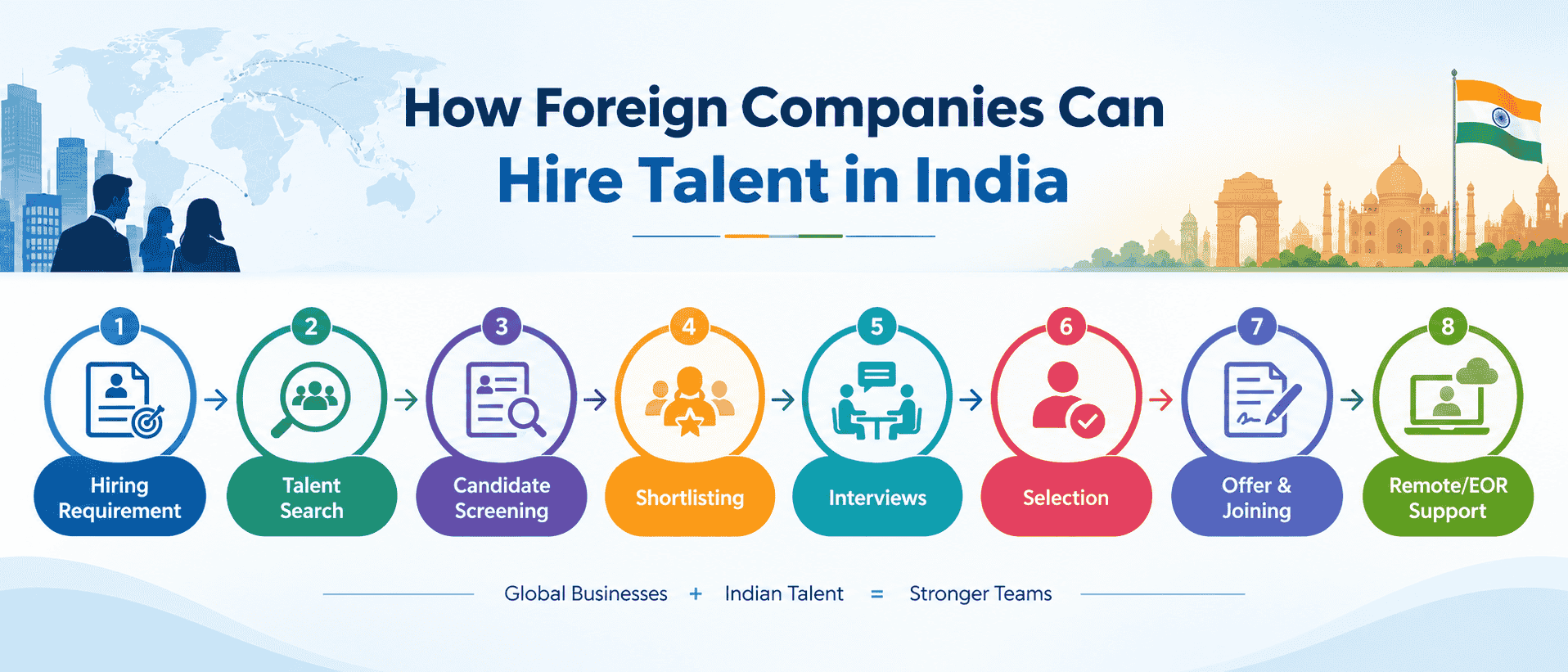


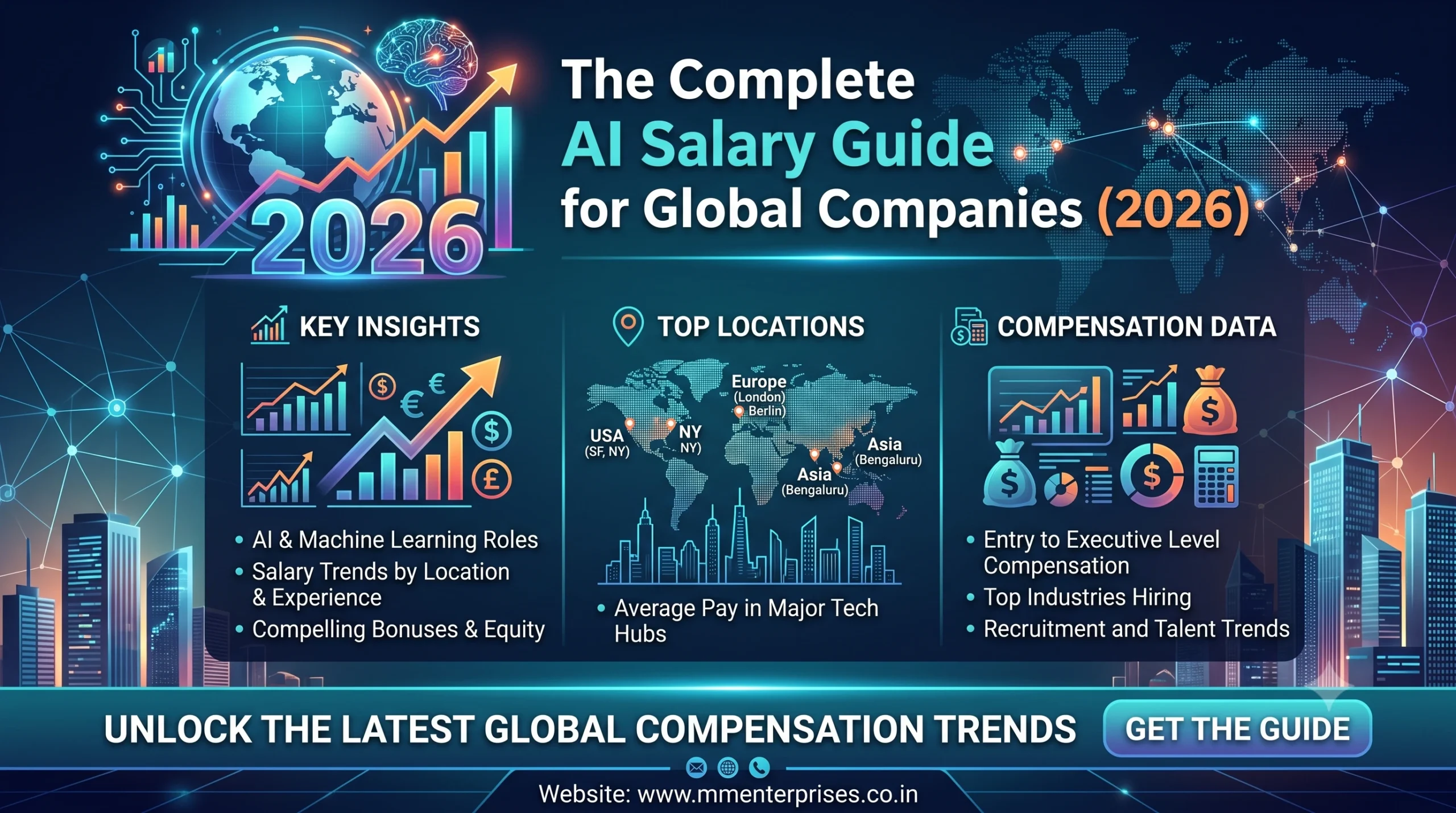
Hiring AI Engineers & Data Scientists in India: The Complete AI Salary Guide for Global Companies (2026)
Website: mmenterprises.co.in
Introduction
Artificial Intelligence (AI) has evolved from an experimental technology into a core business capability. Organizations across software, banking, healthcare, manufacturing, retail, logistics, and life sciences are investing heavily in AI to automate processes, improve customer experiences, and build innovative products.
This rapid adoption has created an unprecedented demand for AI Engineers, Data Scientists, Machine Learning Engineers, Prompt Engineers, MLOps Specialists, and Generative AI experts. However, hiring this talent has become increasingly competitive, particularly in North America and Europe, where salaries continue to rise and experienced professionals remain in short supply.
As a result, global companies are turning to India, one of the world’s largest technology talent hubs, to build high-performing AI teams. India offers a unique combination of skilled engineers, competitive salaries, a mature IT ecosystem, and a rapidly growing startup and Global Capability Center (GCC) landscape.
This guide explores why India has become a preferred destination for AI hiring, current salary benchmarks, in-demand skills, recruitment challenges, and best practices for building an AI team successfully.
Why India Is the Preferred Destination for AI Hiring
India has become one of the fastest-growing AI talent markets in the world. Companies from the US, UK, Europe, Singapore, Australia, and the Middle East are hiring AI professionals in India to support global digital transformation initiatives.
Key advantages include:
- Large pool of software and engineering professionals
- Strong STEM education ecosystem
- Experienced AI and cloud developers
- Competitive salary structure
- Rapidly expanding Global Capability Centers (GCCs)
- Mature IT and outsourcing industry
- Excellent English communication skills
- Strong startup and innovation ecosystem
India is no longer viewed as an outsourcing destination—it is increasingly becoming a strategic center for AI research, product engineering, and innovation.
The Growing Demand for AI Engineers
AI Engineers design, develop, deploy, and optimize artificial intelligence solutions that solve real business problems.
Common responsibilities include:
- Developing machine learning models
- Building Generative AI applications
- Creating AI-powered automation
- Integrating Large Language Models (LLMs)
- Deploying AI solutions on cloud platforms
- Optimizing AI model performance
- Working with structured and unstructured data
Industries hiring AI Engineers include:
- SaaS
- Healthcare
- Banking & Financial Services
- Manufacturing
- E-commerce
- Retail
- Logistics
- Automotive
- Pharmaceuticals
Why Data Scientists Are Essential
While AI Engineers build intelligent systems, Data Scientists transform data into business insights.
Their work includes:
- Data analysis
- Predictive modeling
- Business forecasting
- Customer analytics
- Recommendation systems
- Fraud detection
- Demand forecasting
Organizations increasingly rely on Data Scientists to support data-driven decision-making and improve operational efficiency.
Most In-Demand AI Roles in India
Global companies are actively hiring for:
- AI Engineer
- Data Scientist
- Machine Learning Engineer
- Generative AI Engineer
- Prompt Engineer
- LLM Engineer
- Computer Vision Engineer
- NLP Engineer
- MLOps Engineer
- AI Product Manager
- AI Architect
- Data Engineer
Demand is especially high for professionals with experience in production-grade AI systems.
Essential Skills to Look For
When hiring AI professionals, evaluate both technical and business capabilities.
Technical Skills
- Python
- TensorFlow
- PyTorch
- Scikit-learn
- SQL
- LangChain
- Hugging Face
- OpenAI APIs
- Gemini APIs
- Claude APIs
- Vector Databases
- Kubernetes
- Docker
- AWS, Azure, or Google Cloud
- MLOps tools
Business Skills
- Problem-solving
- Communication
- Stakeholder management
- Product thinking
- Analytical mindset
- Collaboration
AI Salary Guide in India (2026)
The following salary ranges are indicative and may vary based on city, company size, domain expertise, and technical skills.
| Role | Experience | Annual Salary (INR) | Monthly Salary (Approx.) |
| AI Engineer | 2–4 Years | ₹12–20 LPA | ₹1.0–1.7 Lakhs |
| Senior AI Engineer | 5–8 Years | ₹22–38 LPA | ₹1.8–3.2 Lakhs |
| Machine Learning Engineer | 3–7 Years | ₹15–30 LPA | ₹1.25–2.5 Lakhs |
| Data Scientist | 2–5 Years | ₹12–22 LPA | ₹1.0–1.8 Lakhs |
| Senior Data Scientist | 6–10 Years | ₹25–45 LPA | ₹2.1–3.8 Lakhs |
| Prompt Engineer | 2–5 Years | ₹10–20 LPA | ₹0.8–1.7 Lakhs |
| LLM Engineer | 5+ Years | ₹30–60 LPA | ₹2.5–5.0 Lakhs |
| AI Architect | 8–15 Years | ₹45–80+ LPA | ₹3.8–6.7 Lakhs |
Note: Professionals with hands-on experience in Generative AI, AI Agents, and Large Language Models often command premium compensation.
Where to Find AI Talent in India
Top AI hiring hubs include:
- Bengaluru – AI startups, SaaS, GCCs
- Hyderabad – Cloud, AI, and product engineering
- Pune – Manufacturing technology and software
- Chennai – Automotive, AI, and engineering
- Delhi NCR – Enterprise technology and consulting
- Mumbai – FinTech and financial services
- Ahmedabad – Emerging AI startup ecosystem
Each city offers unique strengths depending on industry and business objectives.
Recruitment Challenges
Despite India’s large talent pool, companies often encounter:
High Competition
AI professionals receive multiple offers from startups, product companies, and multinational corporations.
Salary Inflation
Demand for experienced AI talent continues to increase compensation levels.
Skill Verification
Many candidates list AI experience, but not all have worked on production-ready applications.
Long Hiring Cycles
Extended interview processes often result in losing candidates to faster-moving employers.
Best Practices for Hiring AI Talent
Hiring Artificial Intelligence (AI) professionals requires a completely different approach from traditional technology recruitment. While software developers and IT professionals remain in high demand, AI talent is significantly more specialized, combining expertise in machine learning, data engineering, cloud computing, mathematics, statistics, and business problem-solving.
The rapid adoption of Generative AI, Large Language Models (LLMs), AI Agents, intelligent automation, and predictive analytics has intensified competition for experienced AI professionals. Global technology companies, startups, Global Capability Centers (GCCs), financial institutions, healthcare organizations, and manufacturing enterprises are all competing for the same limited talent pool.
As a result, organizations must move beyond conventional hiring practices and adopt a strategic recruitment framework. Companies that clearly define job roles, assess practical technical expertise, offer competitive compensation, and create a compelling employer brand are far more likely to attract and retain high-performing AI professionals.
1. Define the Right Role
One of the most common hiring mistakes organizations make is treating every AI position as the same. Many companies publish generic job descriptions titled “AI Engineer” or “Machine Learning Expert” without clearly defining the actual responsibilities, required technologies, or expected business outcomes.
Artificial Intelligence is a broad discipline that includes multiple specialized roles. Hiring the wrong profile can lead to project delays, increased recruitment costs, poor productivity, and higher employee turnover.
Before beginning the recruitment process, organizations should answer several key questions:
- What business problem will this role solve?
- Is the objective to build AI-powered products or analyze business data?
- Will the employee develop machine learning models or deploy them into production?
- Does the project involve Generative AI, AI Agents, or predictive analytics?
- What cloud platform and AI tools will be used?
A clear understanding of these requirements enables recruiters to create accurate job descriptions, identify the right candidates, and conduct more effective technical evaluations.
AI Engineer
AI Engineers are responsible for designing, building, deploying, and maintaining AI-powered applications that solve real-world business challenges. Their work extends beyond developing machine learning models—they integrate AI into software products, cloud platforms, and enterprise systems.
Typical responsibilities include:
- Designing AI applications
- Building Generative AI solutions
- Integrating Large Language Models (LLMs)
- Developing AI-powered chatbots and virtual assistants
- Working with APIs such as OpenAI, Gemini, and Claude
- Deploying AI applications on cloud platforms
- Optimizing model performance
- Collaborating with software engineering teams
Essential Skills
- Python
- TensorFlow
- PyTorch
- LangChain
- Hugging Face
- Vector Databases
- REST APIs
- Docker
- Kubernetes
- AWS, Azure, or Google Cloud
AI Engineers are best suited for organizations developing AI-enabled products, automation platforms, enterprise applications, or intelligent customer experiences.
Data Scientist
While AI Engineers focus on building intelligent applications, Data Scientists concentrate on extracting valuable business insights from data.
They analyze structured and unstructured datasets to discover patterns, identify opportunities, and support strategic decision-making.
Typical responsibilities include:
- Data exploration
- Statistical analysis
- Predictive modeling
- Business forecasting
- Customer behavior analysis
- Recommendation systems
- Fraud detection
- Business intelligence reporting
Essential Skills
- Python
- SQL
- R
- Pandas
- NumPy
- Scikit-learn
- Tableau
- Power BI
- Statistical modeling
- Data visualization
Data Scientists are ideal for organizations seeking to improve decision-making through analytics, forecasting, and data-driven strategies rather than developing AI software products.
Machine Learning Engineer
Machine Learning Engineers bridge the gap between research and production.
Their primary responsibility is transforming machine learning models developed by Data Scientists into scalable, production-ready systems that can operate efficiently in real-world environments.
Typical responsibilities include:
- Training machine learning models
- Model optimization
- Feature engineering
- Production deployment
- Performance monitoring
- Model retraining
- API development
- Scalable inference systems
Essential Skills
- Python
- TensorFlow
- PyTorch
- XGBoost
- Feature engineering
- Cloud deployment
- Model optimization
- CI/CD pipelines
Machine Learning Engineers are essential for organizations deploying AI at scale across customer-facing products or enterprise platforms.
MLOps Engineer
Developing an AI model is only the beginning. Maintaining, monitoring, and continuously improving that model requires specialized operational expertise.
This is the responsibility of an MLOps Engineer.
MLOps combines Machine Learning with DevOps principles to automate the deployment, monitoring, governance, and lifecycle management of AI systems.
Typical responsibilities include:
- Model deployment
- CI/CD for machine learning
- Infrastructure automation
- Performance monitoring
- Data pipeline management
- Model version control
- Security and governance
- Scalability optimization
Essential Skills
- Kubernetes
- Docker
- MLflow
- Kubeflow
- Jenkins
- Terraform
- AWS SageMaker
- Azure ML
- Google Vertex AI
As organizations scale AI initiatives across departments, MLOps Engineers become critical for maintaining reliability, reducing downtime, and ensuring continuous model performance.
Prompt Engineer
The emergence of Generative AI has created one of the newest and fastest-growing roles in the technology industry—Prompt Engineering.
Prompt Engineers specialize in designing, testing, and optimizing prompts that guide Large Language Models (LLMs) such as ChatGPT, Gemini, Claude, and other Generative AI systems to produce accurate, consistent, and business-ready outputs.
Typical responsibilities include:
- Prompt design
- AI workflow optimization
- AI content generation
- Prompt testing
- AI evaluation
- AI safety improvements
- Workflow automation
- Retrieval-Augmented Generation (RAG)
Essential Skills
- Large Language Models
- Prompt engineering techniques
- LangChain
- OpenAI APIs
- Gemini APIs
- Claude APIs
- Vector databases
- RAG architecture
- AI Agents
Prompt Engineers play an important role in developing AI-powered customer service platforms, enterprise knowledge systems, content automation, coding assistants, and business productivity applications.
Choosing the Right AI Role
Many AI projects fail not because of technology limitations but because organizations hire the wrong professionals for the job.
For example:
- Hiring a Data Scientist when an AI Engineer is required can delay product development.
- Hiring an AI Engineer when business analytics is the primary objective may increase costs without delivering the expected insights.
- Deploying production AI systems without an MLOps Engineer can lead to scalability and maintenance challenges.
- Building Generative AI applications without Prompt Engineering expertise often results in inconsistent outputs and poor user experiences.
Clearly identifying business objectives before recruitment helps companies select the right talent, improve project outcomes, and maximize return on investment.
2. Offer Competitive Compensation
The AI talent market is evolving rapidly, and experienced professionals often receive multiple offers from startups, product companies, Global Capability Centers (GCCs), and multinational corporations.
To remain competitive, companies should benchmark salaries regularly based on:
- Experience level
- Technical expertise
- Industry demand
- Geographic location
- Specialized AI skills
Candidates with expertise in Generative AI, Large Language Models (LLMs), AI Agents, Computer Vision, or MLOps often command premium salaries due to limited talent availability.
Beyond salary, companies should offer a comprehensive compensation package that may include:
- Performance bonuses
- Health insurance
- Learning and certification support
- Flexible work arrangements
- Stock options or ESOPs
- Annual salary reviews
A competitive compensation strategy not only improves offer acceptance rates but also strengthens employee retention.
3. Focus on Practical Experience
Technical certifications and academic qualifications are valuable, but practical experience is often the strongest indicator of an AI professional’s capabilities.
Recruiters and hiring managers should prioritize candidates who have successfully delivered real-world AI solutions.
Look for experience in:
- Live AI or machine learning deployments
- Production-ready applications
- GitHub portfolios showcasing code quality
- Cloud platforms such as AWS, Microsoft Azure, or Google Cloud
- Large Language Model (LLM) integration projects
- Retrieval-Augmented Generation (RAG) implementations
- AI Agents and workflow automation
- Computer Vision or Natural Language Processing (NLP) projects
- End-to-end machine learning pipelines
Technical interviews should focus on business problem-solving, system design, scalability, and deployment experience rather than only theoretical knowledge.
Candidates who have built AI solutions in production environments are typically better prepared to contribute from day one.
4. Streamline the Hiring Process
The best AI professionals are often available in the job market for only a short period. A slow recruitment process can result in losing high-quality candidates to faster competitors.
Organizations should aim to complete the hiring process within two to three weeks.
A structured hiring workflow may include:
- Resume screening
- Initial HR discussion
- Technical assessment or coding challenge
- Technical interview
- Leadership or cultural fit interview
- Final offer
To improve candidate experience:
- Schedule interviews promptly.
- Provide timely feedback after each stage.
- Avoid unnecessary interview rounds.
- Make competitive offers without delay.
A fast and transparent hiring process significantly improves offer acceptance rates and strengthens the company’s reputation in the talent market.
5. Build a Strong Employer Brand
Top AI professionals evaluate more than salary when choosing an employer. They want to work for organizations that invest in innovation, learning, and long-term career development.
Candidates often consider:
- Opportunities to work on cutting-edge AI projects
- Continuous learning and certification programs
- Clear career progression paths
- Leadership quality and mentorship
- Innovation-driven work culture
- Flexible or hybrid work options
- Access to modern AI tools and cloud infrastructure
- Diversity and collaborative team environments
Companies should showcase their employer brand through:
- Employee success stories
- AI case studies
- Technical blogs and engineering insights
- LinkedIn thought leadership
- Participation in AI conferences and hackathons
- Open-source contributions
A strong employer brand helps attract passive candidates, reduces hiring costs, and improves long-term retention.
Choosing the Right Hiring Model
International companies should align their hiring model with business objectives.
Recruitment Consultants
Ideal for sourcing specialized AI professionals quickly.
Employer of Record (EOR)
Suitable for companies without an Indian legal entity.
Global Capability Center (GCC)
Best for long-term AI research and product development.
Direct Entity Setup
Recommended for permanent operations with larger teams.
Many successful organizations combine recruitment consulting with EOR or GCC strategies as they scale.
Why Partner with M M Enterprises?
Hiring AI professionals requires more than posting job advertisements. It requires market intelligence, technical screening, salary benchmarking, and access to passive candidates.
M M Enterprises helps global companies build world-class AI and technology teams through:
- AI Engineer Recruitment
- Data Scientist Recruitment
- Machine Learning Hiring
- Executive Search
- Engineering Recruitment
- Technology Talent Mapping
- Salary Benchmarking
- Workforce Planning
- Recruitment Process Outsourcing (RPO)
Our recruitment specialists understand both technical requirements and industry trends, enabling companies to hire faster and more effectively.
Future Outlook
The demand for AI Engineers and Data Scientists in India will continue to grow as businesses invest in Generative AI, AI Agents, intelligent automation, robotics, predictive analytics, and cloud-native AI solutions.
Organizations that build strong AI teams today will be better positioned to innovate, scale globally, and maintain a competitive advantage in the years ahead.
Conclusion
India has established itself as one of the world’s leading destinations for AI talent. Its combination of technical expertise, competitive salaries, and mature technology ecosystem makes it an ideal location for companies building AI-driven businesses.
Whether you need a small team of AI specialists or a large-scale engineering organization, success depends on hiring the right people, offering competitive compensation, and partnering with experienced recruitment professionals.
M M Enterprises helps international organizations recruit high-quality AI Engineers, Data Scientists, Machine Learning Engineers, and technology leaders across India, enabling faster hiring and sustainable business growth.
Ready to build your AI team in India?
Visit mmenterprises.co.in to connect with our recruitment experts and discover how we can help you hire the talent that powers tomorrow’s innovation.