


Executive Search in India: Finding the Right Leaders for Your Business
Executive search in India helps businesses identify and recruit experienced leaders who can guide teams, strengthen operations, and support long-term growth. For companies looking for CEOs, directors, business heads, and senior management professionals, an executive search partner can provide targeted candidate sourcing, confidential outreach, and structured evaluation. The goal is to find leaders whose experience, skills, and leadership approach match the company’s business objectives.
Introduction
The success of a business depends not only on its products, services, or market position but also on the people making important decisions. Strong leadership helps organizations set clear goals, manage change, develop teams, and respond to new business opportunities.
However, finding the right senior leader can be challenging. Experienced professionals may not actively apply for advertised vacancies, and a candidate with an impressive CV may not necessarily be the right fit for an organization’s culture, strategy, or future plans.
This is why Executive Search in India is an important consideration for companies recruiting senior professionals. Executive search uses a focused approach to identify, approach, assess, and shortlist candidates for leadership and other critical positions.
For Indian businesses and international companies expanding into India, a suitable executive search partner can help make senior-level recruitment more structured and targeted. Instead of relying only on incoming applications, businesses can explore a wider pool of potential candidates and evaluate their suitability against clearly defined requirements.
In this article, we explain how executive search works, why businesses use it, what to consider when choosing a recruitment partner, and how to find leaders who can contribute to long-term business success.
1. What Is Executive Search in India?
Executive search is a specialised recruitment service focused on finding suitable candidates for senior management, executive, and other business-critical positions. It involves identifying potential leaders, assessing their qualifications and experience, and evaluating how well they match the organisation’s strategic requirements.
Unlike general recruitment, which may focus on applications received through job advertisements, executive search often involves proactively approaching professionals who are already working in relevant positions.
An executive search firm in India may help businesses recruit:
- Chief Executive Officers (CEOs) and Managing Directors.
- Chief Financial Officers (CFOs) and Finance Directors.
- Chief Technology Officers (CTOs) and IT leaders.
- Vice Presidents and Business Heads.
- Plant Heads and Operations Directors.
- Sales, marketing, and human resources leaders.
- Senior engineering and industry-specific professionals.
The exact scope depends on the company’s needs and the search firm’s specialisation.
For example, an international manufacturing company establishing operations in India may need a country head who understands the local market, can build a capable team, and can coordinate with global management. Executive search can help identify professionals with the appropriate combination of industry experience, leadership ability, and business understanding.
2. Why Is Executive Search Important for Businesses?
Leadership appointments influence business direction, employee engagement, operational performance, and future growth. Choosing the right person requires more than matching a job title with a candidate’s CV.
Finding Leaders Beyond Traditional Job Applications
Some experienced executives are not actively looking for new opportunities. They may consider a career move if the role offers meaningful responsibilities, professional development, or an opportunity to lead a new business initiative.
An executive search consultant can identify and approach suitable professionals who might not otherwise apply for the position.
This targeted approach can expand the potential candidate pool, particularly when a business needs someone with a specific combination of industry expertise and leadership experience.
Matching Leadership Skills With Business Goals
A successful leader must meet the requirements of the position and understand the company’s wider objectives.
For instance, a growing company may need a business head who can establish new markets, develop customer relationships, and build an effective sales team. Another organisation may need an operations director who can improve processes and manage expansion.
Executive search helps define these requirements before the candidate search begins. This allows the evaluation to focus on relevant experience, decision-making ability, leadership style, and the challenges the successful candidate will need to address.
Supporting Confidential Hiring
Some leadership appointments require discretion. A business may be replacing a senior executive, restructuring a department, or creating a new position that has not yet been announced publicly.
A confidential search can help the company approach candidates discreetly while limiting unnecessary disclosure of sensitive information.
Confidentiality should be agreed upon at the start, including how the role is described, when the employer’s identity is disclosed, and how candidate information is handled.
Improving the Quality of Candidate Shortlisting
Executive recruitment often involves several decision-makers, including business owners, board members, HR leaders, and functional heads.
A structured search can help these stakeholders evaluate candidates against consistent criteria rather than relying only on personal impressions.
A shortlist should explain why each candidate may be suitable, highlighting relevant achievements, leadership experience, and potential development areas. The employer can then make a more informed final decision.
3. How Does the Executive Search Process Work?
A clear process helps companies and recruitment consultants agree on expectations and maintain progress throughout a senior-level search.
Step 1: Define the leadership requirement.
Establish the position’s responsibilities, reporting structure, business objectives, experience requirements, compensation range, and expected timeline.
Step 2: Map the relevant talent market.
Identify suitable industries, organisations, professional backgrounds, and potential candidates who match the agreed criteria.
Step 3: Approach and evaluate candidates
Discuss the opportunity with potential candidates and assess their relevant experience, leadership approach, interest, and career expectations.
Step 4: Present a shortlist.
Share relevant candidate profiles and assessment observations with the employer for review and further interviews.
Step 5: Support selection and offer discussions
Coordinate interviews, collect feedback, and assist with offer discussions and joining follow-ups, as agreed with the client.
The process may vary according to the seniority of the role, market conditions, candidate availability, and the number of interview stages. Background checks and reference checks should be conducted with appropriate authorization and in accordance with applicable requirements.
4. What Are the Benefits of Hiring an Executive Search Firm in India?
Businesses can benefit from executive search when the role requires specialized experience, confidentiality, or access to a targeted group of senior professionals.
| Benefit | Business value |
| Targeted candidate sourcing | Focuses the search on relevant professional backgrounds |
| Wider access to talent | Helps identify candidates beyond incoming applications |
| Confidentiality | Supports discreet searches for sensitive appointments |
| Structured evaluation | Provides consistent criteria for assessing candidates |
| Recruitment coordination | Helps organize interviews, feedback, and offer discussions |
| Industry understanding | Supports searches requiring specific technical or commercial expertise |
These benefits are not automatic. The results depend on the clarity of the brief, the quality of the search process, the candidates available, and the employer’s involvement in the selection process.
5. Which Companies Should Consider Executive Search in India?
Executive search can be useful for businesses at different stages of development.
Growing Companies and Startups
Growing organizations may need experienced leaders to establish departments, improve business processes, develop commercial strategies, or prepare for expansion.
A targeted search can help identify professionals whose experience matches the company’s stage of development rather than simply selecting candidates from larger organizations.
Established Indian Businesses
Established businesses may require senior professionals to lead new divisions, strengthen operations, support succession planning, or bring new expertise into the management team.
Executive search can help identify external candidates while allowing the employer to assess internal talent separately.
International Companies Entering India
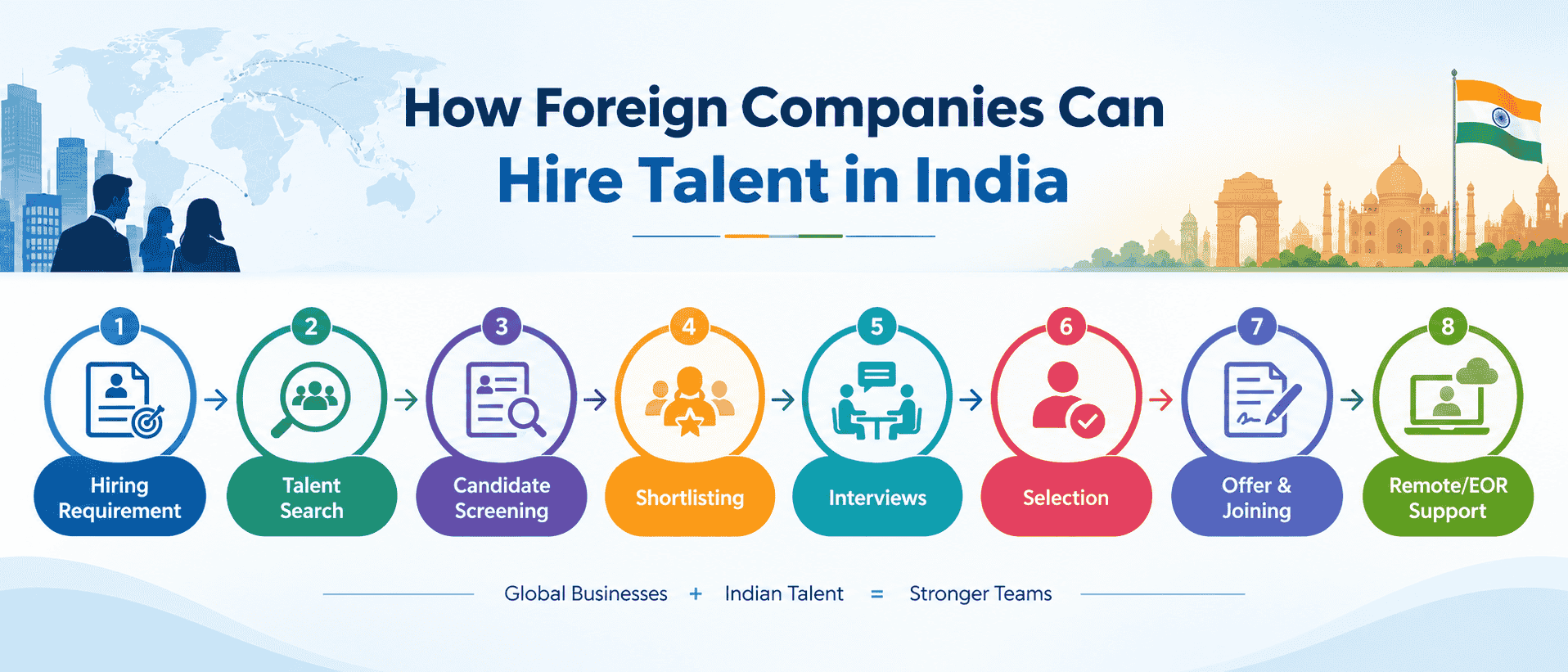
Foreign companies may need an India-based country manager, business development leader, finance head, or operations director.
These appointments can require a combination of local market knowledge and the ability to work with international teams. An executive search partner familiar with the Indian talent market can help identify professionals who meet both requirements.
For international companies, recruitment and employment arrangements should also be planned separately. If the business needs assistance with employment administration, payroll, or an Employer of Record arrangement, it should confirm whether those services are available under a separate agreement.
6. How Do You Choose the Right Executive Search Firm in India?
Selecting an executive search partner requires careful consideration. The firm should understand the business challenge behind the vacancy, not just the designation listed in the job description.
Before appointing a firm, consider the following factors:
- Relevant experience: Ask whether the firm has worked on comparable leadership roles and understands your industry.
- Search methodology: Understand how it identifies, approaches, and assesses potential candidates.
- Candidate confidentiality: Discuss how sensitive information and candidate details will be protected.
- Clear communication: Agree on progress updates, feedback schedules, and responsibilities.
- Transparent commercial terms: Confirm fees, payment milestones, deliverables, and any replacement provisions.
- Assessment approach: Ask how the firm evaluates leadership experience, role suitability, and the candidate’s motivation.
- Realistic timelines: Request an estimated search plan while recognizing that senior appointments depend on candidate availability and notice periods.
It is also helpful to agree on what a successful appointment looks like before the search begins. A clear brief makes it easier for both the company and the search consultant to evaluate progress.
7. What Challenges Can Executive Search Help Address?
Senior-level recruitment can involve challenges that are less common in routine hiring. Recognizing these challenges early helps employers plan a more effective search.
Limited availability of suitable candidates: Some roles require a rare mix of technical expertise, commercial experience, and leadership capability. A targeted search can help explore relevant talent pools.
Unclear expectations: If stakeholders disagree about the responsibilities or authority of a new leader, even a qualified candidate may struggle. Defining the role and reporting structure before recruitment begins helps reduce this risk.
Compensation differences: Senior candidates may have expectations that differ from the employer’s budget. Discussing compensation, benefits, responsibilities, and career opportunities early can avoid unnecessary delays.
Cultural and organizational alignment: A candidate may have an excellent professional record but prefer a working environment that differs from the employer’s culture. Structured interviews and realistic discussions about management expectations can help both sides assess compatibility.
Slow decision-making: Multiple interview rounds and delayed feedback can cause employers to lose interested candidates. Agreeing on decision-makers and interview timelines helps keep the process moving.
Executive search cannot eliminate every hiring risk, but a clear brief, consistent evaluation, and timely communication can make the process more informed.
8. Why Consider MM Enterprises for Executive Search in India?
MM Enterprises (MME) provides executive search and recruitment services for organizations looking for experienced professionals in India and international markets. Its website describes support for senior leadership hiring, recruitment consulting, and industry-specific talent requirements.
For businesses looking to strengthen their leadership teams, MME’s executive recruitment services provide a starting point for discussing role requirements, candidate sourcing, and the search process.
Companies can explore MME’s services to discuss:
- CEO, director, and senior management recruitment requirements.
- Industry-specific leadership and specialist positions.
- Candidate sourcing and shortlisting.
- Interview coordination and recruitment follow-ups.
- Recruitment support for international employers hiring in India.
The best approach depends on the role, the business’s priorities, and the experience needed. Employers should discuss the search scope and commercial terms directly with the recruitment team before proceeding.
To learn more, visit the MM Enterprises website or review its Executive Recruitment Services and Leadership Hiring Services.
9. Frequently Asked Questions About Executive Search in India
1. What is executive search in India?
Executive search in India is a specialized recruitment process used to identify, approach, and evaluate candidates for senior management, executive, and other critical positions. It often involves targeted sourcing rather than relying exclusively on job applications.
2. What positions do executive search firms recruit for?
Depending on their expertise, executive search firms may recruit CEOs, managing directors, CFOs, CTOs, vice presidents, business heads, directors, and senior functional leaders.
3. How is executive search different from regular recruitment?
Regular recruitment often covers a broad range of positions and may rely on job advertisements and incoming applications. Executive search generally uses a more targeted approach to identify and assess professionals for senior or specialised roles.
4. How long does an executive search take in India?
The timeline depends on the position, candidate availability, industry, compensation, interview process, and notice periods. Employers should agree on a realistic search plan with their recruitment partner rather than assume a fixed completion time.
5. Can international companies use executive search firms in India?
Yes. International companies can engage executive search firms to identify India-based leaders for local operations, regional responsibilities, and specialist management positions. The employer should separately establish an appropriate employment arrangement.
6. How much do executive search services cost in India?
Fees vary according to the role’s seniority, search complexity, service scope, and the commercial agreement. Employers should request a written proposal that clearly explains fees, deliverables, payment terms, and any replacement conditions.
7. What should companies look for in an executive search consultant?
Companies should consider industry knowledge, relevant search experience, candidate sourcing methods, confidentiality practices, evaluation processes, communication standards, and transparent commercial terms.
Conclusion: Find the Right Leaders for Your Business
Choosing the right leader is an important investment in a company’s future. The right appointment can strengthen teams, support strategic decisions, improve operations, and help a business respond to changing market needs.
Executive Search in India offers businesses a focused way to identify and evaluate senior professionals whose experience and leadership capabilities match their objectives. With a clear hiring brief, a structured selection process, and the right recruitment partner, companies can make more informed leadership decisions.
MM Enterprises supports businesses with executive search and recruitment services for leadership and other professional roles. If your organisation is planning a senior-level appointment or building a stronger management team, discuss your requirements with MME to explore a suitable recruitment approach.
Visit www.mmenterprises.co.in to learn more about its recruitment services.