
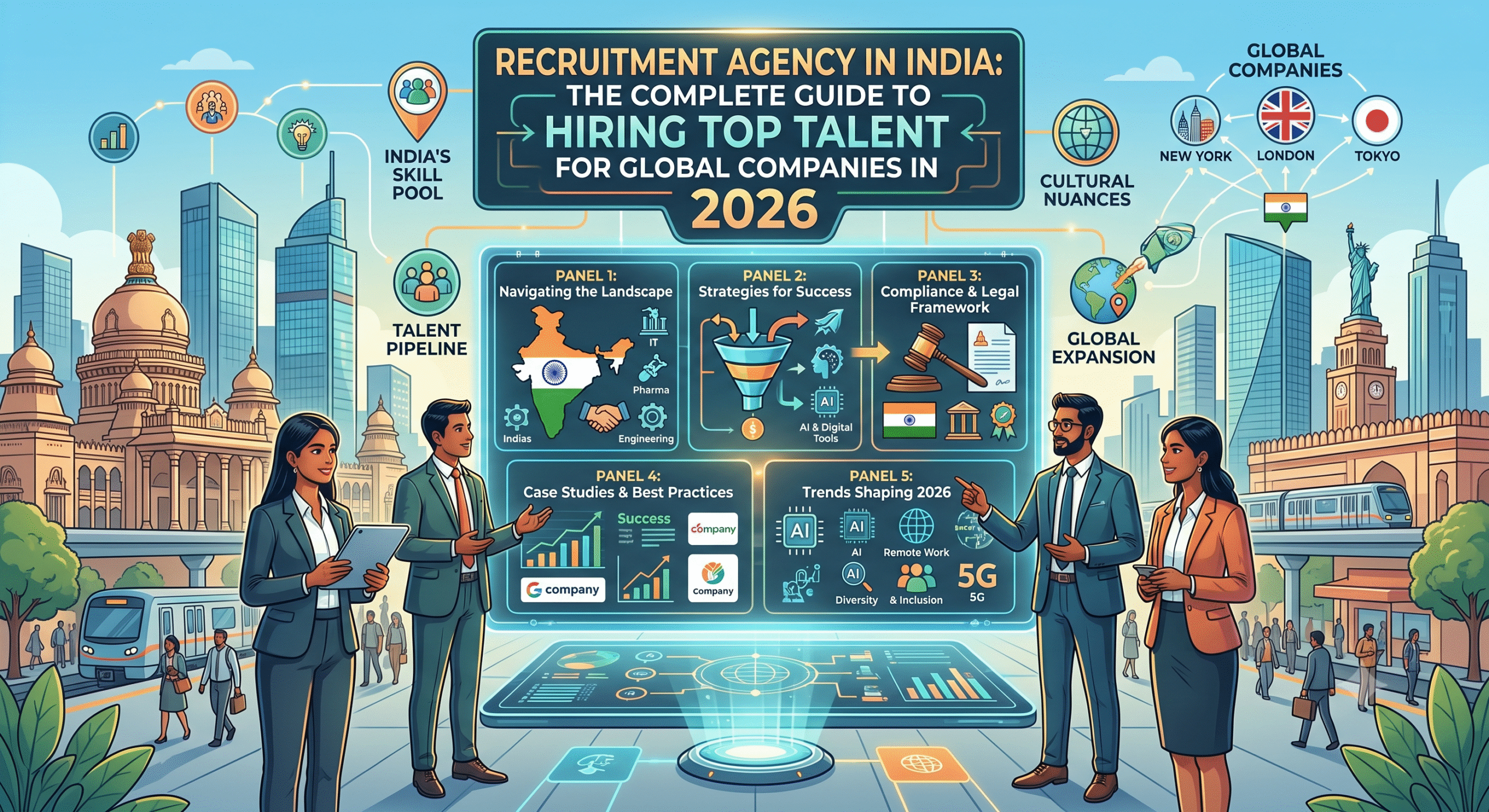
Recruitment Agency in India: The Complete Guide to Hiring Top Talent for Global Companies in 2026
Introduction
As businesses continue to expand across borders, talent acquisition has become one of the most important strategic priorities for organizations worldwide. Companies are no longer limited by geography when building high-performing teams. Instead, they are increasingly seeking skilled professionals in markets that offer a combination of technical expertise, cost efficiency, innovation, and scalability. Among these global talent destinations, India continues to stand out as one of the most attractive recruitment markets in 2026.
India has evolved far beyond being an outsourcing hub. Today, it is a global center for engineering excellence, artificial intelligence, digital transformation, finance, healthcare, manufacturing, research and development, and Global Capability Centers (GCCs). Multinational corporations, startups, private equity-backed businesses, and Fortune 500 companies are investing heavily in Indian talent to accelerate innovation and support long-term business growth.
However, hiring exceptional professionals in India requires much more than posting job advertisements. Competition for top talent is intense, candidate expectations are changing rapidly, and organizations must navigate local employment practices, salary benchmarks, compliance considerations, and employer branding to attract the right people.
This is where an experienced Recruitment Agency in India becomes a valuable strategic partner. Rather than simply filling vacancies, professional recruitment consultants help organizations identify high-quality candidates, shorten hiring cycles, improve offer acceptance rates, and build sustainable talent pipelines.
MME supports domestic and international companies in hiring skilled professionals across industries and functions. With extensive market knowledge, industry expertise, and access to a vast talent network, we help businesses recruit professionals ranging from engineers and AI specialists to senior executives and leadership teams.
Whether you are establishing your first team in India, expanding an existing operation, launching a Global Capability Center, or hiring niche technical specialists, understanding India’s recruitment landscape is essential for making informed hiring decisions.
This comprehensive guide explores why India remains a preferred hiring destination, how the recruitment process works, the industries driving talent demand, and how partnering with the right recruitment consultants can help global organizations secure the best professionals in one of the world’s most dynamic talent markets.
Why Global Companies Recruit in India
India’s position as a global recruitment destination has strengthened significantly over the past decade. In 2026, organizations across North America, Europe, the Middle East, Asia-Pacific, and Australia continue to prioritize India as a strategic location for sourcing highly skilled professionals.
Several factors contribute to India’s growing importance in global talent acquisition.
One of the World’s Largest Skilled Talent Pools
India produces millions of graduates every year across engineering, computer science, business management, finance, life sciences, healthcare, and manufacturing disciplines. Thousands of universities, technical institutes, and professional colleges supply organizations with qualified professionals ready to contribute across diverse industries.
This vast talent ecosystem enables employers to recruit both entry-level professionals and highly experienced specialists without being constrained by limited workforce availability.
Strong Engineering and Technology Expertise
India is globally recognized for its engineering capabilities. Companies hiring software engineers, cloud architects, cybersecurity experts, DevOps professionals, embedded engineers, semiconductor specialists, and product developers often consider India a primary talent source.
Technology professionals in India have extensive experience working on global projects using modern development frameworks, cloud platforms, enterprise software, and emerging technologies. Many have collaborated with international teams, making them well-equipped for distributed and hybrid work environments.
Global Leadership in Artificial Intelligence
Artificial Intelligence has become a major driver of recruitment demand in India. Organizations are actively hiring professionals specializing in machine learning, generative AI, computer vision, natural language processing, data science, robotics, and AI infrastructure.
India’s rapidly growing AI ecosystem benefits from strong academic institutions, thriving startup communities, multinational research centers, and increasing investments in innovation. As a result, global companies are able to build highly capable AI teams while maintaining scalability and operational efficiency.
Cost-Effective Talent Acquisition
While hiring decisions should never be based solely on cost, India continues to offer an attractive balance between quality and investment. Organizations can often build high-performing teams while optimizing recruitment budgets compared to many mature labor markets.
The ability to access skilled professionals at competitive salary levels enables businesses to invest further in product development, research, customer success, and market expansion.
English Proficiency and Global Collaboration
English remains the primary language of business across much of India’s corporate sector. Professionals frequently work with international clients, distributed engineering teams, and global leadership groups, making communication and collaboration significantly easier for multinational organizations.
Combined with experience in international business practices, this makes Indian professionals valuable contributors to globally distributed operations.
Expanding Global Capability Centers
India has become a preferred destination for Global Capability Centers (GCCs), with multinational organizations establishing technology, finance, engineering, analytics, procurement, and innovation hubs across major cities.
Rather than serving solely as support functions, modern GCCs increasingly lead product innovation, research, AI development, cybersecurity, and strategic business operations. This evolution has further strengthened India’s reputation as a long-term global talent destination.
India’s Talent Landscape Overview
India’s workforce has become increasingly diverse, specialized, and innovation-driven. Organizations recruiting in 2026 are no longer limited to hiring software developers alone. Instead, they can access highly qualified professionals across nearly every business function and industry.
Technology and Digital Talent
Technology remains India’s largest recruitment segment. Demand continues to grow for software engineers, full-stack developers, cloud engineers, cybersecurity specialists, AI researchers, data engineers, DevOps professionals, product managers, UX designers, and enterprise application experts.
Many professionals possess experience working with global organizations, agile methodologies, cloud-native architectures, and digital transformation initiatives, enabling companies to build scalable technology teams quickly.
Engineering and Manufacturing Professionals
India is also a major source of mechanical, electrical, civil, industrial, automotive, aerospace, and manufacturing engineers. As global manufacturing investments increase and supply chains diversify, organizations continue to recruit Indian engineering talent for design, production, quality assurance, automation, and research roles.
The country’s expanding industrial ecosystem has created a strong pipeline of professionals with expertise in advanced manufacturing technologies, process optimization, and operational excellence.
Financial and Business Professionals
India has established itself as a leading destination for finance, accounting, taxation, auditing, procurement, compliance, business analytics, and shared services. Global companies rely on Indian professionals to support financial operations, regulatory compliance, strategic planning, and data-driven decision-making.
Professionals with internationally recognized certifications and experience working within multinational organizations further strengthen India’s position as a trusted financial talent hub.
Healthcare and Life Sciences
Healthcare recruitment has expanded considerably due to rising investments in pharmaceuticals, biotechnology, medical devices, clinical research, and digital health. Skilled doctors, nurses, pharmacists, laboratory professionals, regulatory specialists, and healthcare administrators continue to be in high demand across domestic and international markets.
Leadership and Executive Talent
India’s corporate ecosystem has matured significantly, producing experienced business leaders capable of managing regional and global operations. Organizations increasingly recruit executives for technology, manufacturing, finance, sales, operations, human resources, and innovation leadership roles.
Executive search firms play a critical role in identifying senior professionals who possess the leadership capabilities, cultural alignment, and strategic vision required to drive organizational growth.
As global hiring continues to evolve, India offers far more than workforce scale. It provides a unique combination of technical expertise, leadership capability, innovation, and business maturity that enables organizations to build resilient, future-ready teams. Companies that partner with experienced recruitment consultants gain faster access to this exceptional talent while reducing hiring risks, improving recruitment outcomes, and creating a strong foundation for sustainable global expansion.
Engineering Talent, AI Talent, Manufacturing, Finance, Healthcare & GCC Hiring Trends in India (2026)
Engineering Talent: Why Global Companies Continue to Hire Engineers in India
Engineering remains the cornerstone of India’s global talent advantage. Every year, India produces a significant number of engineering graduates across disciplines including computer science, electronics, mechanical, electrical, civil, chemical, aerospace, industrial, and instrumentation engineering. While quantity is impressive, what truly attracts international employers is the increasing quality of engineering talent and its ability to solve complex business challenges.
Today, Indian engineers contribute to mission-critical projects for Fortune 500 companies, unicorn startups, semiconductor manufacturers, automotive leaders, healthcare innovators, and industrial enterprises. They design enterprise software, develop embedded systems, build cloud-native applications, optimize manufacturing processes, and support digital transformation initiatives across the world.
Global companies hire engineers in India for roles such as:
- Software Engineers
- Full-Stack Developers
- Cloud Engineers
- DevOps Engineers
- Cybersecurity Specialists
- Data Engineers
- Embedded Systems Engineers
- Mechanical Design Engineers
- Electrical Engineers
- Automation Engineers
- Quality Assurance Engineers
- Product Development Engineers
One of India’s greatest strengths is its adaptability. Engineers are experienced with Agile methodologies, DevSecOps practices, cloud platforms, AI-assisted development, automation tools, and collaborative project management. Many professionals have worked with distributed international teams, making integration into global organizations seamless.
Recruitment agencies play an important role by identifying candidates with both technical expertise and strong communication skills. Rather than relying solely on resumes, experienced recruitment consultants evaluate project experience, problem-solving ability, cultural fit, and long-term career goals to ensure successful placements.
Hire AI Talent India: Building Future-Ready Teams
Artificial Intelligence has become one of the fastest-growing recruitment segments in India. As businesses accelerate digital transformation, AI is no longer limited to research laboratories. Organizations across healthcare, banking, retail, logistics, manufacturing, insurance, automotive, education, and telecommunications are investing heavily in AI-powered solutions.
This growing demand has positioned India as one of the world’s leading destinations for AI talent.
Companies are actively recruiting professionals specializing in:
- Machine Learning
- Generative AI
- Large Language Models (LLMs)
- Natural Language Processing (NLP)
- Computer Vision
- Reinforcement Learning
- Predictive Analytics
- AI Infrastructure
- Data Engineering
- MLOps
- AI Product Management
- Robotics and Intelligent Automation
The country’s thriving startup ecosystem, expanding research community, and growing investments in AI education have created a strong pipeline of highly skilled professionals.
However, AI specialists remain among the most competitive candidates in today’s job market. Top professionals often receive multiple offers simultaneously, making speed and employer branding essential factors in successful hiring.
Experienced recruitment consultants help organizations:
- Source passive AI candidates
- Validate technical expertise
- Assess practical project experience
- Benchmark salaries
- Improve offer acceptance rates
- Reduce hiring timelines
- Build long-term AI talent pipelines
Whether hiring a single AI engineer or establishing an entire AI Center of Excellence, partnering with a specialized recruitment agency significantly improves hiring outcomes.
Manufacturing Talent: Supporting Global Industrial Growth
India’s manufacturing sector continues to expand rapidly as multinational companies diversify supply chains and establish new production facilities across the country.
Government initiatives, infrastructure development, and increased foreign investment have accelerated demand for experienced manufacturing professionals in industries including:
- Automotive
- Aerospace
- Electronics
- Heavy Engineering
- Renewable Energy
- Consumer Goods
- Industrial Equipment
- Chemicals
- Pharmaceutical Manufacturing
- Food Processing
Modern manufacturing organizations require professionals who understand automation, Industry 4.0, robotics, digital production systems, lean manufacturing, and operational excellence.
Frequently recruited positions include:
- Plant Managers
- Production Engineers
- Process Engineers
- Supply Chain Specialists
- Procurement Managers
- Industrial Engineers
- Quality Managers
- Lean Manufacturing Experts
- Maintenance Engineers
- Project Managers
Recruitment consultants with manufacturing expertise understand industry-specific requirements and can identify candidates with practical experience in production environments, ensuring businesses recruit professionals capable of delivering measurable operational improvements.
Finance Professionals: Supporting Global Business Operations
India has become one of the world’s leading destinations for finance and business operations. Global organizations increasingly establish finance shared services, accounting centers, treasury operations, procurement functions, tax departments, and business analytics teams within India.
Demand continues to grow for professionals in:
- Financial Planning & Analysis (FP&A)
- Corporate Finance
- Accounting
- Taxation
- Internal Audit
- Treasury
- Risk Management
- Compliance
- Procurement
- Payroll
- Financial Reporting
- Business Intelligence
Many professionals possess internationally recognized certifications and experience supporting multinational organizations, enabling seamless collaboration across global finance functions.
Recruitment agencies help organizations recruit finance professionals with industry-specific expertise while ensuring alignment with technical qualifications, compliance requirements, leadership capabilities, and business objectives.
As finance becomes increasingly technology-driven, employers also seek candidates experienced with ERP platforms, automation tools, financial analytics, AI-powered reporting, and digital finance transformation initiatives.
Healthcare Recruitment: Meeting Growing Global Demand
Healthcare remains one of India’s strongest professional sectors. The country produces highly qualified doctors, nurses, pharmacists, medical researchers, laboratory specialists, healthcare administrators, and life sciences professionals who support healthcare systems worldwide.
Growing investments in pharmaceuticals, biotechnology, clinical research, medical devices, telemedicine, and digital health have significantly expanded recruitment opportunities.
International employers frequently recruit professionals in areas such as:
- Clinical Research
- Pharmacovigilance
- Regulatory Affairs
- Biotechnology
- Medical Devices
- Hospital Administration
- Digital Healthcare
- Laboratory Sciences
- Medical Coding
- Healthcare Analytics
Healthcare recruitment requires careful evaluation of professional qualifications, certifications, licensing requirements, regulatory compliance, and international eligibility criteria.
Experienced recruitment consultants simplify this complex process by verifying credentials, assessing technical competency, and ensuring candidates meet employer expectations before progressing through the hiring process.
GCC Hiring Trends: India’s Expanding Global Capability Center Ecosystem
Global Capability Centers (GCCs) continue to reshape India’s recruitment landscape in 2026. Initially established as cost-efficient back-office operations, today’s GCCs function as innovation hubs responsible for product development, engineering, artificial intelligence, cybersecurity, finance, analytics, research, customer experience, and strategic decision-making.
Leading multinational organizations continue expanding GCC operations across major Indian cities due to the country’s exceptional talent ecosystem and mature business infrastructure.
Modern GCCs recruit professionals across multiple disciplines, including:
- Software Engineering
- Artificial Intelligence
- Cloud Computing
- Cybersecurity
- Data Analytics
- Finance
- Procurement
- Human Resources
- Digital Marketing
- Product Management
- Research & Development
- Semiconductor Design
Competition for experienced GCC talent has intensified as more organizations enter the Indian market. Candidates increasingly evaluate employers based on career growth, learning opportunities, flexible work policies, innovation culture, leadership quality, and organizational purpose—not compensation alone.
This has elevated the importance of strategic recruitment partnerships. Experienced recruitment agencies help GCCs build scalable hiring strategies, strengthen employer branding, identify passive candidates, and reduce time-to-hire while maintaining hiring quality.
As India continues evolving into one of the world’s leading innovation economies, Global Capability Centers are expected to remain among the largest drivers of recruitment demand across technology, engineering, finance, healthcare, and advanced manufacturing sectors.
For global organizations planning long-term expansion, India’s talent market offers more than workforce availability—it provides access to highly skilled professionals capable of driving innovation, operational excellence, and sustainable business growth. Partnering with an experienced recruitment agency ensures companies can efficiently identify, attract, and retain the talent needed to succeed in an increasingly competitive global marketplace.
Executive Search India, Recruitment Process, Candidate Screening, Technical Interviews & Assessment Methods
Executive Search India: Finding Leaders Who Drive Business Growth
Hiring senior leadership is one of the most critical decisions any organization makes. While recruiting individual contributors often focuses on technical skills and experience, executive hiring requires evaluating leadership capabilities, strategic thinking, business acumen, cultural alignment, and long-term organizational impact.
As multinational corporations continue expanding their presence in India, demand for executive search services has increased significantly. Organizations are seeking experienced leaders capable of managing cross-functional teams, driving innovation, leading digital transformation, and scaling business operations in competitive global markets.
Executive Search differs substantially from traditional recruitment. Instead of advertising vacancies and reviewing applications, executive search consultants proactively identify, approach, assess, and engage highly accomplished professionals who may not be actively seeking new opportunities.
Typical leadership positions include:
- Chief Executive Officer (CEO)
- Chief Technology Officer (CTO)
- Chief Financial Officer (CFO)
- Chief Operating Officer (COO)
- Chief Human Resources Officer (CHRO)
- Vice Presidents
- Country Heads
- Engineering Directors
- Manufacturing Heads
- Plant Directors
- Sales Leaders
- Business Unit Heads
- R&D Leaders
- GCC Directors
These professionals are often passive candidates who require a confidential, relationship-driven recruitment process.
An experienced executive search firm maintains strong industry networks, understands leadership market dynamics, and conducts detailed assessments beyond the candidate’s résumé. Factors such as stakeholder management, decision-making style, organizational fit, leadership philosophy, change management capability, and long-term vision are carefully evaluated before presenting candidates to clients.
For global companies establishing operations in India, partnering with a specialized executive search consultant significantly reduces hiring risks while ensuring access to exceptional leadership talent.
Recruitment Process Explained
Successful hiring rarely happens by chance. It requires a structured recruitment process that balances speed, quality, compliance, and candidate experience.
Professional recruitment agencies follow a systematic approach designed to identify the right candidates while minimizing hiring delays and improving long-term retention.
Step 1: Understanding Business Requirements
Every successful recruitment project begins with a comprehensive consultation.
Recruitment consultants work closely with hiring managers to understand:
- Business objectives
- Organizational structure
- Team dynamics
- Technical requirements
- Preferred experience
- Salary range
- Career progression opportunities
- Hiring timeline
- Cultural expectations
Rather than relying solely on a job description, recruiters gain insight into what success looks like for the role and the type of individual who will thrive within the organization.
Step 2: Talent Mapping and Market Research
Before contacting candidates, recruiters analyze the talent market.
This includes identifying:
- Target companies
- Industry competitors
- Candidate availability
- Current salary benchmarks
- Skills shortages
- Geographic talent clusters
- Hiring trends
- Emerging technologies
Talent mapping enables organizations to develop realistic hiring strategies while identifying opportunities to attract high-quality professionals.
Step 3: Candidate Sourcing
Professional recruiters use multiple sourcing strategies simultaneously.
Common sourcing channels include:
- Internal talent databases
- Professional networking platforms
- Employee referrals
- Industry associations
- Executive networks
- University partnerships
- Passive candidate outreach
- Talent communities
- Recruitment campaigns
The objective is not simply to generate applications but to identify candidates who closely match both technical and organizational requirements.
Step 4: Initial Candidate Evaluation
Once potential candidates are identified, recruitment consultants conduct detailed screening discussions covering:
- Professional background
- Career achievements
- Technical expertise
- Industry knowledge
- Leadership experience
- Career motivations
- Availability
- Compensation expectations
- Relocation flexibility
- Communication skills
Only candidates meeting predefined hiring criteria progress to subsequent evaluation stages.
Step 5: Client Interviews
Recruiters coordinate interview schedules, prepare candidates, collect structured feedback, and facilitate communication between employers and applicants throughout the hiring process.
Their involvement ensures smoother interview experiences while reducing scheduling delays and communication gaps.
Step 6: Offer Management and Joining Support
The recruitment process continues after candidate selection.
Recruitment consultants assist with:
- Salary negotiations
- Offer presentation
- Counteroffer management
- Notice period engagement
- Documentation
- Pre-joining communication
- Joining formalities
Effective post-offer engagement significantly improves offer acceptance rates and reduces the likelihood of candidate drop-offs.
Candidate Screening: Building a Strong Shortlist
One of the most valuable services provided by recruitment agencies is comprehensive candidate screening.
Submitting a large number of résumés does not improve hiring outcomes. Instead, employers benefit from receiving a carefully curated shortlist of candidates who meet both technical and organizational expectations.
Professional screening typically evaluates multiple dimensions.
Technical Qualifications
Recruiters verify:
- Educational background
- Certifications
- Technical expertise
- Project experience
- Industry specialization
- Technology stack
- Professional accomplishments
Professional Experience
Beyond years of experience, recruiters assess:
- Career progression
- Stability
- Team size managed
- Project ownership
- International exposure
- Leadership responsibilities
- Domain expertise
Soft Skills
Communication and interpersonal abilities remain critical hiring considerations.
Screening evaluates:
- Problem-solving
- Collaboration
- Adaptability
- Leadership
- Decision-making
- Customer orientation
- Emotional intelligence
- Conflict resolution
Cultural Alignment
Even technically exceptional candidates may struggle if organizational values do not align.
Recruiters evaluate:
- Work preferences
- Leadership style
- Team compatibility
- Learning mindset
- Career aspirations
- Organizational values
This reduces long-term attrition while improving employee engagement.
Technical Interviews: Assessing Real-World Capability
Technical interviews have evolved considerably.
Rather than focusing solely on theoretical questions, organizations increasingly assess practical problem-solving abilities.
Depending on the role, technical evaluation may include:
- Coding exercises
- System design discussions
- Architecture reviews
- Live debugging
- Portfolio evaluation
- Case studies
- Engineering simulations
- Technical presentations
- Product discussions
For manufacturing and engineering positions, interviews often focus on:
- Process optimization
- Equipment knowledge
- Lean manufacturing
- Six Sigma
- Automation
- Production planning
- Quality assurance
- Safety compliance
Healthcare professionals may undergo:
- Clinical scenario discussions
- Regulatory knowledge assessments
- Documentation reviews
- Compliance evaluation
- Licensing verification
Recruitment consultants prepare candidates before interviews, ensuring they understand employer expectations while helping hiring managers conduct structured, objective evaluations.
Assessment Methods: Improving Hiring Accuracy
Leading organizations increasingly combine interviews with structured assessment methods to improve recruitment quality.
These assessments provide additional insights beyond resumes and interview conversations.
Technical Assessments
Candidates complete role-specific assignments that evaluate practical knowledge rather than theoretical understanding.
Examples include:
- Programming challenges
- Data analysis tasks
- Engineering calculations
- Financial modelling
- AI model development
- Design exercises
Cognitive Ability Assessments
These evaluate:
- Logical reasoning
- Analytical thinking
- Numerical ability
- Critical thinking
- Learning agility
Such assessments help predict future job performance, particularly for analytical and leadership roles.
Behavioral Assessments
Behavioral evaluations identify how candidates typically respond to workplace situations.
They may assess:
- Leadership potential
- Teamwork
- Communication
- Adaptability
- Conflict management
- Decision-making
- Motivation
These insights support better hiring decisions, especially for customer-facing and managerial positions.
Case Study Assessments
Senior professionals are often evaluated using business case studies.
Candidates may be asked to:
- Solve strategic business challenges
- Develop market expansion plans
- Improve operational performance
- Design hiring strategies
- Analyze financial performance
- Recommend digital transformation initiatives
These exercises reveal strategic thinking, commercial awareness, communication skills, and leadership capabilities.
Reference Verification
Reference checks remain an essential component of executive and specialist recruitment.
Professional recruiters verify:
- Employment history
- Leadership capability
- Performance
- Professional conduct
- Team management
- Business achievements
- Integrity
- Rehire eligibility
Thorough verification reduces hiring risk while increasing employer confidence.
Creating a High-Quality Recruitment Process
Organizations that consistently attract exceptional talent understand that recruitment is a strategic investment rather than an administrative function. A structured hiring process improves candidate quality, accelerates recruitment timelines, enhances employer reputation, and supports long-term business success.
Partnering with an experienced recruitment agency enables companies to access specialized market knowledge, proven sourcing strategies, advanced assessment techniques, and extensive professional networks. Whether hiring software engineers, AI specialists, manufacturing experts, healthcare professionals, or executive leaders, a disciplined recruitment process significantly improves hiring outcomes while reducing recruitment costs and business risk.
As competition for top talent continues to intensify in 2026, companies that invest in professional recruitment practices will be better positioned to build resilient, high-performing teams capable of driving sustainable growth.
Salary Benchmarking, Employer Branding & Recruitment Metrics That Matter in 2026
Salary Benchmarking: Building Competitive Compensation Strategies
Compensation remains one of the most influential factors in recruitment, but in 2026, salary alone is no longer enough to secure top talent. Skilled professionals evaluate an employer’s total value proposition, including career growth, work culture, learning opportunities, flexibility, leadership quality, and benefits.
For global companies entering India, understanding local salary trends is essential. Offering compensation that is significantly below market expectations can result in longer hiring cycles, lower offer acceptance rates, and increased attrition. Conversely, offering salaries well above market benchmarks without a structured compensation framework can inflate hiring costs and create internal pay disparities.
This is why salary benchmarking has become a critical part of strategic talent acquisition.
What Is Salary Benchmarking?
Salary benchmarking is the process of comparing compensation packages against current market standards for similar roles, industries, experience levels, and locations. It helps employers determine competitive salary ranges that attract qualified candidates while maintaining budget control and internal equity.
Professional recruitment consultants analyze multiple factors when benchmarking salaries, including:
- Industry sector
- Job responsibilities
- Years of experience
- Technical specialization
- Geographic location
- Candidate availability
- Demand for specific skills
- Company size
- Leadership responsibilities
- Benefits and incentive structures
By leveraging real-time market intelligence, organizations can make informed compensation decisions that improve recruitment outcomes.
Factors Influencing Salaries in India
Several variables affect salary expectations across India’s talent market:
Industry
Emerging sectors such as Artificial Intelligence, cybersecurity, semiconductor design, cloud computing, and data science typically command higher compensation due to intense competition for specialized professionals.
Location
Major metropolitan cities—including Bengaluru, Hyderabad, Pune, Chennai, Mumbai, Delhi NCR, and Gurgaon—often have higher salary benchmarks because of concentrated demand and higher living costs. However, the rise of hybrid and remote work has also expanded access to talent in Tier II and Tier III cities.
Skills and Certifications
Professionals with expertise in cloud platforms, AI frameworks, enterprise technologies, cybersecurity certifications, project management credentials, or specialized engineering tools generally receive higher salary offers than candidates with only general experience.
Experience
Salary growth is influenced not only by years of experience but also by demonstrated leadership, successful project delivery, domain expertise, and measurable business impact.
Beyond Base Salary
Competitive compensation packages increasingly include:
- Performance incentives
- Annual bonuses
- Stock options or equity
- Learning and certification budgets
- Health and wellness benefits
- Flexible work arrangements
- Retirement benefits
- Paid parental leave
- Career development programs
A well-balanced total rewards strategy helps organizations attract and retain high-performing professionals in competitive hiring markets.
Employer Branding: Becoming an Employer of Choice
An organization’s reputation plays a significant role in recruitment success. Candidates today conduct extensive research before accepting interview invitations or job offers. They evaluate leadership credibility, workplace culture, career opportunities, diversity initiatives, employee reviews, and organizational stability.
Employer branding refers to how current employees, potential candidates, customers, and industry professionals perceive an organization as a workplace.
A strong employer brand offers several advantages:
- Increased application quality
- Higher offer acceptance rates
- Reduced recruitment costs
- Faster hiring
- Lower employee turnover
- Improved employee engagement
- Stronger referrals
Building a Strong Employer Brand
Successful organizations consistently communicate their values, mission, and employee experience through multiple channels.
Career Website
A dedicated careers page should clearly highlight:
- Company culture
- Leadership vision
- Employee testimonials
- Growth opportunities
- Learning programs
- Workplace benefits
- Diversity and inclusion initiatives
- Current job openings
An engaging careers page helps candidates understand what makes the organization unique.
Employee Advocacy
Employees are among the most credible ambassadors of an organization. Positive experiences shared through professional networks and social platforms strengthen employer reputation and influence prospective candidates.
Organizations should encourage employees to celebrate achievements, share success stories, and highlight workplace initiatives that reflect company values.
Transparent Communication
Candidates appreciate clear and timely communication throughout the recruitment process. Providing regular updates, constructive feedback, and realistic job expectations creates a positive candidate experience and strengthens employer credibility.
Career Growth Opportunities
Professionals increasingly prioritize organizations that invest in long-term development. Structured learning programs, leadership training, mentoring, internal mobility, and skill enhancement initiatives demonstrate a commitment to employee success.
The Role of Recruitment Agencies
Recruitment consultants actively reinforce employer branding by accurately representing company culture, growth opportunities, leadership vision, and organizational values during candidate interactions. This ensures expectations are aligned before interviews begin, leading to stronger engagement and better hiring outcomes.
Recruitment Metrics That Matter
Recruitment decisions should be supported by measurable data rather than assumptions. Monitoring recruitment metrics enables organizations to identify bottlenecks, optimize hiring strategies, and improve overall talent acquisition performance.
The following key performance indicators (KPIs) are widely used by leading employers.
Time-to-Hire
Time-to-Hire measures the number of days between a candidate entering the recruitment process and accepting a job offer.
A shorter hiring timeline reduces the risk of losing candidates to competitors and improves business productivity.
Factors influencing Time-to-Hire include:
- Internal approval delays
- Lengthy interview processes
- Limited interviewer availability
- Slow feedback cycles
- Inefficient sourcing methods
Experienced recruitment agencies help streamline hiring by maintaining ready talent pipelines, coordinating interviews efficiently, and ensuring prompt communication between employers and candidates.
Cost-per-Hire
Cost-per-Hire measures the total investment required to recruit a new employee.
This includes:
- Advertising costs
- Recruitment agency fees
- Internal recruiter salaries
- Assessment expenses
- Interview costs
- Technology platforms
- Employer branding initiatives
- Onboarding expenses
While reducing recruitment costs is important, organizations should focus on the overall return on investment. Hiring the wrong candidate often results in significantly higher costs through lost productivity, retraining, and replacement recruitment.
A recruitment partner helps optimize hiring efficiency by delivering qualified candidates faster and reducing the likelihood of costly hiring mistakes.
Offer Acceptance Rate
Offer Acceptance Rate reflects the percentage of candidates who accept employment offers.
A low acceptance rate may indicate issues such as:
- Non-competitive compensation
- Delayed hiring decisions
- Weak employer branding
- Poor candidate engagement
- Inadequate communication
- Strong competition from other employers
Improving this metric requires a combination of competitive salary benchmarking, timely decision-making, personalized candidate engagement, and a compelling employee value proposition.
Recruitment consultants play an important role by managing candidate expectations, addressing concerns, and maintaining engagement throughout the hiring journey.
Candidate Experience
Candidate Experience measures how applicants perceive every stage of the recruitment process—from submitting an application to onboarding.
Positive candidate experiences enhance employer reputation, encourage referrals, and increase the likelihood that unsuccessful applicants may apply again in the future.
Key elements of an excellent candidate experience include:
- Simple application processes
- Clear job descriptions
- Timely communication
- Respectful interviews
- Transparent feedback
- Efficient scheduling
- Professional interactions
- Smooth onboarding
Organizations that prioritize candidate experience often achieve stronger employer branding and improved recruitment outcomes.
Quality of Hire
Quality of Hire evaluates how effectively new employees contribute to organizational success after joining.
Common indicators include:
- Performance ratings
- Productivity levels
- Goal achievement
- Manager satisfaction
- Employee retention
- Cultural alignment
- Promotion rates
Although this metric requires long-term tracking, it provides valuable insights into recruitment effectiveness and hiring quality.
Source of Hire
Understanding where successful candidates originate enables organizations to allocate recruitment budgets more effectively.
Common hiring sources include:
- Recruitment agencies
- Employee referrals
- Professional networking platforms
- Company career pages
- Campus recruitment
- Industry events
- Talent communities
Tracking source effectiveness helps identify the channels that consistently deliver high-performing employees.
Recruitment Funnel Effectiveness
The recruitment funnel measures candidate movement through each stage of the hiring process.
Typical stages include:
- Candidate sourced
- Initial screening
- Technical assessment
- Interview rounds
- Final selection
- Offer extended
- Offer accepted
- Candidate joined
Analyzing conversion rates at each stage helps organizations identify bottlenecks, improve interview quality, and reduce candidate drop-offs.
Using Recruitment Analytics for Better Hiring Decisions
Modern recruitment is increasingly data-driven. Organizations use recruitment analytics to forecast hiring demand, measure recruiter performance, benchmark compensation, predict hiring timelines, and optimize workforce planning.
Advanced analytics also support diversity initiatives, succession planning, leadership hiring, and long-term talent pipeline development.
Recruitment agencies contribute valuable market intelligence by providing insights into talent availability, competitor hiring activity, salary movements, emerging skill demands, and candidate behavior. This information enables employers to make informed hiring decisions while remaining competitive in rapidly evolving industries.
Building Sustainable Recruitment Success
As competition for highly skilled professionals intensifies, organizations must view recruitment as a strategic business function rather than a transactional process. Competitive compensation, a compelling employer brand, and data-driven recruitment metrics work together to attract, engage, and retain exceptional talent.
Companies that continuously benchmark salaries, strengthen their employer reputation, monitor recruitment performance, and collaborate with experienced recruitment consultants are better positioned to build high-performing teams capable of supporting long-term business growth.
In the next section, we will explore recruitment strategies across high-growth industries—including Artificial Intelligence, semiconductors, manufacturing, automotive, construction, healthcare, retail, and Global Capability Centers—highlighting how sector-specific expertise can significantly improve hiring outcomes.
Ready to Build Your Team in India?
Whether you’re evaluating remote hiring, Employer of Record services, or a broader India market entry strategy, choosing the right workforce model can accelerate growth while reducing complexity.
Visit: https://mmenterprises.co.in/
Get in Touch: https://mmenterprises.co.in/lets-connect/
Read More Workforce Insights: https://mmenterprises.co.in/hr-blog/
Connect with MM Enterprises today and discover how Employer of Record services can help you hire, onboard, and scale exceptional talent across India—quickly, compliantly, and confidently.