
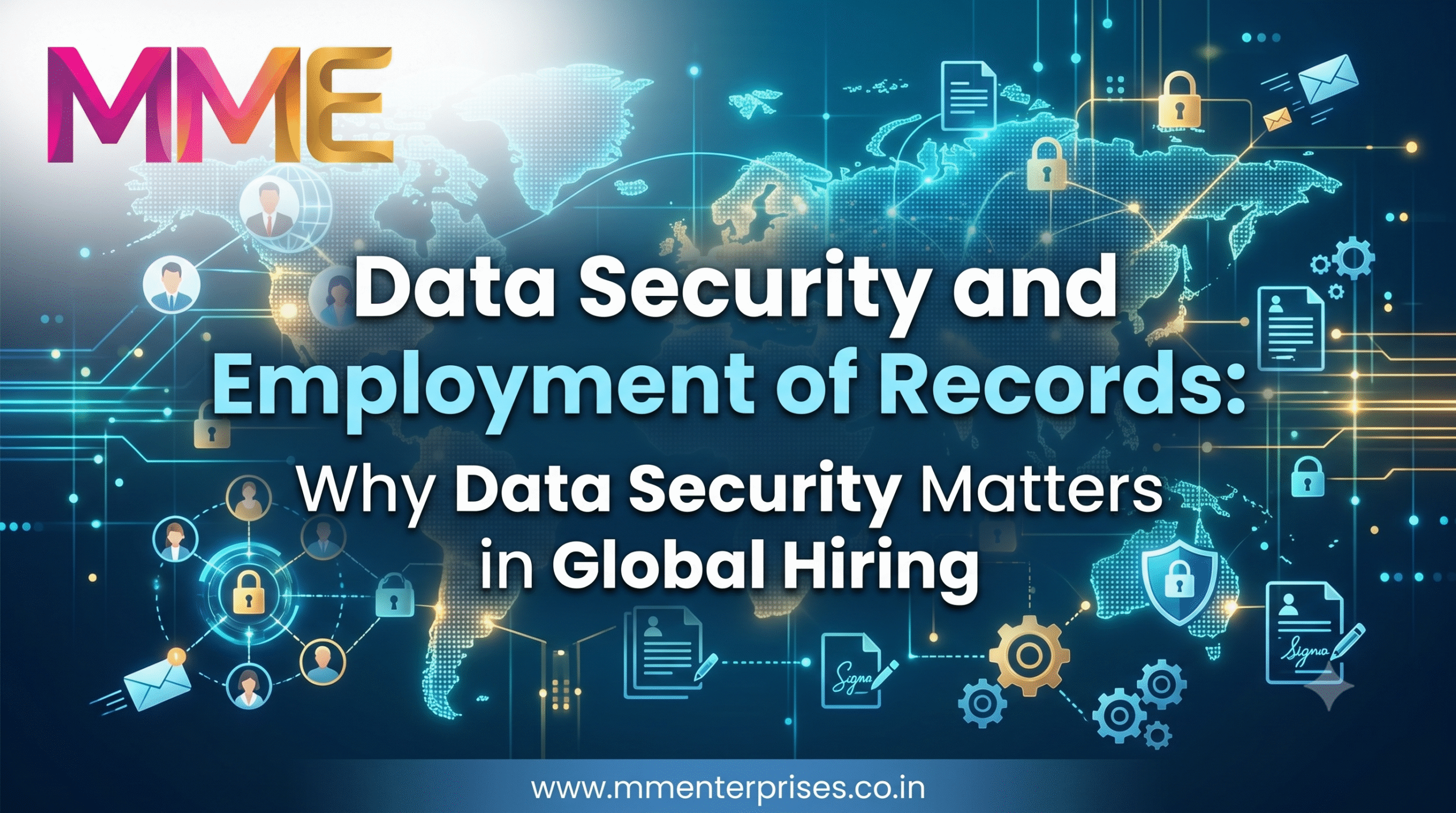
Data Security and Employment of Records: Why Data Security Matters in Global Hiring
Introduction
The modern workforce has transformed dramatically over the past decade. Businesses are no longer restricted by geographical boundaries when hiring talent. Whether it is a technology startup in the United States, a manufacturing company in Germany, a healthcare organization in the United Kingdom, or a financial services firm in the UAE, organizations are increasingly building global teams to access specialized skills, reduce operational costs, and accelerate business growth.
India has emerged as one of the world’s most preferred destinations for global hiring due to its highly skilled workforce, strong technical expertise, English-speaking professionals, and competitive employment costs. As companies expand into India through remote hiring, Employer of Record (EOR) services, offshore development centers, and international recruitment partnerships, managing employee information securely has become a strategic business priority rather than just an administrative function.
Every stage of the employee lifecycle generates sensitive information. From resumes and interview assessments to employment contracts, payroll records, tax documentation, identification proofs, performance evaluations, and exit documentation, organizations collect and process a substantial amount of confidential data. This information is critical for business operations, regulatory compliance, payroll processing, and workforce management. However, if these records are not handled responsibly, they can expose organizations to legal penalties, operational disruptions, financial losses, and reputational damage.
As global hiring continues to evolve, businesses must balance rapid workforce expansion with robust data governance. Secure employment record management is no longer optional—it is an essential component of sustainable international growth.
The Growing Importance of Data Security in Global Hiring
Global recruitment involves multiple stakeholders, digital platforms, and cross-border data transfers. Recruitment agencies, HR teams, payroll providers, hiring managers, legal advisors, Employer of Record providers, and technology platforms often collaborate throughout the hiring process. Each interaction involves the exchange of confidential employee information.
For example, a foreign company hiring software engineers in India may collect:
- Personal identification documents
- Educational certificates
- Employment history
- Salary expectations
- Background verification reports
- Tax declarations
- Bank account details
- Emergency contact information
- Employment agreements
- Performance records
Each document contains sensitive information that must be protected from unauthorized access, accidental disclosure, misuse, or cyber threats.
As organizations embrace remote hiring and digital onboarding, employment records are increasingly stored and managed electronically. While digital transformation improves efficiency and accessibility, it also increases the importance of implementing strong cybersecurity measures, access controls, encryption, secure storage, and well-defined data governance policies.
For global employers, protecting employee data is not simply about complying with regulations—it is about demonstrating responsibility, maintaining employee trust, and safeguarding business continuity.
Employment Records Are Valuable Business Assets
Many organizations view employment records primarily as HR documentation. In reality, they represent valuable business assets that support numerous operational functions.
Accurate employment records help organizations:
- Process payroll accurately and on time
- Administer statutory benefits
- Manage employee performance
- Support workforce planning
- Demonstrate legal compliance
- Handle audits efficiently
- Resolve employment disputes
- Support immigration and international assignments
- Maintain organizational continuity
When these records are incomplete, inaccurate, or poorly protected, businesses may face payroll errors, compliance violations, employee dissatisfaction, and increased legal risks.
A structured employment records management system enables organizations to make informed decisions while maintaining transparency throughout the employee lifecycle.
Why Global Employers Face Greater Data Security Challenges
Managing employment records becomes more complex when organizations operate across multiple countries.
International hiring introduces additional considerations such as:
- Cross-border data transfers
- Different employment regulations
- Multiple payroll systems
- Country-specific tax documentation
- Diverse privacy requirements
- Various employee benefit structures
- Remote workforce management
- Vendor coordination
- Third-party recruitment partnerships
Each country has its own employment practices and regulatory expectations. Organizations hiring employees in India must understand local payroll requirements, statutory contributions, employment documentation, leave policies, tax obligations, and record retention practices while also meeting their home country’s governance standards.
This complexity makes secure employment record management a critical element of successful global workforce expansion.
The Rise of Digital HR and Remote Workforce Management
The widespread adoption of remote work has accelerated digital HR transformation. Recruitment interviews, employee onboarding, payroll approvals, document verification, attendance management, and performance evaluations are now routinely conducted through cloud-based platforms.
While these technologies improve operational efficiency, they also increase the organization’s responsibility to protect digital information.
Businesses must ensure that employee records are:
- Stored securely
- Accessible only to authorized personnel
- Regularly backed up
- Protected against cyber threats
- Retained according to legal requirements
- Deleted securely when no longer required
Without proper safeguards, organizations become vulnerable to phishing attacks, ransomware, unauthorized access, identity theft, and accidental data exposure.
Cybersecurity is therefore closely connected with effective human resource management.
Building Employee Trust Through Responsible Data Management
Employees willingly provide extensive personal information during recruitment because they trust employers to manage it responsibly.
This trust extends beyond payroll processing. Employees expect their personal information to remain confidential, protected, and used only for legitimate employment purposes.
Organizations that demonstrate transparency in data collection and clearly communicate how information is stored, processed, and protected are more likely to strengthen employee confidence and foster long-term engagement.
Strong data governance also enhances employer branding. Companies known for ethical employment practices and responsible data management are often better positioned to attract highly skilled professionals in competitive talent markets.
For multinational organizations, this trust becomes especially important when managing distributed teams across different countries and time zones.
Data Security as a Strategic Business Priority
In today’s digital economy, data security is no longer solely the responsibility of IT departments. Human resources, payroll teams, legal advisors, recruitment partners, and business leaders all play a vital role in protecting employment records.
Organizations expanding globally must integrate data security into every stage of the employee lifecycle—from candidate sourcing and onboarding to payroll processing, performance management, and employee separation.
Establishing secure processes for handling employment records helps reduce business risk, supports regulatory compliance, strengthens organizational resilience, and reinforces the confidence of employees, clients, and business partners.
For companies building global teams, investing in robust data security practices is not just a compliance requirement—it is a competitive advantage. By safeguarding employment records and implementing secure workforce management processes, businesses can expand internationally with greater confidence while protecting one of their most valuable assets: their people and their information.
Employment Records Management: Best Practices for Global Employers
Effective employment records management is a cornerstone of successful global workforce administration. As organizations expand across borders through remote hiring, international recruitment, Employer of Record (EOR) services, and distributed teams, the volume and complexity of employee information increase significantly. Every document collected throughout the employee lifecycle—from recruitment to separation—must be managed with accuracy, consistency, security, and compliance.
Well-organized employment records do more than satisfy legal requirements. They support informed decision-making, simplify payroll administration, improve employee experiences, facilitate audits, and reduce operational risks. Conversely, poorly maintained records can lead to compliance issues, payroll inaccuracies, legal disputes, and reputational damage.
For global employers, implementing standardized employment records management practices is essential to building a scalable and compliant workforce.
Establish a Centralized Digital Record Management System
One of the most effective ways to manage employment records is through a centralized Human Resource Information System (HRIS) or secure document management platform. Instead of maintaining employee files across multiple spreadsheets, email inboxes, and local storage devices, organizations should consolidate records within a secure and structured digital environment.
A centralized system provides several advantages:
- Consistent record organization
- Faster document retrieval
- Improved collaboration between HR, payroll, and legal teams
- Reduced risk of duplicate or outdated records
- Enhanced data security through controlled access
- Simplified compliance reporting
Cloud-based HR platforms also support geographically distributed teams by enabling authorized personnel to access employee records securely from different locations while maintaining audit trails and version control.
Standardize Documentation Across the Employee Lifecycle
Employment records should follow a consistent structure throughout every stage of employment. Standardization ensures that all employees are documented uniformly, regardless of their location or role.
Typical employment records include:
Recruitment Records
- Job applications
- Resumes
- Interview evaluations
- Background verification reports
- Offer letters
- Reference checks
Employment Documentation
- Signed employment contracts
- Identification documents
- Tax declarations
- Banking information
- Emergency contact details
- Confidentiality agreements
- Intellectual property agreements
Payroll and Benefits Records
- Salary revisions
- Payroll statements
- Leave records
- Bonus documentation
- Insurance enrollment
- Statutory contribution records
- Reimbursement claims
Performance Management Records
- Performance reviews
- Training completion certificates
- Promotion letters
- Disciplinary actions
- Goal-setting documents
Separation Records
- Resignation letters
- Exit interviews
- Final settlement documents
- Experience certificates
- Asset return confirmations
Maintaining standardized documentation improves operational consistency while reducing administrative errors.
Define Clear Access Controls
Not every employee should have unrestricted access to employment records. Sensitive information such as salaries, tax documents, medical declarations, banking details, and performance evaluations should only be accessible to authorized personnel.
Organizations should implement role-based access controls (RBAC), ensuring employees can only view the information necessary for their responsibilities.
For example:
- HR teams manage employee documentation.
- Payroll specialists access compensation records.
- Managers review performance-related information.
- Finance teams process approved payroll data.
- Legal teams access compliance documentation when required.
Limiting access significantly reduces the risk of unauthorized disclosure and strengthens organizational security.
Maintain Accurate and Up-to-Date Records
Employment records should be reviewed regularly to ensure their accuracy. Employees frequently update personal information throughout their careers, including:
- Residential addresses
- Contact information
- Banking details
- Tax declarations
- Emergency contacts
- Marital status
- Educational qualifications
- Professional certifications
Outdated records may lead to payroll errors, incorrect tax deductions, delayed benefit administration, or compliance issues.
Organizations should establish periodic review processes that encourage employees to verify and update their information whenever changes occur.
Implement Document Retention Policies
Not every employment record should be retained indefinitely. Organizations should establish formal document retention schedules based on applicable employment regulations, tax requirements, contractual obligations, and internal business policies.
A comprehensive retention policy should define:
- Which documents must be retained
- Minimum retention periods
- Secure archival procedures
- Conditions for permanent deletion
- Responsibilities for record maintenance
Secure disposal is equally important. When records are no longer required, organizations should permanently delete digital files using approved methods and securely destroy physical documents to prevent unauthorized recovery.
Protect Confidential Employee Information
Employment records contain highly sensitive personal information that requires continuous protection.
Organizations should implement multiple security measures, including:
- Data encryption during storage and transmission
- Multi-factor authentication for HR systems
- Secure backup procedures
- Regular vulnerability assessments
- Continuous system monitoring
- Strong password policies
- Endpoint protection for company devices
In addition to technical safeguards, organizations should establish clear policies governing how employment records are created, shared, stored, and disposed of throughout the employee lifecycle.
Prepare for Internal and External Audits
Well-maintained employment records simplify compliance audits and reduce administrative burden.
Global organizations may be required to demonstrate compliance with employment regulations, payroll obligations, tax authorities, labor inspections, or client contractual requirements.
Proper documentation enables organizations to quickly provide evidence of:
- Employment contracts
- Payroll payments
- Leave records
- Statutory contributions
- Employee benefits
- Tax deductions
- Training completion
- Policy acknowledgements
Maintaining organized documentation strengthens operational transparency and minimizes disruption during audits.
Train Employees on Records Management Responsibilities
Employment records management is not solely the responsibility of HR departments. Managers, payroll teams, recruiters, finance professionals, and employees all contribute to maintaining accurate workforce information.
Organizations should provide regular training covering:
- Data confidentiality
- Secure document sharing
- Information classification
- Record retention requirements
- Password management
- Reporting security incidents
- Proper handling of employee documentation
A culture of accountability helps reduce human error and reinforces the importance of protecting sensitive employment information.
Partner with Trusted Workforce Management Experts
As organizations expand internationally, managing employment records across multiple jurisdictions becomes increasingly complex. Differences in employment documentation, payroll regulations, statutory requirements, and local compliance obligations require specialized expertise.
Partnering with experienced workforce management providers such as MM Enterprises enables global employers to streamline employment administration while maintaining high standards of security, accuracy, and regulatory compliance.
By leveraging professional support, businesses can focus on strategic growth while ensuring employment records are managed consistently, securely, and in accordance with applicable legal requirements.
Building a Strong Foundation for Global Workforce Success
Employment records are far more than administrative files—they are critical business assets that support payroll accuracy, compliance, employee trust, and organizational decision-making. A structured records management framework enables businesses to operate efficiently across borders, reduce compliance risks, and respond confidently to audits, workforce changes, and evolving business needs.
For organizations pursuing international expansion through remote hiring, distributed teams, or Employer of Record services, investing in modern employment records management practices creates a solid foundation for sustainable growth. Accurate, secure, and well-governed employment records not only protect the organization but also demonstrate a long-term commitment to professionalism, transparency, and responsible workforce management.
Legal Compliance, Privacy, IP Protection & Cross-Border Data Handling
As businesses expand internationally through remote hiring, Employer of Record (EOR) services, and distributed workforces, managing employee information securely becomes increasingly complex. Every stage of the employment lifecycle involves collecting, processing, storing, and transferring sensitive personal data. This includes resumes, identification documents, employment contracts, payroll records, tax information, performance evaluations, and confidential business agreements.
For global employers, protecting this information goes beyond implementing cybersecurity measures. It also requires compliance with employment regulations, privacy laws, contractual obligations, and intellectual property (IP) protection standards across multiple jurisdictions. Failure to meet these responsibilities can expose organizations to legal disputes, financial penalties, operational disruptions, and reputational damage.
Developing a comprehensive compliance framework enables organizations to expand confidently while maintaining the trust of employees, customers, investors, and business partners.
Understanding Legal Compliance in Global Employment
Employment laws vary significantly between countries. Organizations hiring talent in India must comply with local labor regulations while often adhering to the governance requirements of their home country.
Legal compliance extends beyond hiring practices and includes responsibilities such as:
- Preparing legally compliant employment contracts.
- Maintaining accurate payroll records.
- Managing statutory benefits and deductions.
- Retaining employment documentation.
- Protecting confidential employee information.
- Following lawful termination procedures.
- Maintaining workplace policies and employee acknowledgements.
A structured compliance process helps organizations reduce operational risk while ensuring employment records remain complete, accurate, and legally defensible.
For companies expanding into India without establishing a local legal entity, working with experienced workforce partners can simplify these responsibilities while ensuring ongoing compliance with applicable employment regulations.
Privacy Is a Fundamental Business Responsibility
Employees trust employers with highly personal information throughout their employment journey. This information often includes:
- Government-issued identification
- Residential addresses
- Contact information
- Banking details
- Tax declarations
- Family information
- Emergency contacts
- Educational qualifications
- Employment history
- Performance evaluations
Organizations have a responsibility to ensure this information is collected only for legitimate business purposes and handled responsibly throughout its lifecycle.
Strong privacy practices should include:
- Transparent communication regarding data collection.
- Clearly defined purposes for processing employee information.
- Secure storage and controlled access.
- Regular review of data accuracy.
- Secure disposal of obsolete records.
- Timely reporting of potential security incidents.
Privacy should not be viewed solely as a legal obligation—it is also a reflection of an organization’s commitment to ethical business practices and employee trust.
Protecting Intellectual Property During Global Hiring
One of the primary concerns for companies building international teams is protecting valuable intellectual property.
Remote employees frequently contribute to:
- Software development
- Artificial Intelligence models
- Product designs
- Manufacturing processes
- Business strategies
- Marketing campaigns
- Research projects
- Customer solutions
Without appropriate contractual protections, ownership of intellectual property may become unclear, particularly when employees work across different jurisdictions.
Organizations should ensure employment documentation clearly addresses:
- Ownership of work products.
- Confidentiality obligations.
- Non-disclosure requirements.
- Acceptable use of company resources.
- Protection of proprietary information.
- Return of confidential materials upon separation.
IP protection should begin before an employee joins the organization and continue throughout the employment relationship.
Cross-Border Data Transfers Require Additional Controls
International workforce management often requires employment information to move between countries for recruitment, payroll administration, reporting, compliance, and operational support.
Examples include:
- HR teams located in different countries.
- Global payroll processing.
- International recruitment coordination.
- Regional finance operations.
- Legal compliance reviews.
- Executive reporting.
Every transfer of employee information introduces additional security considerations.
Organizations should implement safeguards such as:
- Encrypted file transfers.
- Secure cloud platforms.
- Access controls based on business need.
- Activity logging and audit trails.
- Data classification policies.
- Secure backup procedures.
Clear governance helps ensure employee information remains protected regardless of where it is processed or stored.
Vendor Compliance and Third-Party Risk Management
Global employers frequently collaborate with external service providers including:
- Employer of Record providers
- Recruitment agencies
- Payroll service providers
- Background verification firms
- HR software vendors
- Employee benefits administrators
Each partner may process confidential employee information.
Before engaging any third-party provider, organizations should evaluate:
- Information security practices.
- Data protection policies.
- Confidentiality commitments.
- Access management procedures.
- Business continuity planning.
- Incident response capabilities.
Regular vendor assessments help maintain confidence that employee information remains protected throughout the workforce ecosystem.
Compliance Through Employee Awareness
Technology alone cannot ensure compliance.
Employees remain one of the most important components of any information security strategy.
Organizations should provide regular training covering:
- Confidential document handling.
- Password security.
- Recognizing phishing attempts.
- Secure remote working practices.
- Acceptable use of company devices.
- Reporting suspected security incidents.
- Data classification procedures.
Building a culture of accountability significantly reduces accidental data exposure and strengthens organizational resilience.
Creating a Future-Ready Compliance Framework
As global hiring continues to evolve, organizations must adopt a proactive approach to compliance rather than reacting to regulatory changes after they occur.
An effective compliance framework combines:
- Secure technology.
- Well-defined policies.
- Accurate employment documentation.
- Strong privacy practices.
- Intellectual property protection.
- Vendor governance.
- Employee awareness.
- Continuous monitoring and improvement.
Businesses that integrate these principles into their workforce strategy are better positioned to scale internationally while maintaining operational excellence.
Protecting employment records is no longer just an administrative responsibility—it is a strategic business investment that supports sustainable growth, strengthens stakeholder confidence, and reinforces an organization’s reputation in an increasingly interconnected global workforce.
How Employer of Record (EOR) Providers Help Secure Employee Data
As organizations embrace remote hiring and global workforce expansion, managing employee information securely becomes increasingly challenging. Companies hiring talent across different countries must not only comply with local employment regulations but also protect sensitive employee records throughout the entire employment lifecycle.
This is where an experienced Employer of Record (EOR) partner becomes invaluable. While many businesses associate an EOR primarily with payroll processing and legal employment, a professional EOR also plays a significant role in maintaining data security, regulatory compliance, and secure employment record management.
For organizations expanding into India without establishing a legal entity, partnering with a trusted EOR helps reduce administrative complexity while ensuring employee information is handled responsibly and securely.
Centralized Employment Record Management
One of the biggest advantages of working with an Employer of Record is the availability of structured and centralized employment documentation.
Instead of maintaining employee information across multiple spreadsheets, emails, and disconnected systems, an EOR manages employment records through standardized HR processes.
These records typically include:
- Employment contracts
- Identity verification documents
- Offer letters
- Payroll records
- Tax declarations
- Leave records
- Salary revisions
- Benefits administration
- Statutory compliance documents
- Exit documentation
Centralized management reduces duplication, improves record accuracy, and allows organizations to retrieve employment information efficiently whenever required.
Secure Payroll Administration
Payroll contains some of the most confidential employee information within any organization.
An Employer of Record manages payroll processes while protecting sensitive information such as:
- Salary details
- Bank account information
- Tax deductions
- Statutory contributions
- Bonus payments
- Incentives
- Expense reimbursements
Professional payroll administration minimizes the risk of payroll errors, unauthorized access, and inconsistent recordkeeping while helping organizations meet statutory obligations accurately and on time.
Compliance with Indian Employment Regulations
Hiring employees in India involves compliance with multiple employment and payroll requirements.
An experienced EOR helps organizations manage responsibilities related to:
- Employment documentation
- Payroll processing
- Statutory deductions
- Leave administration
- Employee benefits
- Regulatory reporting
- Employment lifecycle documentation
This structured approach reduces administrative burden while ensuring workforce operations remain aligned with Indian employment practices.
Controlled Access to Employee Information
Not every individual within an organization requires unrestricted access to employment records.
Professional EOR providers establish structured access controls based on employee responsibilities.
For example:
- HR professionals manage employee records.
- Payroll specialists access salary information.
- Finance teams process approved payments.
- Managers review performance-related information.
- Legal teams access documentation only when necessary.
Role-based access helps reduce unauthorized exposure while improving accountability.
Standardized Employee Onboarding
Employee onboarding often involves collecting a significant amount of confidential information.
A professional EOR establishes standardized onboarding procedures that include:
- Identity verification
- Employment documentation
- Tax registration
- Banking information
- Benefits enrollment
- Confidentiality agreements
- Policy acknowledgements
Standardization improves accuracy while ensuring important documentation is not overlooked.
Support for Remote Workforce Management
Remote employees often work from different cities, states, or countries, making employment administration more complex.
Employers of Record providers simplify remote workforce management by maintaining consistent HR documentation regardless of employee location.
This helps organizations manage:
- Remote onboarding
- Attendance records
- Leave management
- Payroll administration
- Employment documentation
- Employee lifecycle management
Consistent processes improve both operational efficiency and compliance.
Reduced Administrative Risk
As organizations grow internationally, HR teams frequently encounter increasing documentation requirements.
Without standardized processes, businesses may experience:
- Missing contracts
- Payroll inconsistencies
- Outdated employee records
- Incomplete documentation
- Delayed compliance reporting
An experienced Employer of Record reduces these operational risks by implementing documented procedures for every stage of employment.
Supporting Business Continuity
Employment information supports numerous business functions beyond HR.
Accurate records enable organizations to:
- Complete internal audits.
- Support financial reporting.
- Respond to employee inquiries.
- Resolve workplace disputes.
- Prepare regulatory documentation.
- Plan workforce expansion.
Maintaining organized employment records contributes directly to business continuity and operational resilience.
Why Choose MM Enterprises for Global Workforce Solutions?
Expanding into India requires more than finding qualified talent. Organizations need a reliable partner that understands recruitment, workforce management, compliance, payroll coordination, remote hiring, and employment administration.
MM Enterprises has built its reputation by helping global organizations establish and manage high-performing teams in India through professional workforce solutions.
Our approach combines recruitment expertise with practical workforce management support, enabling businesses to focus on growth while reducing administrative complexity.
Comprehensive Workforce Support
We assist organizations throughout the employee lifecycle, including:
- Talent acquisition
- Remote hiring support
- Workforce planning
- Employee onboarding
- HR coordination
- Payroll support
- Employment documentation
- Compliance assistance
- Workforce administration
Our integrated approach simplifies workforce management while improving operational efficiency.
Industry Experience
Organizations across multiple industries trust MM Enterprises to support their hiring initiatives, including:
- Information Technology
- Artificial Intelligence
- Manufacturing
- Engineering
- Healthcare
- Financial Services
- Retail
- Telecommunications
- Energy
- Global Capability Centers (GCCs)
This industry knowledge enables us to understand the unique workforce requirements of each sector.
Scalable Workforce Solutions
Whether hiring a single specialist or building a large distributed team, organizations require scalable HR processes that can grow alongside their business.
MM Enterprises supports businesses at every stage of workforce expansion by providing structured recruitment and workforce management solutions designed to accommodate changing business needs.
Commitment to Professional Standards
Successful workforce management depends on consistency, transparency, and attention to detail.
Our teams emphasize:
- Accurate employment documentation
- Organized workforce administration
- Timely HR coordination
- Professional communication
- Compliance-focused processes
- Long-term client relationships
This commitment helps organizations establish a stable foundation for sustainable international growth.
Helping Businesses Expand with Confidence
Global hiring should create opportunities—not administrative challenges.
With the right workforce partner, organizations can focus on innovation, customer growth, and operational excellence while maintaining confidence that employment administration is handled professionally.
Whether your organization is exploring remote hiring, expanding into India, building engineering teams, or evaluating Employer of Record solutions, MM Enterprises is committed to supporting your workforce journey with practical expertise, responsive service, and dependable HR solutions.
As international hiring continues to evolve, businesses that combine strategic workforce planning with strong employment governance will be best positioned to compete in the global marketplace. Choosing an experienced workforce partner helps ensure that employee data remains secure, employment records remain organized, and global expansion progresses smoothly and confidently.