
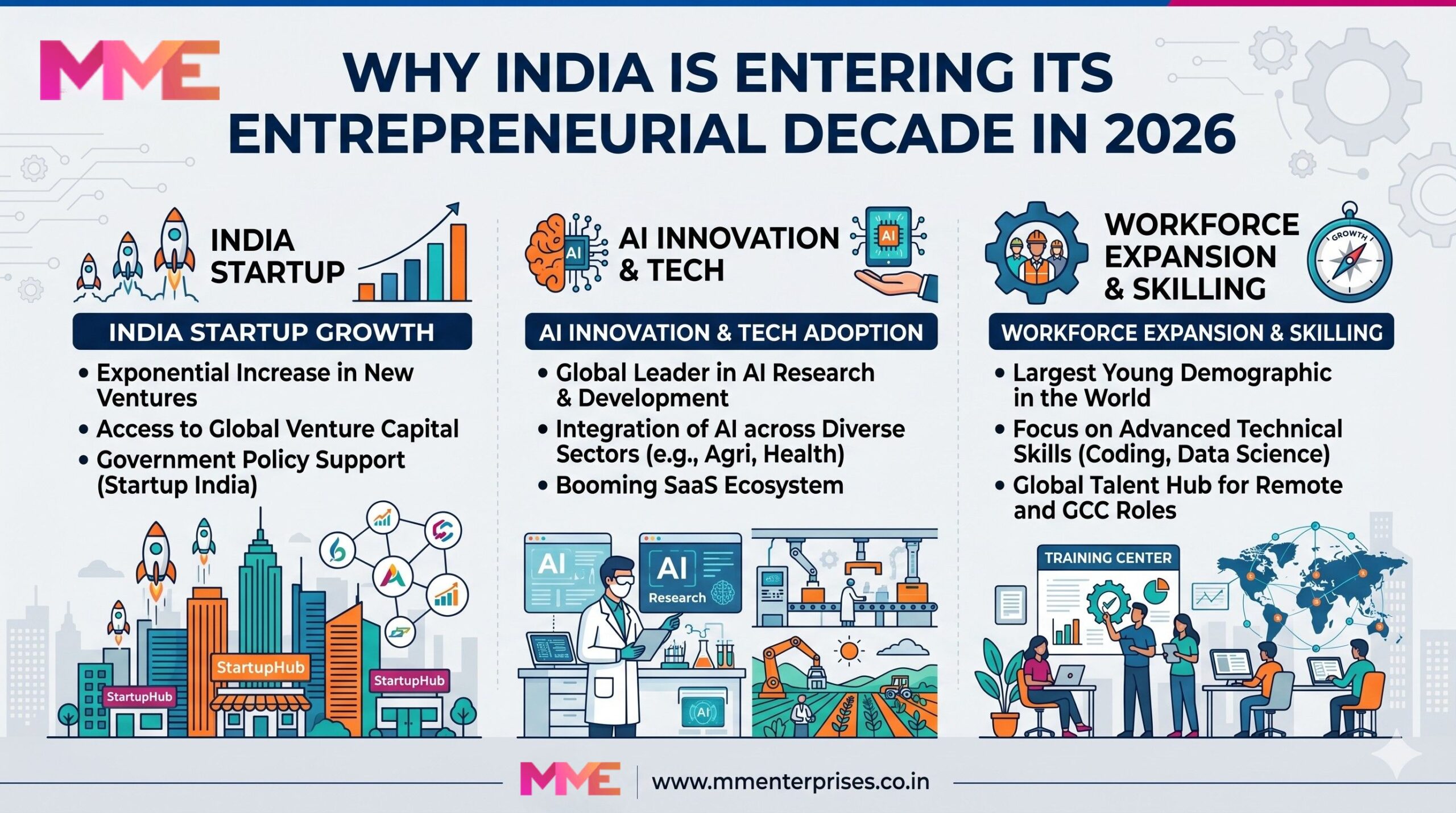
Why India Is Entering Its Entrepreneurial Decade in 2026
India is experiencing one of the most significant economic and cultural transformations in modern business history.
Across technology, renewable energy, SaaS, consulting, engineering services, AI startups, creator-led businesses, EV infrastructure, and digital commerce, a new generation of entrepreneurs is emerging faster than ever before.
The conversation is no longer limited to traditional startup hubs or unicorn founders.
Today, professionals across India are increasingly asking:
- Should I build my own company?
- Can I work independently?
- Is this the right time to scale globally from India?
- Can AI reduce startup barriers?
- Can remote teams help me build faster?
The answer, increasingly, is yes.
India is entering what many industry leaders are now calling its “Entrepreneurial Decade in 2026
The shift is visible everywhere:
- Rising startup registrations
- Independent consultants launching firms
- Engineers becoming founders
- Women entrepreneurs scaling digital businesses
- AI-enabled startups operating lean
- Remote-first teams growing rapidly
- Global investors expanding into India
- International companies hiring Indian talent aggressively
Most importantly, entrepreneurship in India is no longer viewed as an alternative career path.
It is becoming the mainstream growth model.
For founders, CFOs, CHROs, operations leaders, global expansion teams, and investors, this transformation is creating enormous opportunities.
At the center of this evolving ecosystem, workforce infrastructure, compliance management, recruitment scalability, and Employer of Record (EOR) services are becoming critical enablers of startup growth.
This is where MM Enterprises India is positioning itself as a strategic workforce and business expansion partner helping companies scale confidently across India’s rapidly evolving entrepreneurial economy.
India Startup Growth 2026 Is Reshaping the Global Business Landscape
India’s startup ecosystem has evolved dramatically over the past decade.
What began as a technology-focused startup movement has now expanded into a broad entrepreneurial economy that includes:
- Renewable energy startups
- AI and automation companies
- HR tech businesses
- SaaS platforms
- Engineering consultancies
- EV infrastructure firms
- Construction technology startups
- Digital agencies
- Creator-led businesses
- D2C brands
- Remote service companies
- Workforce solution providers
The scale of this growth is unprecedented.
India is now widely viewed as:
- A global startup hub
- A scalable workforce destination
- A technology innovation market
- A remote talent ecosystem
- A business expansion base
- A strategic operations center
Unlike previous business cycles, today’s founders are launching companies with:
- Lower infrastructure costs
- AI-driven productivity
- Access to global markets
- Remote-first operations
- Flexible workforce models
This has significantly reduced traditional startup barriers.
The result is a new wave of entrepreneurship in India that is faster, leaner, more scalable, and globally connected.
The Indian Founders Trend Is Accelerating Rapidly
One of the biggest shifts in 2026 is the mindset transformation happening across India’s professional workforce.
Highly skilled professionals are increasingly choosing:
- Ownership over employment
- Flexibility over rigid corporate structures
- Independent growth over traditional career paths
- Scalable digital businesses over conventional models
This Indian founders trend is being driven by several powerful factors.
1. AI Is Lowering Startup Costs
Artificial intelligence is transforming entrepreneurship globally.
Today, founders can use AI tools for:
- Content creation
- Customer support
- Lead generation
- Software development
- Recruitment automation
- Market research
- Operations management
- Sales outreach
- Financial forecasting
This means startups can scale faster with smaller teams.
Entrepreneurs no longer need massive operational infrastructure to launch businesses.
AI is enabling:
- Lean startups
- Solo founders
- Small distributed teams
- Faster product development
- Lower operating costs
For Indian entrepreneurs, this creates a massive opportunity.
Remote Work Has Made Entrepreneurship More Accessible
Remote work has fundamentally changed how companies are built.
In previous decades, startups often required:
- Physical office spaces
- Large operational teams
- Centralized hiring
- Significant capital investment
Today, remote-first business models are making startup accessibility dramatically easier.
Indian founders can now:
- Hire remote talent
- Build distributed teams
- Serve global clients
- Operate internationally
- Scale digitally
- Access worldwide opportunities
This is one reason India startup growth 2026 is accelerating so rapidly.
Remote infrastructure has decentralized entrepreneurship.
A founder in Kolkata, Jaipur, Kochi, Indore, or Bhubaneswar can now build globally competitive businesses without relocating to traditional startup hubs.
India’s Startup Ecosystem Is Becoming More Inclusive
Another important shift is the democratization of entrepreneurship in India.
The startup ecosystem India is no longer concentrated among elite networks alone.
Today’s entrepreneurial movement includes:
- Tier-2 city founders
- Independent consultants
- Women entrepreneurs
- Technical specialists
- Freelancers launching agencies
- Engineers building niche firms
- Renewable energy startups
- Cross-border remote businesses
This broadening ecosystem is increasing innovation across industries.
Entrepreneurship is becoming more community-driven, accessible, and opportunity-focused.
Why Global Companies Are Investing Heavily in India
International businesses increasingly view India as:
- A talent-rich economy
- A scalable operations market
- A startup partnership destination
- A renewable infrastructure hub
- A global engineering ecosystem
Global expansion leaders are investing aggressively because India offers:
- Large technical workforce availability
- Competitive operational costs
- Rapid digital adoption
- Infrastructure growth
- Startup innovation
- AI engineering capability
- Strong entrepreneurial momentum
This is creating strong demand for:
- Workforce solutions
- Recruitment partners
- Payroll management
- Compliance infrastructure
- Employer of Record services
As startup growth accelerates, workforce execution becomes increasingly important.
Why Workforce Infrastructure Is Becoming a Startup Growth Driver
Many founders initially focus on:
- Product development
- Sales
- Branding
- Fundraising
However, as businesses scale, workforce operations quickly become one of the biggest challenges.
Growing companies must manage:
- Hiring
- Payroll
- Compliance
- Employee onboarding
- HR operations
- Multi-state workforce management
- Labor law obligations
- Tax regulations
Without structured workforce systems, startups often face:
- Operational delays
- Hiring bottlenecks
- Payroll issues
- Compliance risks
- Administrative overload
This is why workforce infrastructure is becoming a strategic business advantage.
The Rise of EOR Services in India’s Startup Ecosystem
Employer of Record (EOR) services are becoming increasingly important for startups and global businesses entering India.
An EOR allows companies to legally hire employees without establishing a full local entity immediately.
This creates major advantages for:
- Foreign startups
- Remote-first companies
- Global founders
- Renewable businesses
- EV infrastructure firms
- SaaS companies
- Fast-scaling operations
EOR services help businesses:
- Hire faster
- Reduce setup delays
- Stay compliant
- Scale workforce operations
- Manage payroll efficiently
- Reduce legal risk
For startups operating in fast-moving industries, speed matters.
Companies that build agile workforce systems gain significant competitive advantages.
Why MM Enterprises Is Emerging as a Strategic Workforce Partner in India
As entrepreneurship in India accelerates, businesses require operational partners that understand:
- Startup scalability
- Hiring urgency
- Compliance complexity
- Workforce flexibility
- Global expansion
- Multi-state payroll management
- Recruitment operations
This is where MM Enterprises Official Website is building strong industry authority.
MM Enterprises supports startups, global companies, renewable firms, engineering businesses, and scaling organizations with:
- Employer of Record (EOR) services
- Recruitment solutions
- Payroll management
- Compliance support
- Workforce deployment
- HR operations
- Employee onboarding
- Engineering hiring
- Multi-state workforce management
The company is positioning itself as a trusted operational growth partner for modern businesses entering or scaling across India.
Why Founders Need Flexible Workforce Models in 2026
Modern startups are no longer operating with rigid workforce structures.
Today’s founders increasingly prefer:
- Agile teams
- Project-based hiring
- Remote operations
- Cross-border workforce models
- Faster onboarding
- Scalable staffing systems
Flexible workforce infrastructure improves:
- Growth speed
- Operational efficiency
- Hiring scalability
- Execution continuity
- Market responsiveness
This is especially important in industries such as:
- Renewable energy
- Solar EPC
- AI startups
- Engineering services
- Construction technology
- EV infrastructure
- SaaS businesses
The businesses that scale fastest are often the ones with the strongest workforce systems.
AI Startups and Renewable Businesses Are Driving New Hiring Trends
Two sectors are shaping India’s entrepreneurial decade aggressively:
- AI-driven businesses
- Renewable energy companies
These industries require:
- Technical specialists
- Engineering talent
- Project managers
- Scalable workforce systems
- Rapid deployment capability
India’s engineering ecosystem gives startups significant operational advantages.
This is why international companies increasingly hire Indian teams for:
- Product development
- Engineering execution
- Renewable infrastructure projects
- AI operations
- Technical support
- Digital transformation
As hiring demand rises, workforce agility becomes even more critical.
Why India Is Becoming a Global Startup Execution Hub
India is no longer viewed only as:
- A back-office market
- A support destination
- A low-cost outsourcing economy
Instead, India is becoming:
- A startup execution market
- A founder ecosystem
- A global workforce hub
- A renewable innovation center
- A remote operations destination
- A scalable engineering economy
This transition is reshaping global business strategies.
Companies worldwide increasingly use India for:
- Technical hiring
- Engineering teams
- Product operations
- Startup scaling
- Global capability centers
- Renewable workforce deployment
The long-term opportunity is enormous.
Strategic Advantages for CFOs, CHROs, and Global Expansion Leaders
Why CFOs Value Structured Workforce Infrastructure
Finance leaders increasingly prioritize:
- Cost predictability
- Compliance reduction
- Workforce scalability
- Operational efficiency
Structured EOR and workforce solutions help reduce:
- Administrative overhead
- Entity setup costs
- Payroll risk
- Expansion delays
Why CHROs Need Agile Hiring Systems
Modern HR leaders focus on:
- Talent acquisition
- Workforce governance
- Employee experience
- Hiring speed
- Scalable onboarding
As startup growth accelerates, HR operations become increasingly strategic.
Why Global Expansion Leaders Prefer India
India offers:
- Technical workforce depth
- Startup momentum
- Renewable growth
- AI engineering capability
- Cost-efficient scaling
- Long-term operational opportunities
This makes India one of the world’s most attractive entrepreneurial markets.
The Future of Entrepreneurship in India
India’s entrepreneurial decade is only beginning.
Over the next several years, the country is expected to see:
-
- Massive startup growth
- AI-led business expansion
- Renewable infrastructure scaling
- Increased independent consulting
- Cross-border remote operations
- Global founder participation
- Workforce technology innovation
- Engineering-driven entrepreneurship
The companies that succeed will be those that can:
- Hire quickly
- Scale efficiently
- Maintain compliance
- Build agile teams
- Operate globally
- Leverage AI effectively
This makes workforce strategy one of the most important business priorities of the next decade.
IITs Dominate the Unicorn Founder Pipeline
The strongest pattern in the chart is the dominance of the Indian Institutes of Technology (IITs).
Top performers include:
- Indian Institute of Technology Delhi — 21 founders
- Indian Institute of Technology Bombay — 17 founders
- Indian Institute of Technology Madras — 15 founders
- Indian Institute of Technology Kanpur — 14 founders
- Indian Institute of Technology Kharagpur — 7 founders
- Indian Institute of Technology Roorkee — 3 founders
- Indian Institute of Technology Guwahati — 4 founders
IITs remain India’s strongest global entrepreneurship pipeline, particularly for:
- Deep-tech startups
- SaaS companies
- AI businesses
- Engineering-led ventures
- Silicon Valley startup ecosystems
The data reinforces the global perception of IIT graduates as high-impact founders and technology leaders.
2. Non-IIT Universities Are Also Producing Global Founders
The image also shows strong representation from:
- Birla Institute of Technology and Science — 10 founders
- University of Delhi — 2 founders
- University of Mumbai — 4 founders
- Anna University — 4 founders
- Banaras Hindu University — 6 founders
- Osmania University — 5 founders
India’s entrepreneurial success is no longer limited to elite institutions alone.
The startup ecosystem is becoming:
- More decentralized
- More accessible
- More geographically diverse
This aligns with the broader entrepreneurial trend happening across India in 2026.
3. South India Has a Strong Founder Concentration
Tamil Nadu institutions perform strongly:
- IIT Madras
- Anna University
- College of Engineering Guindy
- University of Madras
- Loyola College
South India continues to be a major:
- Engineering talent hub
- SaaS ecosystem
- Deep-tech startup region
- Global capability center destination
Chennai and Bengaluru’s engineering culture likely contributes heavily to this outcome.
4. Engineering Education Is the Core Driver
Most universities listed are engineering or technology-focused institutions.
This suggests that:
- Technical education strongly correlates with startup creation
- Engineering problem-solving skills translate well into entrepreneurship
- India’s STEM ecosystem is fueling global innovation
This is particularly important in sectors such as:
- AI
- SaaS
- Renewable energy
- Semiconductor technology
- EV infrastructure
- Cloud computing
5. India Is Becoming a Global Founder Economy
The bigger message of the image is not just about universities.
It reflects a larger shift:
India is evolving from:
- A workforce economy
to - A founder economy
Indian professionals are increasingly becoming:
- Startup founders
- Global operators
- Investors
- Technology innovators
- AI entrepreneurs
This aligns strongly with:
- Remote work growth
- AI accessibility
- Global venture funding
- Cross-border startup scaling
6. Why This Matters for Businesses and Workforce Companies
As India produces more global founders:
- Startup hiring demand rises
- Engineering recruitment accelerates
- Workforce infrastructure becomes critical
- EOR services become more important
- Compliance and payroll operations grow in complexity
This creates major opportunities for companies supporting:
-
- Startup expansion
- Recruitment
- Payroll
- HR operations
- Employer of Record services
This is exactly why companies like MM Enterprises India are strategically positioned in India’s evolving startup and workforce ecosystem.
Frequently Asked Questions (FAQs)
Why is India startup growth accelerating in 2026?
India startup growth 2026 is accelerating because of AI accessibility, remote work adoption, lower startup costs, digital infrastructure expansion, renewable industry growth, and increasing entrepreneurial ambition among professionals and engineers.
Why is entrepreneurship in India becoming more popular?
Entrepreneurship in India is becoming more attractive because professionals increasingly value flexibility, ownership, scalability, and independent income opportunities. AI tools and remote work have also reduced traditional startup barriers.
What industries are growing fastest in India’s startup ecosystem?
Fast-growing sectors include:
- AI startups
-
- Renewable energy
- Solar EPC
- EV infrastructure
- SaaS businesses
- Engineering services
-
- HR technology
- Remote workforce solutions
Why are EOR services important for startups in India?
Employer of Record services help startups:
- Hire legally
- Avoid entity setup delays
- Manage payroll
- Stay compliant
- Scale workforce operations faster
This improves operational agility significantly.
Why is MM Enterprises becoming a trusted workforce partner?
MM Enterprises supports businesses with:
- EOR services
- Recruitment solutions
- Payroll management
- Compliance operations
- Workforce scalability
- Engineering hiring
- Multi-state HR support
This positions the company strongly within India’s growing B2B workforce ecosystem.
Conclusion
India is entering a transformational entrepreneurial era.
The combination of:
- AI-driven productivity
- Remote-first operations
- Startup accessibility
- Engineering talent
- Renewable growth
- Workforce scalability
- Global investment
is reshaping how businesses are built.
The next decade will not simply belong to companies with the best technology.
It will belong to organizations that can:
- Scale workforce operations efficiently
- Build agile hiring systems
- Maintain compliance
- Mobilize talent rapidly
- Execute faster than competitors
As India’s startup ecosystem continues expanding, strategic workforce partners will play an increasingly critical role.
MM Enterprises India Official Website is positioning itself at the center of this transformation by helping startups, renewable companies, global businesses, and fast-scaling organizations build compliant, scalable, and execution-ready workforce operations across India’s rapidly growing entrepreneurial economy.