
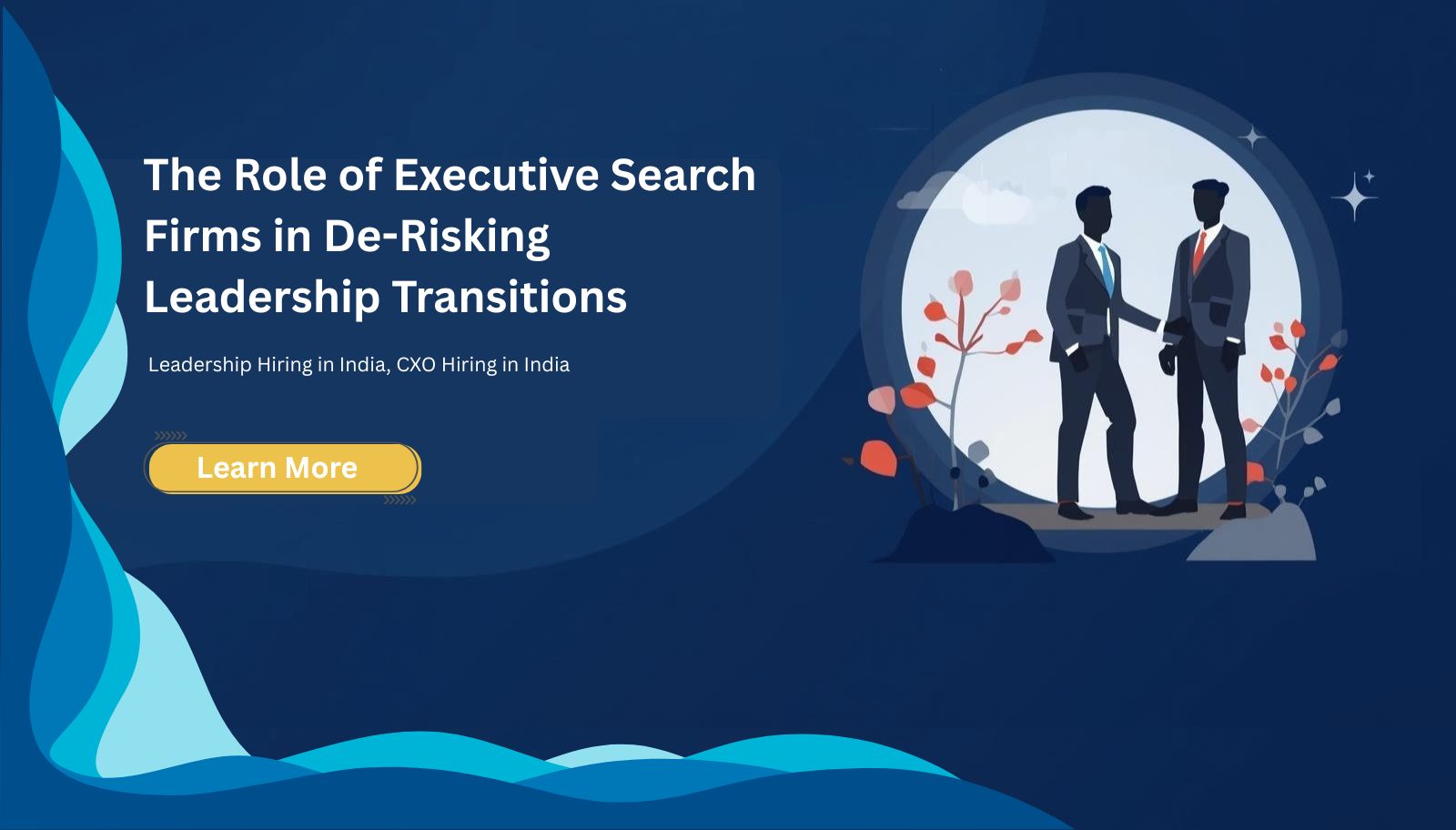
The Role of Executive Search Firms in De-Risking Leadership Transitions – Leadership Hiring in India, CXO Hiring in India
Leadership transitions are rarely framed as risk events.
They’re discussed as:
- A resignation
- A succession milestone
- A strategic upgrade
But for boards and succession planners, every CXO transition is, in reality, a high-impact risk moment—one that can quietly destabilize performance, culture, and market confidence if mishandled.
At MMEnterprises, we often enter conversations after something has already gone wrong:
- Momentum slowed
- Teams fragmented
- Strategy execution stalled
- Market confidence wavered
The common root cause?
Leadership transitions treated as hiring exercises instead of risk-management exercises.
Why Leadership Transitions Are One of the Highest Hidden Risks on the Board Agenda
Unlike operational risks, leadership risk doesn’t show up immediately on dashboards.
But its impact compounds across:
- Revenue predictability
- Talent retention
- Strategic execution
- Investor and partner confidence
In the Indian market—where leadership reputation, informal networks, and signaling matter deeply—CXO hiring in India carries additional complexity.
A delayed or poorly managed transition doesn’t just leave a role vacant.
It creates strategic ambiguity.
The Real Risks Boards Underestimate During CXO Transitions
1. Continuity Risk
Outgoing leaders take more than a title with them:
- Context
- Relationships
- Institutional memory
Without a structured transition strategy, incoming leaders start at a disadvantage.
2. Signaling Risk
Leadership changes send strong messages—to employees, partners, regulators, and competitors.
Unclear or leaky hiring processes often signal:
- Instability
- Internal misalignment
- Strategic uncertainty
3. Execution Risk
Even short leadership gaps can derail:
- Transformation programs
- Market expansion
- M&A integration
- Regulatory engagements
This is especially relevant in Leadership Hiring in India, where execution velocity often defines competitive advantage.
Why Executive Search Firms Exist at the Intersection of Hiring and Risk
Executive search firms are often misunderstood as “premium recruiters.”
In reality, their primary value lies elsewhere.
Their real role is risk reduction.
At senior levels, the risk isn’t finding talent—it’s:
- Choosing the wrong leader
- Choosing the right leader at the wrong time
- Failing to integrate leadership into governance and culture
This is where executive search firms de-risk leadership transitions in ways internal teams cannot.
How Executive Search De-Risks Leadership Transitions in Practice
1. Independent Market Intelligence
Boards often rely on internal perspectives shaped by existing culture.
Executive search firms bring:
- External market benchmarks
- Leadership availability insights
- Compensation and role-design realism
This objectivity is critical during succession planning.
2. Confidentiality as a Risk Control Mechanism
Public or semi-public CXO hiring creates:
- Internal anxiety
- External speculation
- Competitive vulnerability
Professional search firms operate through controlled, confidential outreach, protecting:
- Employer brand
- Market perception
- Board credibility
This is a non-negotiable element of CXO Hiring in India.
3. Role Clarity Before Candidate Outreach
Many leadership transitions fail because:
- The role is emotionally defined, not structurally defined
- Expectations differ between board, CEO, and stakeholders
Executive search firms force alignment before the search begins—reducing post-hire conflict.
4. Transition-Ready Candidate Assessment
Senior leaders don’t fail due to lack of skill.
They fail due to:
- Cultural misfit
- Misaligned authority
- Incompatible governance styles
At MMEnterprises, leadership evaluation focuses on:
- Decision-making maturity
- Board interaction capability
- India-specific market context
- Transition resilience
Why This Matters More in India’s Leadership Market
India’s leadership ecosystem has unique characteristics:
- Relationship-driven influence
- Founder-centric histories
- Rapid scale expectations
- Increasing regulatory scrutiny
Industry trends show that Leadership Hiring in India is shifting from:
“Who can grow fast?”
to
“Who can grow responsibly, predictably, and at scale?”
This raises the stakes for every CXO transition.
The EOR Dimension: Reducing Structural Risk During Leadership Changes
Leadership transitions are often delayed by:
- Entity setup timelines
- Employment compliance complexity
- Cross-border governance issues
This is where Employer of Record (EOR) models play a growing role.
Through EOR, boards can:
- Appoint CXOs without entity delays
- Maintain compliance
- Reduce permanent establishment risk
- Enable faster leadership continuity
MMEnterprises integrates executive search + EOR, allowing leadership transitions without structural friction.
Learn more:
- Employer of Record in India: https://mmenterprises.co.in/employer-of-record-services-in-india/
- HR & leadership insights: https://mmenterprises.co.in/hr-blog/
Where Internal Hiring Teams Reach Their Limit
Internal teams are essential partners—but they face constraints:
- Limited access to passive CXO talent
- Internal politics
- Confidentiality challenges
- Lack of transition risk frameworks
Executive search firms complement—not replace—internal HR by addressing what internal systems are not designed to handle.
Why Boards Trust MMEnterprises During Leadership Transitions
At MMEnterprises, executive search is treated as a governance responsibility, not a recruitment task.
Our approach combines:
- Board-level role framing
- Confidential CXO search
- India market leadership intelligence
- EOR-enabled onboarding
- Ongoing compliance and governance support
This makes MMEnterprises a trusted partner for:
- Succession planning
- Interim-to-permanent transitions
- Cross-border leadership hiring
- High-risk leadership changes
Frequently Asked Questions (FAQs)
Are executive search firms only needed for large enterprises?
No. They are most valuable during high-impact transitions, regardless of company size.
Can EOR be used for CXO roles in India?
Yes. Many global companies use EOR for senior leadership to reduce setup and compliance risk.
How early should boards involve executive search firms?
Ideally during succession planning—not after a resignation.
Does executive search slow down hiring?
No. It reduces false starts, re-hiring cycles, and transition failures.
A Final Word to Boards and Succession Planners
Leadership transitions are inevitable.
Risk exposure is not.
When handled with the right search lens, governance alignment, and structural flexibility, leadership change becomes a controlled evolution—not a destabilizing event.
If your board is navigating or anticipating a leadership transition in India,
MMEnterprises brings the discretion, market depth, and risk-mitigation expertise this moment demands.
Explore more at www.mmenterprises.co.in