

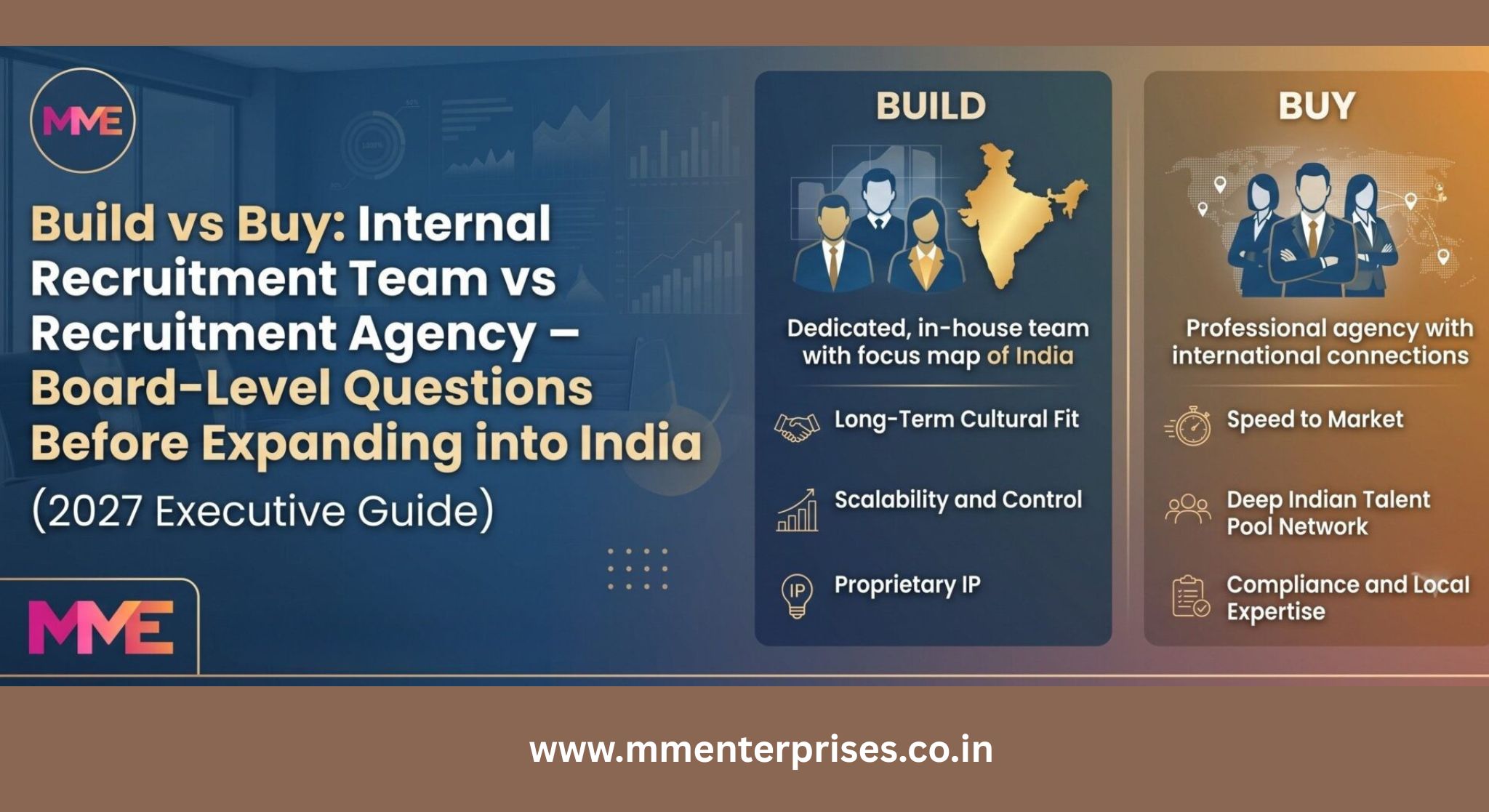
Build vs Buy: Internal Recruitment Team vs Recruitment Agency
Board-Level Questions Before Expanding into India (2027 Executive Guide)
Introduction
India has become one of the world’s most attractive destinations for international business expansion. From global technology companies and manufacturers to healthcare organizations, financial institutions, and Global Capability Centers (GCCs), businesses are choosing India to access a highly skilled workforce, competitive operating costs, and a rapidly growing innovation ecosystem. As organizations accelerate their global expansion strategies, India is increasingly viewed as a strategic talent hub rather than just an outsourcing destination.
However, entering the Indian market presents a critical challenge that extends beyond simply finding qualified candidates. Competition for experienced professionals in sectors such as technology, engineering, life sciences, manufacturing, and finance has intensified significantly. Companies are competing not only with domestic employers but also with multinational corporations that are expanding their presence across major Indian cities. At the same time, boards and investors expect faster market entry, predictable hiring costs, and measurable returns on expansion initiatives.
This creates a complex decision for executive leadership. Should the organization invest in building an internal recruitment team from the ground up, partner with a specialized recruitment agency that understands the Indian talent market, or leverage Employer of Record (EOR) Services in India to hire employees quickly without establishing a local legal entity? Each approach offers distinct advantages, costs, and risks that can directly influence the success of an India expansion strategy.
The decision goes far beyond recruitment. It affects how quickly your business can enter the market, the quality of talent you attract, operational efficiency, employment compliance, employer branding, workforce scalability, and overall time-to-market. Choosing the wrong hiring model can lead to increased recruitment costs, compliance challenges, delayed business operations, and missed growth opportunities.
This executive guide provides a board-level framework to help CEOs, Founders, CHROs, HR Directors, Talent Acquisition Leaders, Global Mobility Teams, and Finance Executives evaluate the most effective hiring strategy for India. You’ll learn when to build an internal recruitment function, when to partner with a recruitment agency, and when Employer of Record (EOR) Services in India offer the fastest, most compliant, and cost-effective route to building a high-performing workforce. By the end of this guide, you’ll have practical decision frameworks, cost comparisons, and strategic insights to choose the hiring model that best supports your long-term business objectives in India.
Read more about our blogs
Section 1
Why This Decision Matters More Than Ever
India’s position in the global talent landscape has evolved dramatically over the past decade. What was once considered a cost-effective outsourcing destination has become a strategic hub for innovation, research, engineering, and business operations. Today, multinational corporations, private equity-backed companies, and high-growth startups are expanding into India to access specialized talent, establish Global Capability Centers (GCCs), and support international growth. This shift has made workforce planning a critical component of corporate expansion strategies.
One of the biggest drivers behind this trend is the rapid growth of Global Capability Centers. Organizations across technology, healthcare, manufacturing, banking, automotive, and life sciences are establishing GCCs in India to manage engineering, product development, finance, customer support, and digital transformation initiatives. These centers require the rapid hiring of highly skilled professionals, making recruitment speed a competitive advantage.
At the same time, demand for AI professionals, software engineers, cybersecurity specialists, semiconductor experts, data scientists, and cloud architects continues to outpace supply. Although India produces a large number of graduates each year, experienced professionals with niche technical expertise remain highly competitive. Companies entering the market often find themselves competing against established multinational employers with strong employer brands and attractive compensation packages.
Adding to the challenge is India’s regulatory environment. Employment contracts, payroll, taxation, statutory benefits, labor laws, and employee compliance requirements differ significantly from those in North America, Europe, and other international markets. A single compliance mistake can result in financial penalties, operational delays, or reputational damage. As a result, many global organizations are increasingly adopting Employer of Record (EOR) Services in India to hire employees quickly while ensuring full compliance with local employment regulations.
Remote and hybrid work models have further transformed hiring strategies. Businesses are no longer limited to recruiting talent from one metropolitan area. Instead, they are building distributed teams across Bengaluru, Hyderabad, Pune, Chennai, Delhi NCR, Ahmedabad, and emerging technology hubs. While this expands access to talent, it also increases the complexity of payroll administration, statutory compliance, onboarding, and workforce management.
These market realities explain why recruitment is no longer viewed solely as an HR responsibility. Today, hiring decisions directly influence business expansion timelines, revenue growth, investor expectations, operational efficiency, and long-term competitiveness. Boards, CEOs, CHROs, CFOs, and Global Mobility Leaders are now actively evaluating whether to build an internal recruitment team, partner with recruitment specialists, or leverage Employer of Record (EOR) Services in India to achieve faster, compliant, and scalable expansion.
Table
Global Expansion Priorities
| Business Goal | Hiring Impact |
| Faster market entry | Faster recruitment required |
| Cost optimization | Reduce hiring expenses |
| Compliance | Avoid employment risks |
| Scalability | Hire across multiple cities |
| Investor confidence | Predictable workforce growth |
Section 2
Build vs Buy: Understanding Both Hiring Models
Choosing between building an internal recruitment function and partnering with an external hiring partner is one of the first strategic decisions companies make when expanding into India. The right approach depends on hiring volume, expansion timelines, internal capabilities, compliance requirements, and long-term business objectives. While some organizations benefit from developing an in-house talent acquisition team, others achieve faster results by working with recruitment agencies or leveraging Employer of Record (EOR) Services in India for end-to-end workforce management.
Below is a detailed comparison of both hiring models.
Option A: Build an Internal Recruitment Team
An internal recruitment team manages the entire hiring lifecycle within the organization. This model is typically suitable for companies planning a long-term presence in India with continuous hiring requirements.
What Does an Internal Recruitment Team Include?
- Talent Acquisition Managers
- Recruitment Specialists
- HR Business Partners
- Employer Branding Professionals
- HR Operations Team
- Recruitment Coordinators
- Applicant Tracking System (ATS)
- Recruitment Marketing Resources
Advantages of Building an Internal Recruitment Team
1. Greater Control Over Hiring
The company controls every stage of recruitment, from sourcing candidates to onboarding, ensuring alignment with corporate culture and business goals.
2. Strong Employer Branding
An internal team can consistently communicate the company’s values, mission, and employee value proposition, helping attract high-quality talent.
3. Better Candidate Experience
Direct communication with applicants often results in a more personalized recruitment process and stronger relationships with potential employees.
4. Long-Term Cost Efficiency
For organizations hiring hundreds of employees annually, maintaining an internal recruitment function can become more economical over time than paying repeated agency fees.
5. Improved Workforce Planning
Internal recruiters work closely with department heads, enabling better forecasting of hiring needs and succession planning.
Challenges of Building an Internal Recruitment Team
- High initial investment in HR personnel and recruitment technology.
- Longer time required to establish recruitment operations.
- Limited access to passive or specialized candidates.
- Ongoing training and recruiter retention costs.
- Full responsibility for employment law compliance.
- Slower expansion into new geographic markets.
Option B: Partner with a Recruitment Agency
Recruitment agencies specialize in sourcing, screening, and presenting qualified candidates across industries and job functions. They maintain extensive talent networks and market intelligence, enabling companies to hire more efficiently.
Services Typically Offered
- Permanent Recruitment
- Executive Search
- Industry-Specific Hiring
- Talent Mapping
- Market Intelligence
- Salary Benchmarking
- Bulk Hiring
- Candidate Screening
Advantages of Partnering with a Recruitment Agency
1. Faster Hiring
Recruitment agencies have ready access to active and passive candidates, significantly reducing time-to-hire.
2. Access to Specialized Talent
Experienced recruiters understand niche industries and maintain relationships with difficult-to-find professionals.
3. Lower Internal Resource Requirements
Organizations can focus on business expansion while the agency manages sourcing, screening, interview coordination, and candidate engagement.
4. Market Expertise
Recruitment consultants provide valuable insights into salary trends, talent availability, competitor hiring strategies, and local employment conditions.
5. Flexible Hiring Support
Companies can scale recruitment activities up or down depending on hiring demand without expanding their internal HR team.
Challenges of Using a Recruitment Agency
- Recruitment fees may increase for high-volume hiring.
- Limited control over the candidate sourcing process.
- Employer branding depends partly on the agency’s representation.
- Most agencies focus only on recruitment and do not manage payroll, employment contracts, statutory compliance, or employee administration.
For companies entering India without establishing a legal entity, combining recruitment expertise with Employer of Record (EOR) Services in India offers a more comprehensive solution by covering recruitment, compliant employment, payroll, statutory benefits, tax administration, and ongoing HR support.
Build vs Buy Comparison
| Factor | Internal Recruitment Team | Recruitment Agency |
| Hiring Speed | Moderate; requires internal setup and sourcing | Fast; immediate access to talent networks |
| Initial Investment | High | Low to Moderate |
| Recruitment Expertise | Depends on internal team | Specialized industry knowledge |
| Candidate Reach | Limited to internal sourcing capabilities | Extensive active and passive talent pools |
| Employer Branding | Full organizational control | Shared with recruitment partner |
| Hiring Scalability | Slower to scale | Easily scalable for project or bulk hiring |
| Technology Investment | Company purchases ATS and recruitment tools | Included within agency services |
| Market Intelligence | Built internally over time | Immediate access to salary and hiring insights |
| Compliance Responsibility | Managed internally | Limited recruitment support only |
| Best Fit | Long-term, continuous hiring | Rapid hiring and specialized recruitment |
Section 3
Board-Level Questions Before Choosing Either Model
Before deciding whether to build an internal recruitment team, partner with a recruitment agency, or adopt Employer of Record (EOR) Services in India, leadership teams should evaluate the following strategic questions.
1. How quickly do we need to hire?
If your expansion timeline is measured in weeks rather than months, a recruitment agency or Employer of Record (EOR) Services in India can significantly reduce time-to-hire.
2. What is our expected hiring volume?
High-volume, long-term hiring may justify building an internal recruitment team, while smaller or project-based hiring is often better suited to external partners.
3. Are we establishing a legal entity in India?
If not, Employer of Record (EOR) Services in India allow you to hire employees legally without setting up a local subsidiary.
4. Do we understand the Indian talent market?
Companies with limited local hiring experience can benefit from recruitment specialists who understand salary benchmarks, talent availability, and hiring practices.
5. Can we manage employment compliance?
Indian labor laws, payroll regulations, and statutory requirements are complex. If compliance expertise is limited, an EOR can reduce operational and legal risks.
6. What is our recruitment budget?
Evaluate the total cost of recruiters, HR technology, employer branding, and compliance before choosing an in-house hiring model.
7. How important is scalability?
If hiring needs are likely to increase rapidly across multiple cities, choose a model that can scale without significantly increasing internal resources.
8. What level of control do we require?
An internal recruitment team provides greater control over hiring processes, while recruitment agencies and EOR providers offer speed, expertise, and operational efficiency.
Executive Decision Checklist
- □ Do we need to hire within the next 30–60 days?
- □ Will we hire more than 50 employees annually?
- □ Do we have an Indian legal entity?
- □ Does our HR team understand Indian employment laws?
- □ Is rapid market entry a business priority?
- □ Do we need to reduce compliance risks?
- □ Will hiring expand across multiple Indian cities?
- □ Have we evaluated Employer of Record (EOR) Services in India as an alternative?
Section 4
Total Cost of Building an Internal Recruitment Function
Building an internal recruitment team involves more than hiring recruiters. Companies must invest in HR technology, employer branding, recruitment marketing, compliance, and ongoing operational support. These costs can increase significantly during the first year of expansion.
Key Cost Components
- Recruitment Team Salaries
- HR Manager & HR Operations
- Applicant Tracking System (ATS)
- LinkedIn Recruiter & Job Portals
- Employer Branding Campaigns
- Recruitment Marketing
- HR Software & Payroll Systems
- Training & Development
- Legal & Compliance Support
- Office Infrastructure & Administration
Estimated Annual Cost
| Cost Category | Estimated Annual Cost (USD) |
| Recruiter Salaries | $40,000–$80,000 |
| HR Manager | $25,000–$50,000 |
| ATS & Recruitment Software | $5,000–$15,000 |
| LinkedIn Recruiter & Job Portals | $6,000–$12,000 |
| Employer Branding & Marketing | $8,000–$20,000 |
| Legal & Compliance | $10,000–$25,000 |
| HR Technology & Payroll Tools | $5,000–$15,000 |
| Training & Administration | $5,000–$10,000 |
| Estimated Total | $104,000–$227,000 |
Section 5
Cost of Partnering with a Recruitment Agency
Partnering with a recruitment agency allows businesses to hire experienced professionals without investing in a full internal recruitment infrastructure. Costs are typically based on the hiring model and the number of positions being filled.
Common Recruitment Agency Pricing Models
1. Success-Based Hiring
The agency charges a fee only after a candidate is successfully hired. This is the most common model for permanent recruitment.
2. Retained Search
A fixed fee is paid upfront for executive or confidential leadership hiring, regardless of the hiring timeline.
3. Recruitment Process Outsourcing (RPO)
The agency manages all or part of the recruitment process for a monthly fee or project-based pricing.
4. Project or Bulk Hiring
Suitable for companies hiring multiple employees within a short period, offering cost efficiencies for high-volume recruitment.
Advantages
- Faster access to qualified candidates
- Reduced time-to-hire
- Industry-specific recruitment expertise
- Lower investment in HR technology and recruitment tools
- Flexible hiring based on business needs
- Access to salary benchmarking and market insights
Limitations
- Recruitment fees can increase with multiple hires.
- Limited control over candidate sourcing.
- Most agencies do not manage payroll, employment contracts, or statutory compliance.
Best Fit
A recruitment agency is ideal for companies that need to fill specialized or multiple positions quickly. However, if your business also requires compliant employment, payroll management, tax administration, and employee benefits without setting up a legal entity, Employer of Record (EOR) Services in India provide a more comprehensive workforce solution beyond recruitment alone.
Section 6
Where Employer of Record (EOR) Fits Into the Decision
Many global companies compare an internal recruitment team with a recruitment agency. However, there is a third option that combines recruitment support with compliant employment—Employer of Record (EOR) Services in India.
An EOR enables companies to hire employees in India without establishing a local legal entity, while managing employment compliance and HR administration.
What Does an Employer of Record (EOR) Handle?
1. Legal Employment
The EOR becomes the legal employer, allowing you to hire quickly without incorporating a business in India.
2. Payroll Management
Processes monthly payroll, tax deductions, and statutory contributions accurately and on time.
3. Employment Contracts
Prepares locally compliant employment agreements that align with Indian labor laws.
4. Statutory Compliance
Manages labor law compliance, social security contributions, leave policies, and government filings.
5. Employee Benefits
Administers mandatory and optional employee benefits, including insurance and leave entitlements.
6. Onboarding & Offboarding
Supports employee onboarding, documentation, and compliant exit management.
7. HR Administration
Handles day-to-day HR support, employee records, and workforce documentation.
Comparison Table
| Capability | Internal Team | Recruitment Agency | Employer of Record (EOR) Services in India |
| Candidate Recruitment | ✓ | ✓ | ✓ |
| Employment Contracts | ✓ | ✗ | ✓ |
| Payroll Processing | ✓ | ✗ | ✓ |
| Tax & Statutory Compliance | ✓ | ✗ | ✓ |
| Employee Benefits | ✓ | ✗ | ✓ |
| HR Administration | ✓ | ✗ | ✓ |
| Legal Employer | ✗ | ✗ | ✓ |
| No Local Entity Required | ✗ | ✗ | ✓ |
Section 7
Decision Matrix for Different Business Scenarios
Every business has different expansion goals, hiring volumes, and compliance requirements. The table below helps determine the most suitable hiring model based on common business scenarios.
Scenario 1: Startup Entering India
Situation: Hiring 5–20 employees quickly without setting up a legal entity.
Recommendation: Employer of Record (EOR) Services in India
Scenario 2: Mid-Sized Company Expanding Operations
Situation: Hiring 20–100 employees across multiple departments.
Recommendation: Recruitment Agency + Employer of Record (EOR) Services in India
Scenario 3: Large Enterprise Establishing a GCC
Situation: Long-term expansion with continuous hiring.
Recommendation: Build an Internal Recruitment Team, supported by recruitment agencies for niche roles.
Scenario 4: Project-Based or Seasonal Hiring
Situation: Temporary workforce for a fixed-duration project.
Recommendation: Employer of Record (EOR) Services in India
Scenario 5: Executive or Specialized Hiring
Situation: Recruiting senior leaders or highly specialized professionals.
Recommendation: Executive Search Recruitment Agency
Decision Matrix
| Business Situation | Recommended Hiring Model |
| 5–20 employees | Employer of Record (EOR) Services in India |
| 20–100 employees | Recruitment Agency + EOR |
| 100+ employees | Internal Recruitment Team |
| Temporary or Contract Hiring | Employer of Record (EOR) Services in India |
| Executive Leadership Hiring | Recruitment Agency |
| No Legal Entity in India | Employer of Record (EOR) Services in India |
| Rapid Market Entry | Employer of Record (EOR) Services in India |
Section 8
Common Mistakes Global Companies Make
Many international companies face delays and unexpected costs because of avoidable hiring mistakes. Recognizing these risks early can improve the success of your India expansion.
1. Delaying Workforce Planning
Waiting until after market entry to begin hiring can slow business operations and increase recruitment costs.
2. Underestimating Compliance Requirements
Ignoring Indian labor laws, payroll regulations, and statutory obligations can result in legal and financial risks. Employer of Record (EOR) Services in India help ensure compliant hiring from day one.
3. Choosing Cost Over Quality
Selecting the lowest-cost recruitment partner may lead to poor candidate quality, higher attrition, and repeated hiring expenses.
4. Ignoring Salary Benchmarks
Offering non-competitive compensation makes it difficult to attract and retain skilled professionals in a competitive market.
5. Hiring Without a Scalable Strategy
Using different hiring methods for each role creates inconsistent processes and operational inefficiencies as the business grows.
6. Neglecting Employer Branding
A weak employer brand can reduce candidate interest and increase the time required to fill critical positions.
7. Overlooking Employee Onboarding
Poor onboarding impacts productivity, employee engagement, and long-term retention.
Section 9
Board-Level India Expansion Checklist
Provide downloadable-style checklist.
Examples:
✔ Expansion objectives defined
✔ Hiring forecast prepared
✔ Salary benchmark completed
✔ Compliance assessed
✔ Recruitment partner selected
✔ Payroll strategy ready
✔ Employment contracts reviewed
✔ EOR evaluated
✔ Budget approved
✔ Leadership hiring completed
Section 10
Executive Summary
Building an internal recruitment function works well for companies with long-term hiring volume, established HR capabilities, and a permanent presence in India. Recruitment agencies accelerate access to specialized talent and reduce time-to-hire, making them valuable for focused or executive hiring. For organizations entering India without a legal entity, an Employer of Record (EOR) combines recruitment support with compliant employment, payroll, benefits administration, and statutory compliance, allowing teams to become operational much faster while reducing administrative complexity.
Emphasize that the optimal approach depends on hiring scale, expansion timeline, compliance requirements, and long-term business objectives rather than a one-size-fits-all solution.
Ready to Build Your Team in India?
Whether you’re evaluating an internal recruitment function, selecting a recruitment partner, or considering an Employer of Record (EOR), making the right workforce decision early can reduce hiring costs, accelerate market entry, and minimize compliance risks.
MM Enterprises supports global organizations with:
- Recruitment Services across multiple industries
- Employer of Record (EOR) Services in India
- Executive Search
- Payroll & HR Compliance
- India Market Entry Hiring Strategy
- Talent Mapping & Salary Benchmarking
Download our free “India Expansion Hiring Decision Toolkit” or schedule a consultation to determine the most effective hiring model for your business goals.